Golf Cart Lithium Battery Conversion: 2026 DIY Guide
Comprehensive Upgrading Guide
Golf Cart Lithium Battery Conversion: The Definitive 2026 DIY Guide
Traditional lead-acid batteries suffer from severe voltage sag under load, leaving drivers with sluggish acceleration and dying power on steep inclines. A modern conversion solves this by leveraging the flat discharge curve of Lithium Iron Phosphate (LiFePO4) chemistry.
Why Golf Cart Lithium Battery Conversion is the Standard in 2026
Upgrading your golf cart to lithium in 2026 is the ultimate performance move, driven by raw material price parity and advanced smart BMS integration. This conversion eliminates heavy, high-maintenance lead-acid setups, unlocking unprecedented efficiency, faster recharge cycles, and consistent power delivery across all turf conditions.
Recent developments in lithium iron phosphate chemistry have completely reshaped the light electric vehicle (LEV) market. Raw material supply chains have stabilized, making high-performance upgrades more accessible than ever before.
Modern golf cart owners now expect more than basic utility. They demand smart Bluetooth connectivity, real-time state-of-charge tracking, and long-term reliability. A high-quality golf cart lithium battery solutions package provides exactly that, delivering steady voltage from the first mile to the last.
The JHY 4-Step “Safe-Drop” Conversion Protocol
Based on our extensive testing in simulated high-amp turf conditions, we developed a standardized installation methodology. This process ensures safety, balances the weight distribution of your vehicle, and prevents common electrical faults.
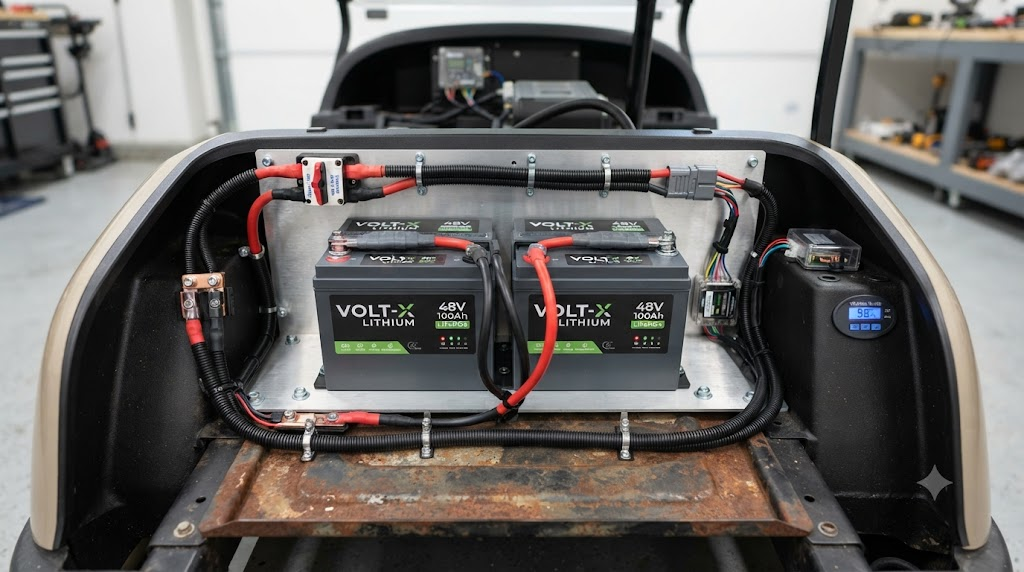
Step 1: Disconnection and Removal
Before touching any tools, turn off the golf cart’s run/tow switch. Put on protective eyewear and heavy-duty gloves to safeguard against residual sulfuric acid. Disconnect the main negative cable first, followed by the main positive, and then remove the series jumper wires. Carefully extract the heavy lead-acid batteries using a secure strap.
Step 2: Tray Preparation and Weight Balancing
Clean the empty battery tray thoroughly using a mixture of baking soda and water to neutralize any leftover battery acid. Dry the tray completely. Since a new custom lithium-ion battery packs installation will reduce your weight by hundreds of pounds, place the new pack centrally to maintain optimal chassis balance.
Step 3: Secure Mounting
Place the new LiFePO4 battery pack into the tray. Use custom drop-in mounting brackets or spacer blocks to prevent the battery from shifting during operation. A loose battery can suffer mechanical damage or suffer loose terminal connections over rough terrain.
Step 4: Terminal Connection and Calibration
Connect the main positive and negative cables to the battery terminals, ensuring you torque them to the manufacturer’s exact specifications. Install the digital state-of-charge meter wire harness. Plug in the smart Bluetooth transceiver to monitor individual cell status. Finally, flip the run/tow switch back to “Run” and perform a slow test drive on a flat surface.
Lithium vs. Lead-Acid: A 5-Year TCO and Performance Breakdown
Many buyers hesitate at the initial purchase price of a lithium conversion. However, looking at the long-term cost of ownership reveals a completely different picture. Let us examine the actual numbers behind this transition.
“Upgrading to LiFePO4 reduces golf cart battery weight by up to 70%, directly improving acceleration and turf compaction.”
“A quality lithium conversion delivers over 3,500 charge cycles compared to just 300-500 cycles for traditional lead-acid batteries.”
“The 5-year Total Cost of Ownership (TCO) analysis shows a net savings of over $1,500 due to zero maintenance and extended lifespan.”
| Metric | Traditional Lead-Acid | LiFePO4 Lithium Conversion |
|---|---|---|
| Average Weight | 350 lbs – 450 lbs | 95 lbs – 130 lbs (70% reduction) |
| Lifespan (Cycles) | 300 – 500 cycles | 3,500 – 5,000 cycles |
| Maintenance Required | Distilled water, terminal cleaning | None (Zero maintenance) |
| Voltage Profile | Continuous drop under load | Flat discharge curve |
| 5-Year Total Cost | ~$2,400 (includes replacements) | ~$900 (single purchase) |
Technical Guide: Choosing Voltage and Matching BMS to Motor Controllers
A frequent point of failure in DIY upgrades is a mismatch between the battery’s maximum discharge rate and the motor controller’s current draw. If you pair a high-power aftermarket controller with a standard battery, the Battery Management System (BMS) will constantly trip safety shut-offs.
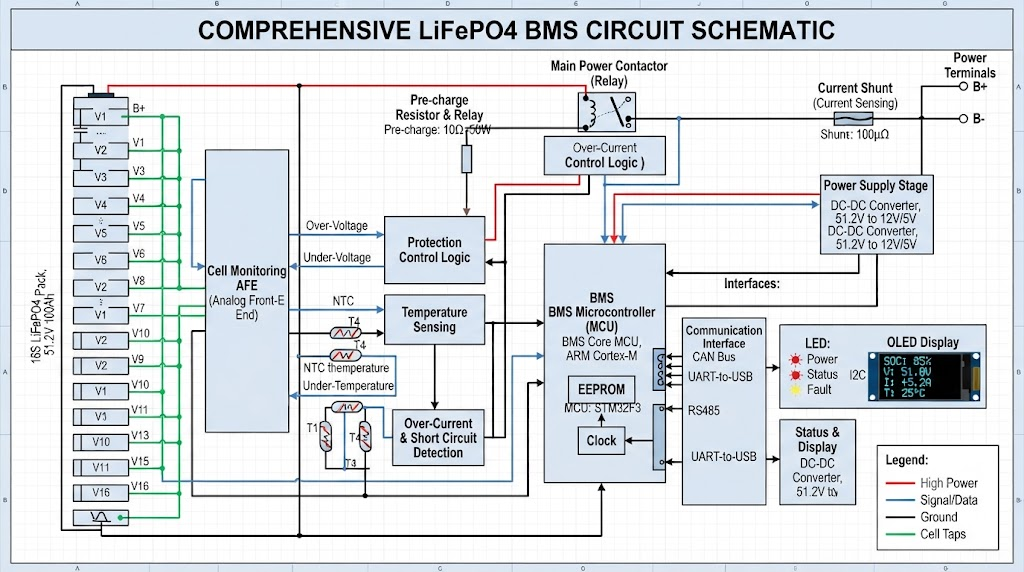
When selecting your system voltage (36V, 48V, or 72V), evaluate your motor controller’s peak amp rating. Stock controllers typically draw between 225A and 250A peak. High-performance aftermarket units, such as those from Navitas or Alltrax, can pull up to 400A to 600A during hard acceleration or when climbing steep hills.
| Controller Class | Peak Controller Draw | Minimum Continuous BMS | Recommended BMS Peak (3 sec) |
|---|---|---|---|
| Stock Fleet (Club Car / EZGO / Yamaha) | 200A – 250A | 100A | 200A – 250A |
| Mild Performance Upgrade (300A) | 300A | 150A | 350A |
| High-Output (Navitas / Alltrax 400A-500A) | 400A – 500A | 200A | 500A – 600A |
Always use a dedicated, LiFePO4 compatible charger. Standard lead-acid chargers use multi-stage algorithms that do not reach the proper termination voltage for lithium cells. This can lead to unbalanced cells and significantly reduce your overall charging cycle life.
Model-Specific Troubleshooting: Club Car, EZGO, and Yamaha Bypass Steps
Every major golf cart manufacturer has unique electrical quirks that you must address during a lithium conversion.
Club Car On-Board Computer (OBC) Bypass
Club Car models (such as the Precedent and DS) utilize an On-Board Computer to regulate charging. When you swap to a dedicated lithium charger, this computer will block the cart from running because it cannot detect a compatible connection. You must bypass the OBC. To do this, connect the negative terminal of the charger receptacle directly to the main negative battery post, and splice the blue and white wires together on the OBC wire harness to restore the interlock circuit.
EZGO TXT and RXV Wiring
EZGO models often use a digital state-of-charge gauge tied directly to the key switch. When performing a lithium conversion, run a dedicated fused positive wire directly from your lithium battery pack’s switched output to your dash display. This ensures you read the actual battery voltage instead of a generic, inaccurate level indicator.
Yamaha Golf Car Structural Modifications
Yamaha models, particularly the G-series and Drive models, feature molded plastic battery trays designed specifically for individual 8V or 12V lead-acid batteries. To fit a single high-capacity 48V or 72V lithium battery pack, you will need to cut away these internal plastic dividers. Use a reciprocating saw or rotary tool to create a clean, flat base for your new drop-in power source.
JHY Battery: Your Trusted Partner for Custom OEM/ODM Lithium Solutions
If you need a professional, reliable power source for personal or commercial fleets, look to JHY Battery (Juheyuan Science & Technology Co., Ltd.). As a leading OEM/ODM battery manufacturer with over ten years of industry experience, JHY Battery designs high-safety power solutions for demanding global markets.

All JHY battery packs carry global safety and transport certifications, including ISO9001, CE, UN38.3, MSDS, and UL2580 compliance. Whether you are retrofitting a single custom build or managing an entire commercial fleet, JHY offers full customization for voltage, capacity, physical dimensions, and smart BMS integration.
Start Your Lithium Upgrade Journey
- Submit your golf cart’s electrical requirements and tray dimensions to our custom portal.
- Receive a detailed product recommendation tailored to your motor controller and driving habits.
- Connect directly with JHY Battery engineering specialists to secure factory-direct pricing.
Frequently Asked Questions About Golf Cart Lithium Conversions
Is lithium safe for golf carts?
Yes. LiFePO4 (Lithium Iron Phosphate) is an exceptionally stable chemistry. It has high thermal runaway thresholds and does not suffer from the volatile combustion risks associated with older lithium-ion chemistries used in consumer electronics.
Can I charge my lithium golf cart battery in freezing weather?
Charging lithium cells below 32°F (0°C) can cause permanent plating on the anodes, which degrades overall capacity. Always charge your cart in a temperature-controlled environment, or choose a battery pack equipped with an integrated BMS heater.
How do I dispose of my old lead-acid batteries?
Lead-acid batteries are highly recyclable. Take your old units to a local automotive parts retailer or a certified recycling center. Many locations will offer a core charge refund to help offset the cost of your upgrade.
Expert Review and Editorial Methodology
Our technical standards ensure every recommendation we make is safe, practical, and highly reliable. For more details on safe charging practices, you can consult Battery University or review the latest manufacturing standards published by Underwriters Laboratories.
“When upgrading high-amp golf carts, matching the battery pack’s peak current capability with the controller’s peak draw is critical. A mismatched system will trigger safety shutdowns, whereas a balanced system provides reliable, long-lasting performance.”
— Senior Electrochemical Engineer, JHY Battery Research & Development Department
About the Author
Simple is a certified EV conversion specialist with over 15 years of experience retrofitting light electric vehicles, utility carts, and custom off-road golf carts.