High-Drain 18650 Batteries for Power Tools: Pack Guide
The 5-Tier High-Drain Power Tool Battery Selection Matrix
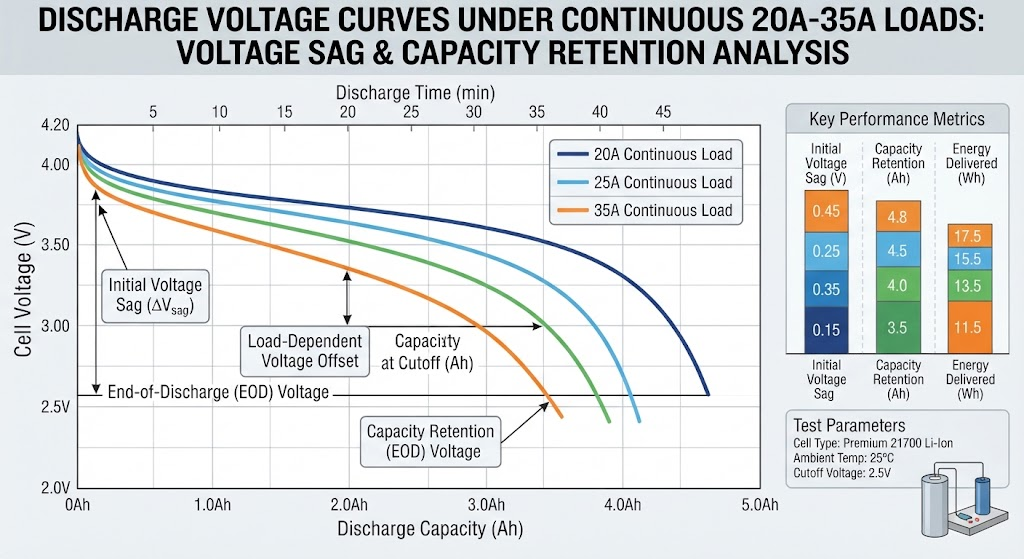
Selecting high-drain 18650 batteries for power tools requires balancing continuous discharge amperage (20A to 35A), internal AC impedance (under 12mΩ), and thermal dissipation ceilings. High-drain cells must sustain sudden inrush currents without dropping below the tool inverter’s undervoltage threshold or exceeding internal safety limits.
In our manufacturing experience across millions of industrial packs, high-drain cell selection cannot rely solely on nameplate milliamp-hour (mAh) ratings. Heavy industrial loads generate intense electro-thermal stress that causes voltage sag and accelerates cell degradation if the cell’s internal architecture is mismatched to the motor’s power curve.
To establish a repeatable engineering standard for cordless equipment OEMs, we developed The 5-Tier High-Drain Power Tool Battery Selection Matrix. This framework evaluates cells across electrochemical, thermal, protection, mechanical, and quality metrics.
| Selection Dimension | Target Specification | Engineering Impact | Failure Risk If Ignored |
|---|---|---|---|
| 1. Electrochemical Stall Tolerance | CDR ≥ 25A; Pulse ≥ 45A (5s); AC IR ≤ 12mΩ (1kHz) | Maintains terminal voltage > 3.0V under peak tool torque and stall conditions. | Premature low-voltage cutoff, tool stalling under heavy load, reduced peak torque. |
| 2. Thermal Dissipation Margin | ΔT ≤ 35°C rise at 20A continuous; Core temp ≤ 75°C | Prevents active separator breakdown and electrolyte decomposition during rapid duty cycles. | Thermal runaway, accelerated capacity fade, BMS over-temperature lockout. |
| 3. Interconnect Joule Efficiency | Joint resistance ≤ 0.3mΩ; 0.2mm–0.3mm pure nickel / Cu-Ni | Minimizes I²R conductive losses across series busbars at high current. | Busbar desoldering, localized hotspot formation, melted plastic enclosures. |
| 4. Dynamic Ruggedization | Cell gap ≥ 1.0mm; UL94-V0 cell cage; Drop test ≥ 2.0m | Isolates mechanical shock from high-impact hammering tools and drops. | Internal cell short circuits, tab breakage, weld fatigue fracture. |
| 5. Industrial Cell Traceability | ΔIR ≤ 1.5mΩ; ΔV ≤ 5mV; 300 PPM (≤0.03%) defect rate | Ensures balanced series degradation across 800+ high-drain duty cycles. | Early pack death caused by single out-of-balance cell tripping undervoltage. |
Electrochemical Fundamentals: INR, NMC, and Voltage Sag Dynamics
Cordless power tools demand distinct lithium-ion electrochemistry compared to energy-dense consumer electronics. While consumer cells maximize volumetric energy density using thick active material coatings, high-drain cells utilize thin, highly porous electrode coatings on Lithium Nickel Manganese Cobalt Oxide (LiNiMnCoO2 or INR/NMC) cathodes to accelerate lithium-ion transport kinetics.
Voltage Sag Definition: The instantaneous reduction in cell output voltage below its open-circuit potential when an external load is applied, governed by Ohm’s Law and polarization overpotential: Vterminal = OCV – I × (Rohmic + Rcharge_transfer + Rdiffusion).
When a brushless power tool motor draws a 30A pulse, a standard cell with an internal resistance (IR) of 35mΩ experiences a direct ohmic drop of 1.05V per cell. In a 5S1P (18V nominal, 21V peak) pack, this amounts to a 5.25V drop across the pack. This instantly pushes terminal voltage below the typical 15.0V low-voltage motor cutout, shutting down the tool even when the pack is at 70% state of charge.
By contrast, Grade-A high-drain 18650 cells engineered by JHY Battery feature an AC internal resistance below 12mΩ. At 30A continuous draw, total ohmic loss across the 5S string remains under 1.8V, allowing the motor to sustain full operating RPM and deliver rated torque throughout the discharge curve.
Thermal Dissipation and Busbar Interconnect Engineering for High-Amp Packs
Joule heating inside a high-drain battery pack scales with the square of the discharge current (Ploss = I2R). Delivering a sustained 25A through a 5S2P pack dissipates substantial heat through both cell cores and series interconnects.
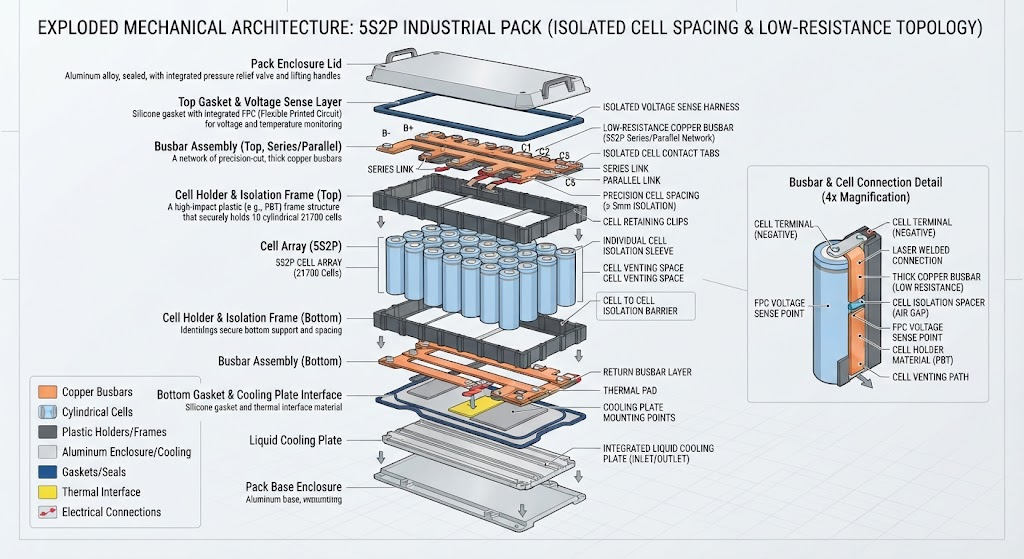
Standard 0.15mm nickel-plated steel strips cannot handle these current densities. At 25A, nickel-plated steel strips exhibit excessive resistance, creating localized hotspots exceeding 90°C at the weld junctions. This thermal concentration degrades the cell’s top seal and risks thermal runaway.
For industrial-grade custom lithium battery packs, JHY Battery implements several specialized thermal and mechanical design rules:
- Interconnect Sizing: We use 0.20mm to 0.30mm pure nickel strips (purity > 99.6%) featuring center-slit stress-relief geometry, or copper-nickel composite busbars to keep inter-cell resistance below 0.3mΩ.
- Cell Spacing: Mandatory cell-to-cell structural air gaps (≥1.0mm) within flame-retardant (UL94-V0) polycarbonate/ABS cradles prevent heat cascading between adjacent cells.
- Thermal Dissipation: Convective airflow channels integrated into the pack casing guide motor-fan exhaust or ambient air across cell surfaces, capping core temperature rise at ≤35°C during heavy cycling.
Extreme Niche Engineering: High-Torque Brushless Tools Under Extreme Abuse
Cordless rotary hammers, brushless 9-inch angle grinders, and concrete cut-off saws present some of the harshest operating conditions in the battery industry. These tools subject battery assemblies to continuous harmonic vibrations (10Hz–2000Hz), mechanical drop shocks exceeding 50G, and cyclic motor stall surges reaching 45A to 60A in jobsite temperatures ranging from -20°C to +60°C.
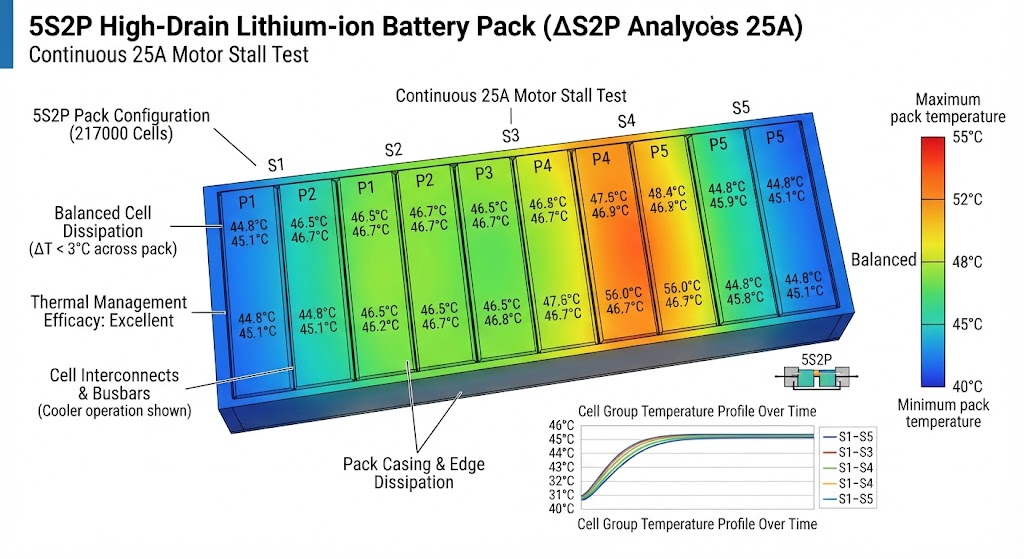
Off-the-shelf consumer battery assemblies often fail within 50 to 100 cycles under these conditions due to spot-weld shear fatigue, internal anode delamination, or premature BMS overcurrent tripping.
Smart BMS Architecture and High-Current Protection Strategies
A power tool Battery Management System (BMS) must provide rigorous safety without interrupting demanding cutting or drilling operations. Standard protection circuits with slow response times either trip unnecessarily during routine motor starts or react too slowly to prevent cell damage during a true mechanical stall.
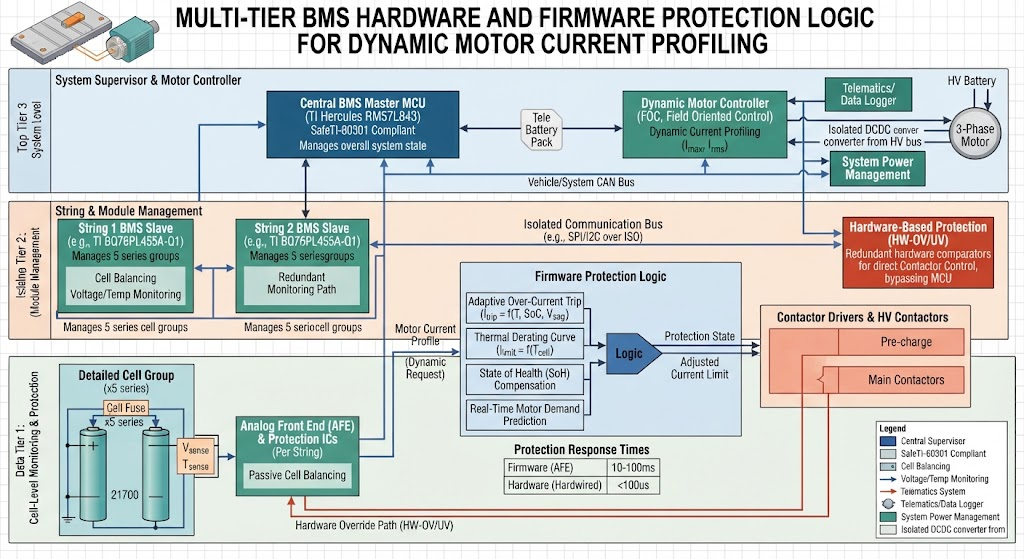
Our engineered smart BMS design incorporates a dual-tier protection architecture that separates short-circuit hardware interrupts from firmware-managed motor overload logic:
- Hardware Short-Circuit Trip (<50µs): Pure analog comparators detect catastrophic short-circuits (>120A) and open gate drives in microseconds, protecting internal cell fuses.
- Dynamic Overcurrent Trip (Tier 2): Multi-stage firmware monitors current vs. time profiles, tolerating 50A motor startup surges for 200ms while isolating sustained overcurrents above 35A within 2 seconds.
- Multi-Point NTC Thermal Telemetry: Dedicated NTC thermistors placed directly on central cell cans and MOSFET heat spreaders trigger progressive current throttling if temperatures reach 75°C.
- Tool-to-Pack Digital Handshake: High-speed UART, SMBus, or CANBUS protocols communicate state-of-charge (SOC), pack health, and live thermal limits directly to the brushless motor controller.
Form Factor Trade-Offs: High-Drain 18650 vs 21700 Cell Migration
Power tool OEMs often evaluate whether to maintain the proven 18650 cylindrical standard or transition to the larger 21700 form factor. Both options offer specific electro-mechanical advantages depending on tool classification and ergonomic requirements.
| Parameter | High-Drain 18650 (e.g., 2500mAh) | High-Drain 21700 (e.g., 4000mAh) | Architectural Trade-Off Analysis |
|---|---|---|---|
| Cell Dimensions / Weight | Ø18.3mm × 65.0mm / ~45g | Ø21.3mm × 70.5mm / ~70g | 18650 enables compact, slim-profile handle integration. |
| Continuous Discharge (CDR) | 25A–30A per cell | 35A–45A per cell | 21700 delivers higher continuous power in 1P configurations. |
| 5S1P Pack Energy / Mass | 45Wh / ~320g total pack | 72Wh / ~490g total pack | 18650 provides a 35% lighter pack for sub-compact tools. |
| 5S2P Pack Energy / Mass | 90Wh / ~620g total pack | 144Wh / ~950g total pack | 18650 5S2P delivers an optimal balance between weight and 50A continuous power. |
For sub-compact drills, multi-tools, and high-dexterity screwdrivers, high-drain 18650 cells remain the industry benchmark for grip balance and ergonomics. For high-demand applications like demolition hammers and table saws, larger 21700 or multi-parallel 18650 configurations provide the required extended runtime.
Precision Manufacturing, Cell Matching & Quality Standards at JHY Battery
In high-discharge series-parallel assemblies, pack longevity depends directly on cell matching consistency. A 2mΩ internal resistance delta between series groups will lead to voltage divergence during aggressive discharge, triggering early undervoltage cutoffs and cutting pack usable life by more than 50%.
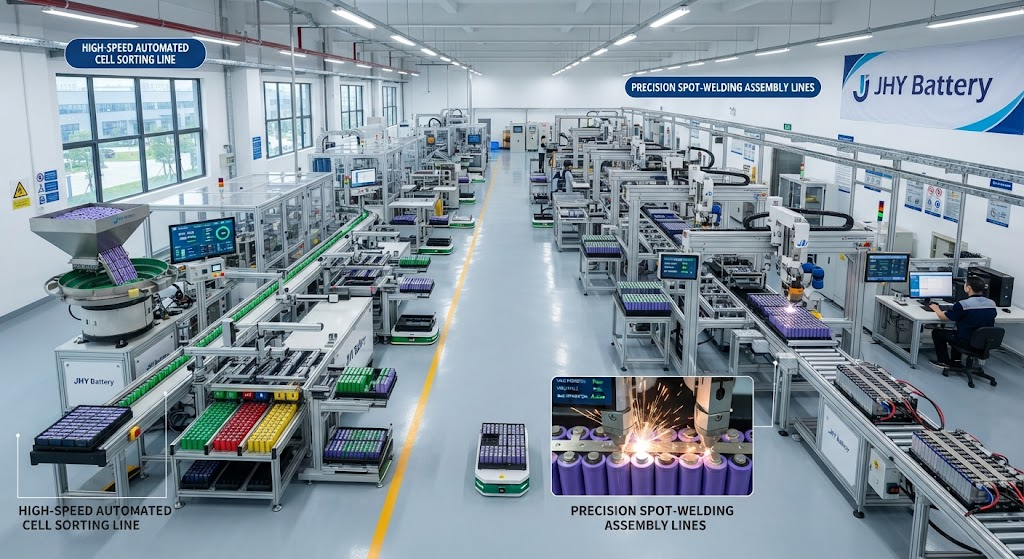
At JHY Battery, our turnkey OEM/ODM battery manufacturing facilities deploy fully automated, Manufacturing Execution System (MES) tracked production:
- Precision Cell Sorting: Every cell undergoes automated OCV and AC IR testing (1kHz) at 25°C ± 0.5°C. We enforce strict sorting criteria of ΔIR ≤ 1.5mΩ and ΔV ≤ 5mV across entire production lots.
- Low Defect Rate Guarantee: Backed by over 30 years of industrial manufacturing, 1,200+ team members, and 800+ hardware and firmware engineers, we maintain a guaranteed 0.03% (300 PPM) defect rate.
- Quality Management Certifications: Production operations comply with both ISO 9001 and ISO 13485 quality management systems, incorporating full lot traceability from raw cell to finished pack testing.
Global Certification & Transport Safety Compliance (UN38.3, UL 2054, IEC 62133)
Bringing commercial power tool packs to international markets requires navigating strict transport and safety compliance frameworks. Cordless power tools must meet rigorous international standards to ensure transport safety and end-user protection.
To avoid customs rejections and testing delays, JHY Battery engineers all custom packs to comply with global battery safety certifications during the initial CAD and BMS layout phases:
- UN 38.3 Transport Testing: Packs must pass eight mandatory abuse tests (T1 Altitude, T2 Thermal Cycling, T3 Vibration, T4 Shock, T5 External Short-Circuit, T6 Impact/Crush, T7 Overcharge, T8 Forced Discharge) per the UNECE Manual of Tests and Criteria.
- IEC 62133-2: Mandatory global safety standard evaluating cell and pack behavior under mechanical drop, continuous charging, thermal abuse, and forced internal short circuits as outlined by the International Electrotechnical Commission.
- UL 2054 / UL 1642: Pack and cell safety standards for commercial and industrial battery-powered appliances, enforced by Underwriters Laboratories.
- Environmental Directives: Full compliance with CE, FCC, KC, CB, RoHS, REACH, and battery recycling directives.
Frequently Asked Questions: High-Drain Power Tool Battery Packs
3-Step Action Plan: Accelerate Your Power Tool Pack Development
Bringing a rugged, high-drain cordless tool pack to market requires clear collaboration between mechanical, electrical, and manufacturing teams. JHY Battery simplifies this with our streamlined engineering process:
- Step 1: Application Sizing & Load Profiling: Submit tool motor operating voltage (12V, 18V, 36V), continuous and stall amperage profiles, mechanical dimensional limits, and runtime targets.
- Step 2: DFM, Thermal Modeling & Custom BMS Layout: JHY Battery engineers simulate thermal dissipation, design the custom PCM/BMS, and optimize busbar welding topology within 48 hours.
- Step 3: Rapid Functional Prototyping & Global Certification: Receive functional, fully tested prototype packs in 5-7 business days ready for tool field validation, drop testing, and UN38.3/UL compliance testing.
Request a Custom Power Tool Battery Pack Engineering Review
Partner with JHY Battery for turnkey OEM/ODM battery packs, fast 5-7 business day functional prototyping, and verified 300 PPM manufacturing quality.
Request Custom Battery Consultation & Prototype Quote
Direct Engineering Contacts: Simple@chinabatterymanufacturer.com | joeshen@chinabatterymanufacturer.com | WhatsApp / B2B Line: +86-18575997879