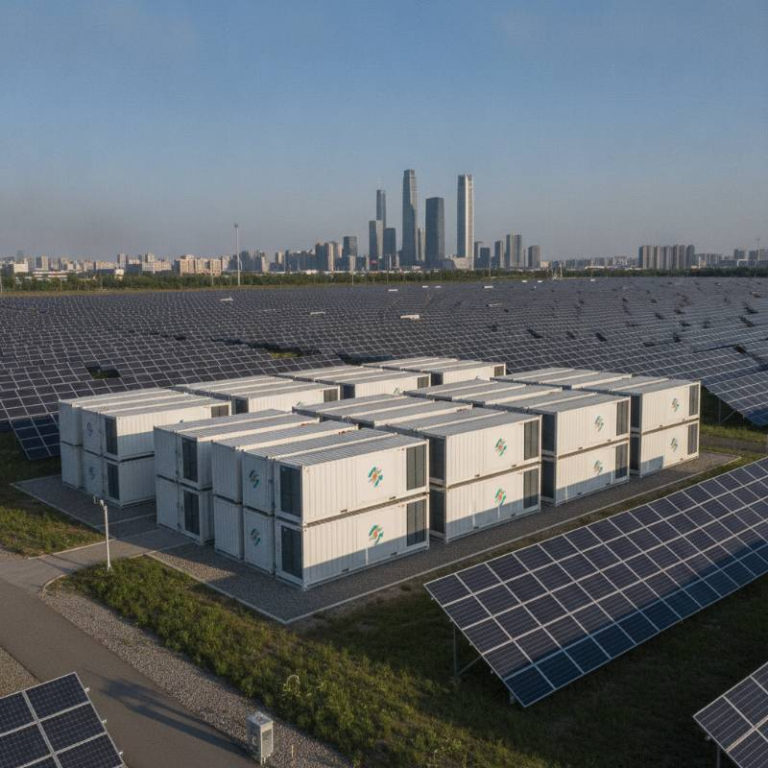
Best Lithium Battery Suppliers for UK Solar Installers
Navigating the UK Residential Battery Storage Market: The Sourcing Shift
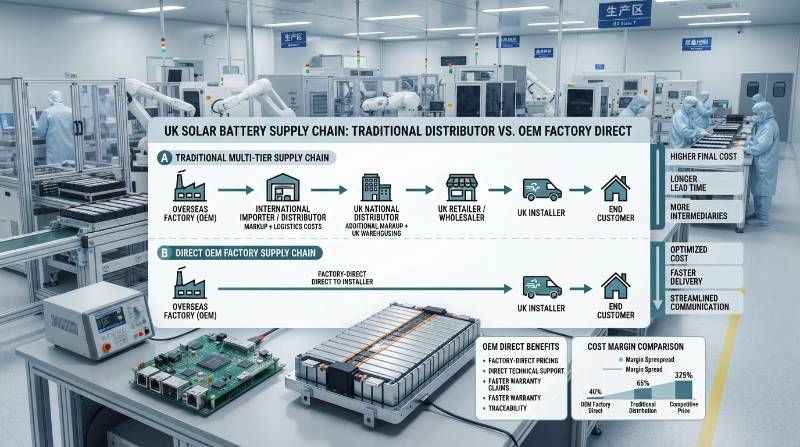
The leading lithium battery suppliers for UK residential solar installers provide factory-direct, Grade-A LiFePO4 systems engineered for strict compliance with PAS 63100:2024 and ENA G98/G99 standards. By bypassing multi-tier wholesale markups through direct OEM/ODM channels, engineering procurement teams secure 28% to 40% margin improvements while obtaining closed-loop inverter firmware compatibility tailored for UK smart export tariffs.
The UK residential solar and storage market is experiencing structural margin compression. Installers face soaring wholesale hardware markups from local intermediaries, even as homeowner demand accelerates due to dynamic time-of-use tariffs like Octopus Agile and Octopus Flux.
For Engineering, Procurement, and Construction (EPC) companies, maintaining healthy installation margins requires re-evaluating the supply chain. Sourcing directly from proven industrial manufacturers of residential and commercial energy storage systems eliminates distributor friction while securing customized hardware optimized for domestic electrical infrastructure.
Critical Sourcing Criteria: Evaluating Tier-1 Lithium Battery Suppliers
Procuring domestic Battery Energy Storage Systems (BESS) demands rigorous technical vetting beyond basic nameplate capacity. System longevity and safety depend fundamentally on cell grade, Manufacturing Execution System (MES) traceability, and balancing architecture.
Cell Provenance, Capacity Sorting, and MES Traceability
Tier-1 manufacturing mandates the exclusive use of automotive Grade-A Lithium Iron Phosphate (LiFePO4) prismatic cells. Lower-tier suppliers frequently blend Grade-B cells or re-wrapped automotive surplus, which suffer from accelerated internal impedance growth and early capacity drift.
Industrial Engineering Standard: High-reliability stationary storage requires cell impedance variance (ΔIR) strictly below ±0.05 mΩ and static voltage variance (ΔV) under ±2 mV across the entire string prior to pack assembly.
Full MES traceability ensures that every individual cell welded into an energy storage module is digitally tracked by QR code from electrode slurry mixing to formation. This automated tracking provides audit-ready data covering initial internal resistance, charge/discharge delta curves, and factory batch yields.
True 6,000-Cycle Warranties vs. Marketing Claims
A legitimate 10-year residential warranty must guarantee a minimum of 6,000 complete cycles at 80% Depth of Discharge (DoD) under 0.5C/0.5C operating conditions at 25°C. Installers should inspect the degradation curve slope:
- Standard Grade-A LFP: Retains ≥80% State of Health (SOH) after 6,000 cycles (approx. 16.4 years of daily cycling).
- Sub-tier LFP / Repurposed Cells: Often drops below 70% SOH before reaching 2,500 cycles due to cathode particle fracturing and electrolyte consumption.
- Defect Thresholds: Top-tier industrial manufacturing operates under a guaranteed ≤0.03% (300 PPM) defect rate backed by fully automated laser welding and computerized end-of-line testing.
UK Regulatory Compliance: PAS 63100:2024, G98/G99, and Safety Standards
Deploying home storage in the UK requires adherence to rigorous national safety, electrical, and grid-connection codes. Non-compliant hardware risks insurer refusal, grid rejection by Distribution Network Operators (DNOs), and direct installer liability.
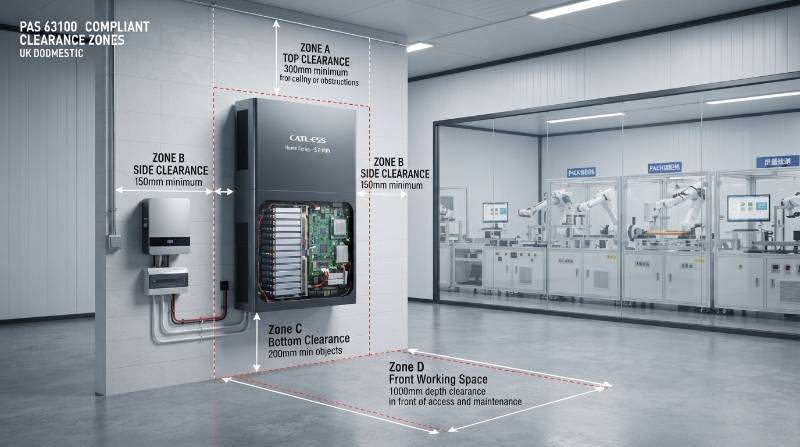
PAS 63100:2024 Installation Clearances & Siting Constraints
Published by the British Standards Institution (BSI), PAS 63100:2024 sets strict requirements for domestic battery placement. It establishes spatial separation rules to prevent fire propagation to habitable rooms, escape routes, and protected corridors.
- Prohibited Locations: Installations in bedrooms, bathrooms, and sole escape routes are prohibited.
- Loft Deployments: Permitted only when access stairs meet specific building control egress codes, thermal insulation prevents sub-zero freezing, and smoke/heat detection interlinks with the primary fire alarm.
- Garage & External Clearance: Requires minimum non-combustible separation distances between the ESS enclosure, window reveals, and external doors.
ENA Engineering Recommendations G98 and G99
Every grid-tied battery storage inverter combination must hold type-test certification under Energy Networks Association (ENA) G98 (micro-generators up to 16A per phase, ~3.68kW single-phase) or G99 (systems exceeding 16A per phase). The supplier’s Battery Management System (BMS) must communicate directly with the inverter to enforce export limits and loss-of-mains protection.
International Safety Testing: IEC 62619 and UL 9540A
All residential lithium packs must carry verified certification against IEC 62619 (safety requirements for secondary lithium cells and batteries in industrial/stationary applications). Additionally, top-tier systems undergo UL 9540A large-scale fire testing, validating that thermal runaway cannot propagate from an individual faulted cell to adjacent cells or out of the metal enclosure.
The Changhong-JHY 5-Tier UK Grid Resilience Framework
To provide UK installers with fully compliant, long-life systems, Sichuan Changhong Group / JHY Battery engineered the Changhong-JHY 5-Tier UK Grid Resilience Framework. This systematic approach ensures optimal hardware reliability from raw chemistry to finished commissioning.
- Automated Grade-A Impedance & Capacity Pairing: Eliminates pack-level degradation mismatch via four-stage automated sorting (ΔIR ≤ 0.05 mΩ).
- Multi-Inverter Closed-Loop Communication: Dynamic, multi-protocol firmware built directly into the BMS, matching CAN/RS485 baud rates for leading UK hybrid inverters.
- Integrated Sub-Zero PTC Thermal Conditioning: Internal positive temperature coefficient (PTC) heating films automatically engage prior to charging during sub-zero cold snaps.
- Dual-Layer Aerosol Fire Suppression: Hardware-level micro-encapsulated aerosol cartridges situated within the cell module instantly extinguish thermal anomalies.
- Direct-to-Warehouse DDP Logistics: Streamlined factory-to-door freight bypassing distributor margins, complete with UK customs clearance, hazardous goods documentation, and local warehouse stocking via our turnkey OEM/ODM battery manufacturing line.
Low-Voltage (51.2V) vs. High-Voltage Stackable Topologies: Engineering Trade-offs
UK solar EPCs frequently evaluate whether to standardize on 51.2V Low-Voltage (LV) modular packs or High-Voltage (HV) stackable series architectures (150V to 600V+). Each topology presents specific trade-offs across conversion efficiency, DC cabling complexity, and installation time.
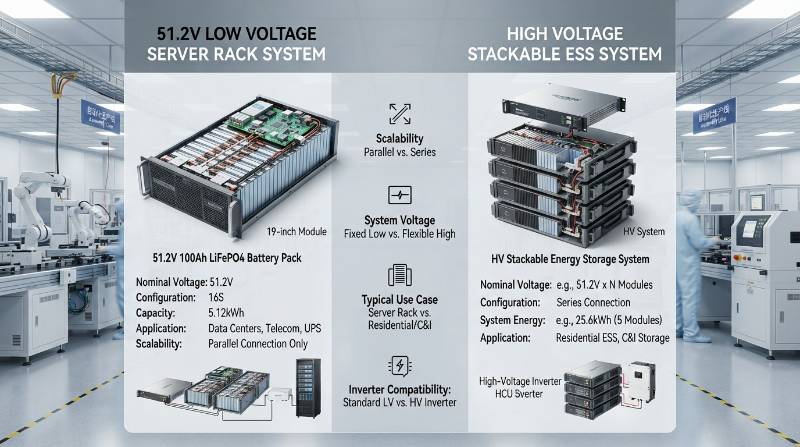
| Engineering Metric | 51.2V Low-Voltage (LV) Systems | High-Voltage (HV) Stackable Systems |
|---|---|---|
| System Nominal Voltage | 51.2V DC (16S Configuration) | 153.6V – 614.4V DC (48S to 192S Series) |
| Round-Trip Efficiency (RTE) | 92% – 94% (Higher I²R DC cable losses) | 96% – 97.5% (Lower current, minimal DC losses) |
| DC Cable Sizing & Complexity | Heavy-gauge copper (35mm² – 70mm²) required | Standard 4mm² – 6mm² solar DC conductors |
| Installer Labor Hours | Moderate (requires busbars, heavy cabling) | Fast (toolless quick-stack blind-mating connectors) |
| Scalability & Modularity | Parallel expansion up to 15–32 units (160+ kWh) | Stack-based expansion from 5 kWh up to 40 kWh |
| Target Application | Retrofit AC-coupled & cost-sensitive domestic ESS | New-build hybrid DC-coupled high-efficiency installations |
For modular expansion across both topologies, our engineering team manufactures custom high-cycle LiFePO4 battery packs utilizing CNC-fabricated aluminum chassis, IP65 outdoor wall mounts, and standard 19-inch server rack enclosures.
Cold-Climate Engineering: Mitigating UK Sub-Zero Charging Lockout
One of the most persistent failure points in UK residential storage installations is sub-zero temperature charging lockout. Standard LiFePO4 cells cannot accept charge below 0°C without risking permanent internal damage.
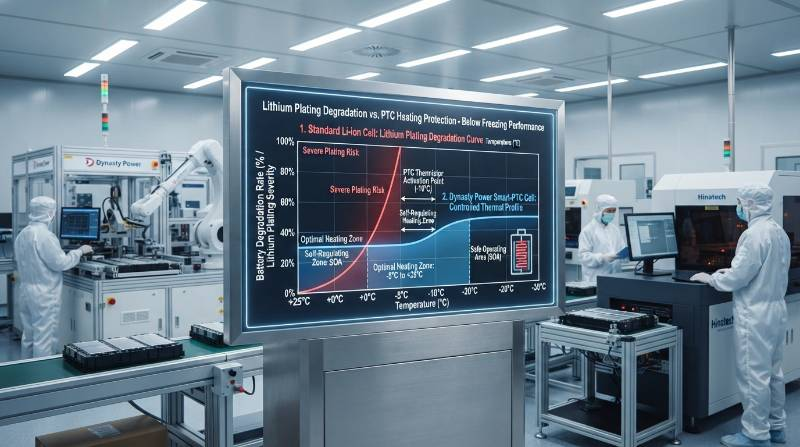
The Physics of Lithium Plating at Low Temperatures
When charging LiFePO4 at or below 0°C, lithium ions diffuse slowly into the graphite anode. Instead of intercalating smoothly between graphite layers, metallic lithium deposits directly onto the anode surface as dendrites.
This lithium plating leads to irreversible capacity loss, internal short circuits, and severe thermal runaway risks. Standard BMS firmware responds to this condition by completely locking out charging current when internal temperature sensors read ≤0°C.
PTC Heating Films & Advanced Electrolyte Formulations
In uninsulated UK garages, outbuildings, and ventilated lofts, winter ambient temperatures regularly dip between -2°C and -8°C. To resolve charging lockouts without operator intervention, our specialized low-temperature lithium batteries incorporate dedicated thermal management:
- Internal PTC Heating Pads: When incoming solar or grid power is detected below 2°C, the BMS diverts power directly to high-efficiency PTC heating elements wrapped around the cell matrix.
- Pre-Heat Cycle: Cells are warmed to +5°C before the main charging contactor closes, preserving electrochemical stability.
- Low-Viscosity Electrolyte Blends: Incorporate targeted organic ester co-solvents and fluorinated ethylene carbonate (FEC) additives to maintain ion transfer capability at temperatures down to -20°C.
Inverter Compatibility Matrix: Seamless CAN/RS485 Closed-Loop Communication
Field commissioning delays often stem from communication mismatches between third-party hybrid inverters and battery management systems. A true OEM partner provides pre-configured, selectable firmware protocols directly accessible via DIP switches or LCD touchscreens.
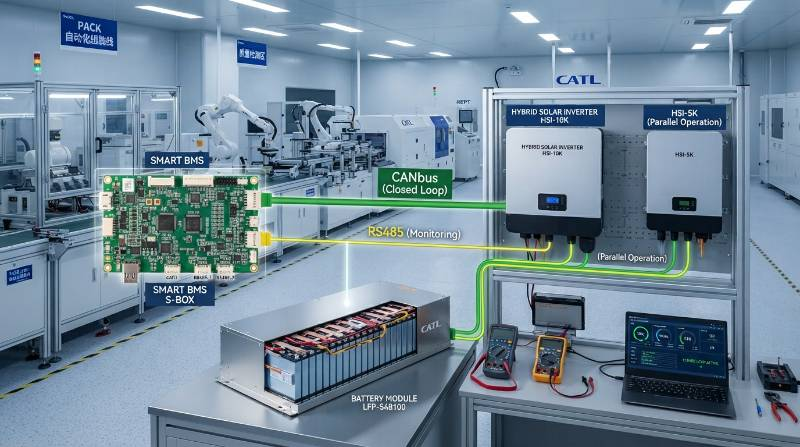
Our engineering division delivers smart multi-protocol BMS design featuring closed-loop integration with the UK’s leading residential inverter platforms:
| Inverter Brand | Physical Layer | Baud Rate | Telemetry Handshake Parameters |
|---|---|---|---|
| Solis Hybrid (RHI / S5 / S6) | CAN 2.0B / RS485 | 500 kbps / 9600 bps | Dynamic Charge Current Limit (CCL), Discharge Limit (DCL), Pack SOC, Max Cell Temp |
| Sunsynk / Deye | CAN 2.0B | 500 kbps | Pack Voltage, Cell Imbalance Alarms, Real-time SOH, High-Speed Power Ramp Control |
| Victron Energy (Color Control / Cerbo GX) | VE.Can (CAN-bus) | 250 kbps | Charge Voltage Limit (CVL), Extended Cell Voltage Telemetry, Dynamic Dynamic Cut-off |
| Luxpower (LXP Series) | CAN / RS485 | 500 kbps / 19200 bps | SOC Synchronization, Inverter Auto-Configuration, Real-time Fault Code Forwarding |
| Growatt (SPH / MIN Series) | CAN / RS485 | 500 kbps / 9600 bps | Overvoltage Protection Flags, Fast Shut-down Command, Active Cell Balancing Status |
Direct Factory Sourcing vs. Distributor Wholesale: Financial & Customization Analysis
Regional distribution networks introduce substantial intermediary markups, limited customization, and delayed warranty processing. Partnering directly with an established tier-1 battery manufacturer restructures financial performance for growing installation companies.
| Evaluation Vector | UK Regional Wholesale Distributor | Direct OEM/ODM Manufacturer (JHY Battery) |
|---|---|---|
| Unit Hardware Margin | Compressed (25% – 40% distributor markup applied) | Maximized (Direct factory DDP pricing) |
| Custom Branding & Enclosures | None (Locked to third-party brand) | Full White-Labeling (Custom metal chassis, RAL colors, logo silkscreen) |
| Firmware Customization | Generic locked firmware | Custom CAN/RS485 maps, bespoke tariff charge profiles |
| Technical Support & Escalation | Third-party desk agents | Direct access to R&D BMS hardware and firmware engineers |
| Supply Chain Security | Subject to local distributor stockouts | Scheduled container shipments & direct buffer allocations |
Frequently Asked Questions for UK Solar Installers & EPCs
How are dangerous goods transport (UN38.3) and UK customs managed?
All battery shipments are fully certified under UN38.3 and IMDG Code (Class 9 Miscellaneous Dangerous Goods). Working on Delivered Duty Paid (DDP) terms, our logistics division manages sea freight, UK port customs clearance (e.g., Felixstowe or Southampton), UK battery waste compliance documentation, and final transit directly to your regional warehouse.
What are typical Minimum Order Quantities (MOQs) for custom-branded residential packs?
Standard evaluation samples have an MOQ of 1 unit for prototype testing and firmware verification. For full OEM private-label custom metal fabrication and personalized packaging, initial MOQs begin at pallet quantities (typically 16 to 32 units).
How does BMS firmware adapt to UK smart tariffs like Octopus Agile?
Modern time-of-use tariffs require high C-rate cycling during short off-peak charging windows (e.g., 02:00 to 05:00) and rapid export response. Our BMS supports continuous 0.5C to 1.0C charge/discharge throughput with responsive State of Charge (SOC) tracking, ensuring smooth interaction with cloud-controlled home energy managers.
How is field technical support and warranty RMA handled for UK installers?
We supply modular spare components (plug-and-play BMS modules, display panels, and cell string blocks) directly to installer depots. Advanced diagnostics allow remote extraction of black-box BMS fault logs over RS485/Bluetooth, enabling rapid field troubleshooting without unnecessary pack decommissioning.
Are these systems compliant with UK home insurance guidelines?
Yes. Compliance with IEC 62619, UL 9540A, and PAS 63100:2024 ensures full acceptability by UK property insurers. Systems incorporate redundant hardware-level overvoltage, undervoltage, overcurrent, and dual-zone temperature trip relays backed by passive mechanical safety venting.
Scale Your UK Solar Storage Installations with Direct Factory OEM/ODM Excellence
Backed by Sichuan Changhong Group’s 30+ years of manufacturing lineage and a team of 800+ R&D engineers, JHY Battery delivers high-cycle, fully certified LiFePO4 energy storage systems tailored specifically for UK grid environments.
- Rapid Prototyping: Custom lithium battery samples and private-label tooling delivered in 5 to 7 business days.
- Guaranteed Quality: 0.03% (300 PPM) defect rate backed by automated capacity sorting and full MES traceability.
- Full Certification: ISO 9001, ISO 13485, IEC 62619, CE, UN38.3, and G98/G99 compliance-ready BMS architectures.
- Sub-Zero Resilience: Integrated PTC heating solutions engineered for UK loft and garage installations.