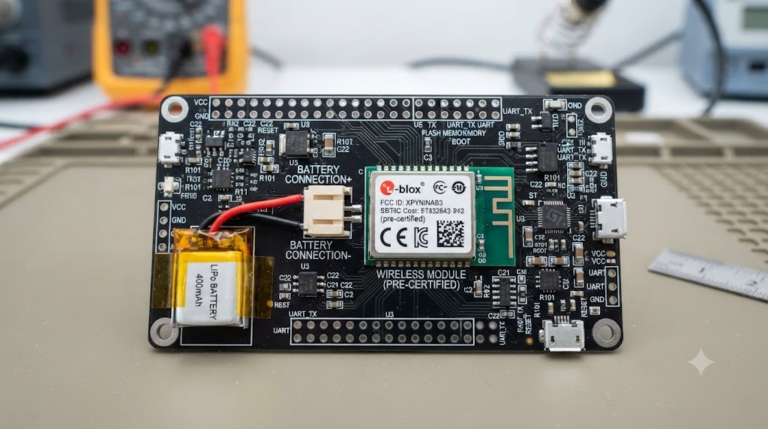
Industrial Drone Batteries: High-Rate UAV Power Systems
Defining High-Rate Discharge: Continuous vs. Burst Power in Enterprise Drones
A high-rate lithium drone battery delivers sustained high-current output—typically 15C to 30C continuous and 50C+ burst—while maintaining nominal operating voltage under severe motor loads. These power packs combine internal cell resistance below 1.5 mΩ with energy densities exceeding 240 Wh/kg for industrial flight missions.
| Parameter | Standard Consumer / Survey LiPo | High-Rate Industrial Lithium Pack |
|---|---|---|
| Continuous C-Rate | 1C – 5C | 15C – 30C |
| Peak Burst Rating (10s) | 10C | 45C – 60C |
| Voltage Sag @ Max Load | > 0.45V per cell | < 0.18V per cell |
| Thermal Stability (Max Temp) | Up to 60°C (Risk of swelling) | Up to 80°C (Reinforced current collectors) |
| System Flight Efficiency | Rapid drop-off during acceleration | Linear power output across discharge curve |
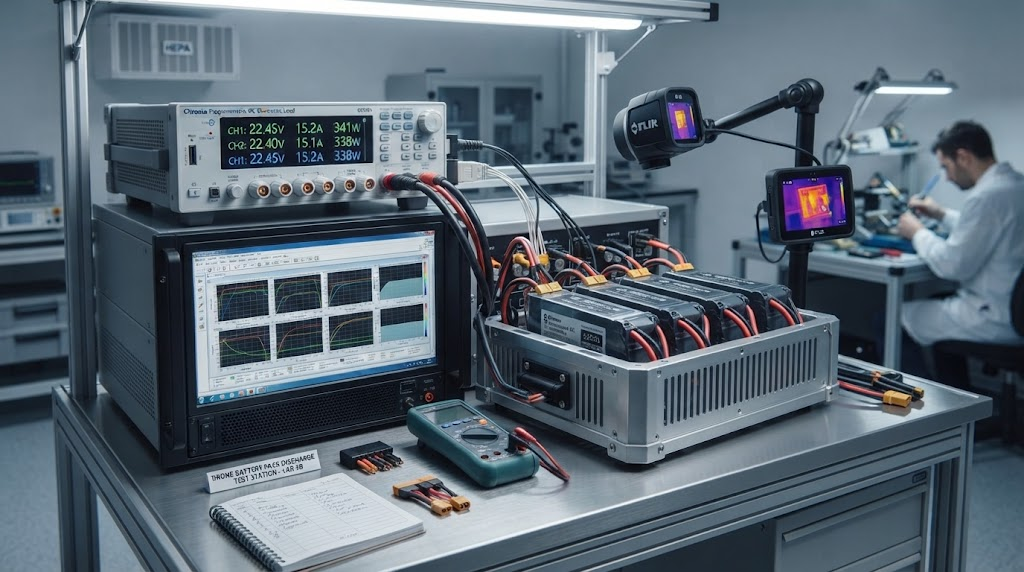
In heavy-lift unmanned aerial vehicles (UAVs), discharge rate dictates flight safety. Continuous C-rating refers to the steady current a pack discharges without exceeding safe internal temperatures. Burst rating represents instantaneous delivery needed during aggressive yaw corrections, vertical climb-outs, and sudden wind-shear compensation.
When an enterprise hexacopter encounters turbulent crosswinds, the electronic speed controllers (ESCs) instantly pull high peak currents. A battery with inadequate C-rating experiences severe voltage sag, triggering false low-voltage battery failsafes (RTL) or motor desynchronization.
Battery Chemistry Teardown: High-C LiPo vs. Semi-Solid State vs. High-Nickel NMC
Selecting the optimal electrochemistry involves balancing volumetric constraints, discharge behavior, and gravimetric energy density.
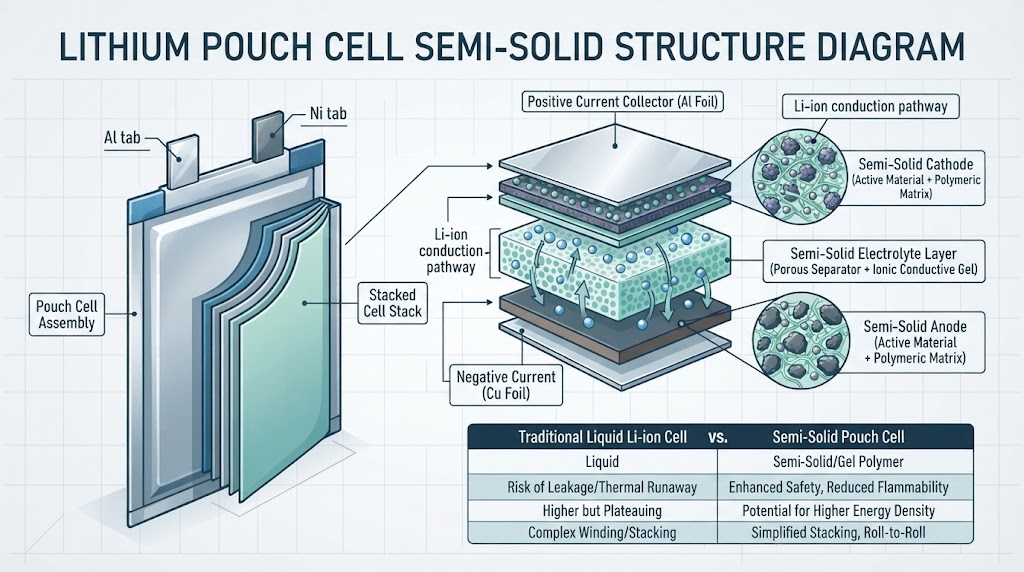
Traditional Lithium Polymer (LiPo) pouch cells remain the benchmark for sheer discharge output. Using thin, stacked electrode plates with liquid electrolyte, high-C LiPo cells discharge up to 30C continuously with minimal internal resistance. However, their lower energy density limits total loiter duration.
Semi-solid-state cells replace liquid electrolyte matrices with gelled or solid polymer electrolytes. According to propulsion research published via IEEE Xplore, solid-electrolyte interfaces dramatically suppress dendrite formation under rapid cycling. Semi-solid-state high-rate cells achieve gravimetric energy densities up to 280 Wh/kg compared to 180-210 Wh/kg in traditional industrial LiPo packs. This delivers longer endurance for mapping missions while supporting 10C–15C continuous draw.
High-Nickel NMC (Nickel Manganese Cobalt, such as NMC 811) cylindrical cells provide high energy density (up to 300 Wh/kg), but suffer from higher internal resistance (15–30 mΩ per cell). When configured for heavy multirotors, standard cylindrical packs experience thermal runaway risks if discharged past 3C–5C.
For custom industrial configurations requiring distinct voltages, shapes, or hybrid chemistries, explore custom lithium battery packs designed for demanding platforms.
The 4D Power Sizing Protocol: Calculating Amp Draw from Motor Thrust Curves
Avoid generic flight-time calculators when engineering enterprise platforms. We utilize the 4D Power Sizing Protocol to accurately model battery requirements:
1. Discharge (Continuous & Peak Current)
Calculate dynamic amp draw directly from motor thrust tables at All-Up Weight (AUW). For a quadcopter with an AUW of 16 kg, each motor must produce 4 kg of thrust at hover (50% throttle). If a 100KV motor draws 18A at 4 kg thrust on a 12S bus, total hover draw is:
Total Continuous Current = 18A × 4 = 72A Continuous Hover Current
At 100% full throttle (e.g., 9 kg thrust per motor during emergency climbs), each motor draws 52A:
Peak Burst Current = 52A × 4 = 208A Peak Current
2. Duration (Effective Usable Capacity)
Calculate battery capacity using an 80% Depth-of-Discharge (DoD) safety ceiling to prevent low-voltage degradation. For a target 35-minute hover flight (0.58 hours):
Required Capacity = (72A × 0.58h) / 0.80 = 52.2 Ah (12S / 44.4V Nominal)
3. Dissipation (Thermal Heat Generation)
Heat dissipation scales with the square of current multiplied by internal resistance ($P_{loss} = I^2 \times R_{int}$). High-rate cells with sub-1.5 mΩ resistance generate less heat, protecting the core from thermal expansion during prolonged hovers.
4. Degradation (Cycle Life Under Thermal Load)
Continuous discharge above 70% of a pack’s maximum rated C-rate accelerates cathode cracking. Sizing the pack’s continuous rating to double the actual hover current extends usable cycle life past 500 charge cycles.
Payload Power Dynamics: Managing LiDAR, Multispectral, and Heavy Gimbal Surges
Industrial drones are mobile power grids supporting sophisticated sensor suites. Auxiliary systems draw direct current through secondary buck-boost regulators, placing complex electrical demands on the battery pack.
Enterprise LiDAR mapping payloads increase continuous power draw by 28% to 42% over optical survey flights, demanding cell internal resistance below 1.5 mΩ. High-resolution LiDAR scanners, spinning mirrors, onboard INS computers, and thermal imaging cameras create sustained parasitic loads between 45W and 160W.
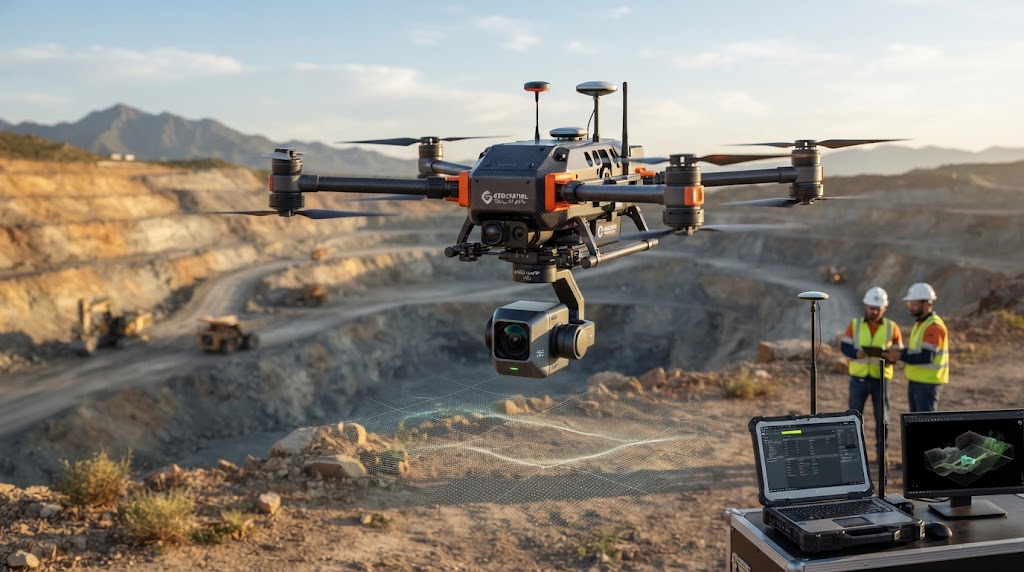
If the battery exhibits elevated internal resistance, high motor throttle pulls down bus voltage. This ripple voltage disrupts sensitive LiDAR laser frequencies or causes companion computer resets. Deploying high-rate pouch cells with low internal resistance stabilizes main bus voltage across dynamic throttle changes.
Cold-Weather Performance & Thermal Dissipation Under Heavy Loads
Low ambient temperatures present severe challenges for lithium-ion and LiPo chemistries. Below freezing, liquid electrolyte viscosity spikes, impeding lithium-ion transfer between cathode and anode.
Operating high-rate cells at -10°C without active thermal management causes an immediate 35% reduction in usable flight endurance and accelerated voltage sag. In field operations, drawing high current from a cold-soaked pack induces lithium plating on the anode, causing permanent capacity loss and thermal runaway risks.
For sub-zero infrastructure inspections, packs must incorporate integrated self-heating BMS circuitry. Drawing minimal pre-flight power from an external supply or internal cells, heating jackets warm core temperatures to +15°C before motor arming.
Conversely, operating under high ambient heat requires heat-conductive silicone potting, graphite thermal spreaders, and aluminum casing to shed heat during sustained 20C climbs.
Smart BMS Integration: Telemetry Protocols for ArduPilot, PX4, and CubePilot
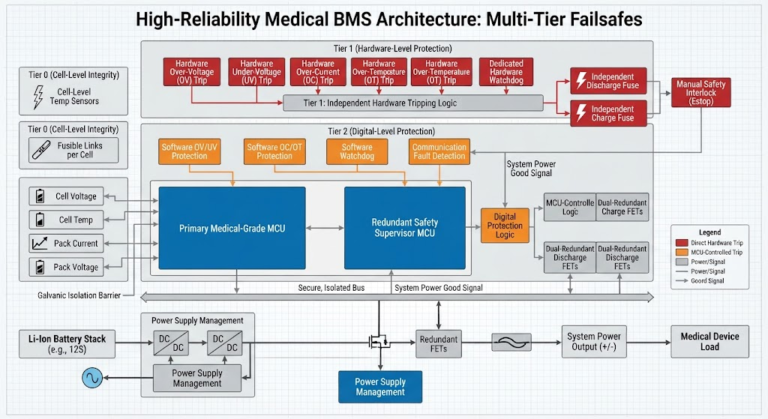
Industrial UAV safety relies on direct communication between the battery management system (BMS) and the flight controller. Analog voltage dividers are insufficient for autonomous beyond-visual-line-of-sight (BVLOS) operations.
Modern enterprise platforms deploy intelligent digital communications via CAN bus (utilizing DroneCAN / UAVCAN protocols) or SMBus/I2C. These links feed critical operational parameters to autopilots such as Cube Orange, Pixhawk 6X, or custom PX4-based architectures:
- Individual Cell Voltages: Real-time balancing metrics down to 1 mV accuracy to detect failing series groups.
- Coulomb Counting: High-precision current shunts measuring true consumed milliamp-hours (mAh) for accurate State of Charge (SoC).
- Multi-Point Thermistors: Internal temperature sensors tracking thermal distribution across the core.
- State of Health (SoH) Logging: Cycle-count monitoring and real-time internal resistance calculations over time.
For broad enterprise power deployments across utility inspection and ground robotics, refer to industrial equipment battery solutions equipped with advanced digital BMS telemetry.
Total Cost of Ownership: Cost-Per-Flight-Hour and Cycle Life Economics
Commercial fleet managers assess power systems using Cost-Per-Flight-Hour (CPFH) calculations rather than upfront pack price alone.
CPFH = Pack Purchase Price / (Total Usable Cycles × Flight Hours per Cycle)
Consider an enterprise LiDAR inspection drone operating a 12S 22,000mAh pack:
- Off-the-shelf Low-Grade LiPo: Purchase price $380. High heat generation degrades cell health within 120 cycles (0.5 hours per flight = 60 flight hours). CPFH = $6.33 per flight hour.
- Engineered High-Rate Semi-Solid Pack: Purchase price $720. Lower thermal dissipation and reinforced anode chemistry sustain 500 cycles (0.65 hours per flight = 325 flight hours). CPFH = $2.21 per flight hour.
High-rate, low-resistance packs lower fleet maintenance overhead, eliminate unexpected voltage-sag crashes, and optimize total equipment ROI.
Regulatory Compliance & Safe Air Transport: UN 38.3 and IATA Directives
Transporting high-capacity lithium packs to international job sites requires strict adherence to global dangerous goods regulations managed by IATA and national aviation authorities.
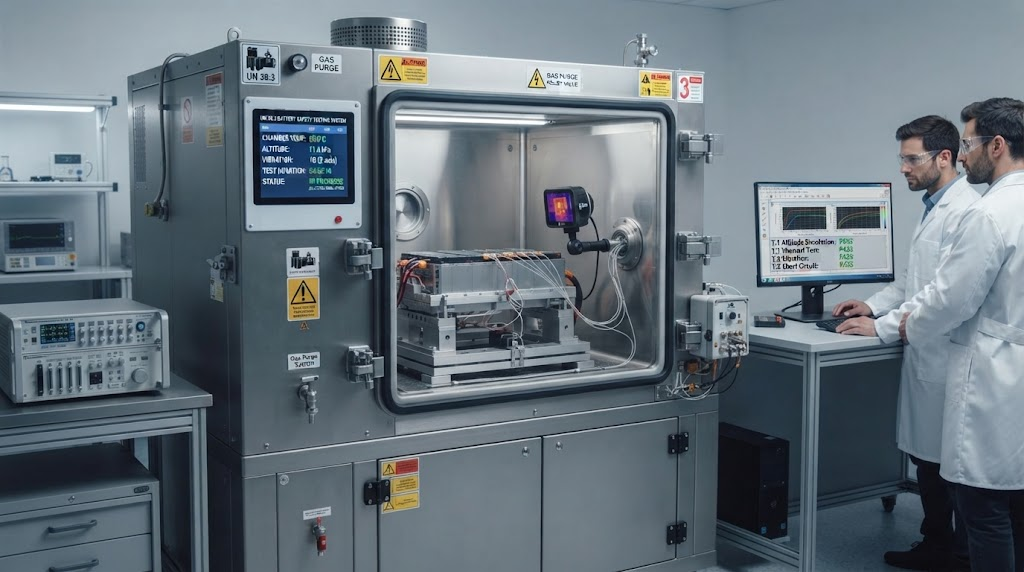
High-capacity drone packs exceeding 100 Wh are classified as UN 3480 (Lithium-ion batteries) Class 9 Dangerous Goods. Air shipping mandates complete UN 38.3 testing certification, which subjects packs to eight rigorous evaluations:
- T.1 Altitude Simulation (Low Pressure 11.6 kPa)
- T.2 Thermal Cycling (-40°C to +72°C)
- T.3 Vibration (7 Hz to 200 Hz sinusoidal sweep)
- T.4 Shock (150g acceleration pulse)
- T.5 External Short Circuit (at 55°C)
- T.6 Impact/Crush Testing
- T.7 Overcharge Protection Verification
- T.8 Forced Deep Discharge
To safely handle enterprise-grade power systems and explore certified manufacturing capabilities, review LiFePO4 and high-rate battery manufacturing standards.
OEM/ODM Customization Roadmap with JHY Battery
Standard off-the-shelf batteries rarely match the exact bay dimensions, center-of-gravity constraints, and discharge profiles of custom commercial airframes. Juheyuan Science & Technology Co., Ltd. (JHY Battery) designs and manufactures turnkey custom lithium battery packs for enterprise UAV integrators worldwide.
Our OEM/ODM engineering path delivers reliable high-rate solutions through a streamlined 3-step action pathway:
- Input Thrust & Payload Metrics: Supply your airframe’s AUW, motor thrust curves, voltage constraints (6S to 24S), and target flight envelope to our engineering team.
- CAD Topology & BMS Engineering: Within 24 hours, receive a comprehensive design package including 3D structural CAD models, thermal heat dissipation simulations, and custom DroneCAN/SMBus firmware schematics.
- Prototype Validation & Certified Production: Rapid prototyping transitions directly into ISO9001, CE, UN38.3, and UL-certified mass manufacturing, backed by stringent cell sorting and individual internal resistance matching.
Frequently Asked Questions (FAQ)
What minimum C-rate is required for heavy-lift industrial drones?
Heavy-lift industrial drones carrying mapping or delivery payloads require packs with at least 15C continuous discharge and 30C to 50C burst ratings. This headroom prevents voltage sag during climb-out and turbulent flight conditions.
What is the ideal storage voltage for high-rate LiPo and semi-solid batteries?
The optimal storage voltage is 3.82V to 3.85V per cell. Storing cells at full charge (4.20V+) accelerates electrolyte oxidation, raises internal resistance, and causes pouch swelling. Storing below 3.60V risks irreversible copper shunt formation and permanent cell death.
How does cell internal resistance (IR) affect drone flight endurance?
High internal resistance wastes battery energy as internal heat rather than converting it to motor thrust. A cell with IR above 3.5 mΩ suffers premature low-voltage cutoffs under load, reducing usable flight time by 15% to 30% compared to a fresh sub-1.5 mΩ cell.
Can high-rate drone batteries support fast charging in the field?
Yes, premium high-rate cells engineered with low internal resistance and active thermal balancing support direct current fast charging (DCFC) rates up to 2C–3C, allowing 20% to 80% replenishment within 15 to 20 minutes safely.
Engineering Authority & Review
This technical guide was authored and reviewed by the Senior Aerospace Power Systems Engineering group at JHY Battery (Juheyuan Science & Technology Co., Ltd.).
Our findings reflect over a decade of lithium battery pack development, empirical testing across ISO9001-certified cleanroom manufacturing environments, and telemetry log analysis from thousands of commercial flight missions using ArduPilot and PX4 autopilots.
Power Your Next-Generation UAV Fleet
Custom high-rate lithium-ion, LiPo, and semi-solid-state battery packs engineered for industrial payloads, extreme temperatures, and long endurance.