AMR Lithium Battery Solutions: Custom Industrial Packs
Core Engineering Parameters for Modern AMR Power Systems
An Autonomous Mobile Robot (AMR) lithium power architecture is a specialized energy storage system engineered for continuous, high-payload robotic mobility. It integrates high-rate lithium cells, closed-loop thermal containment, and a communications-grade Battery Management System (BMS) to deliver stable bus voltage, autonomous fast charging, and continuous real-time fleet telemetry.
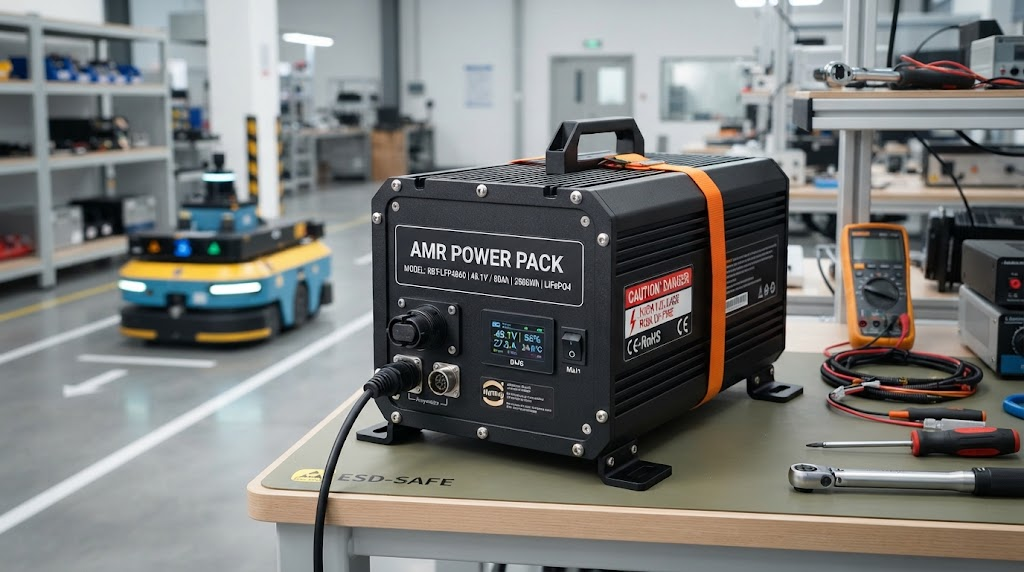
Modern distribution facilities and smart factories demand industrial logistics equipment that operates around the clock. Upgrading from legacy lead-acid units to engineered industrial equipment batteries provides the high discharge rates and rapid recharge capabilities needed to sustain multi-shift operations.
| パラメータ | Standard Industry Baseline | High-Performance Robotics Specification |
|---|---|---|
| System Nominal Voltage | 24V DC (8S LiFePO4 / 7S NMC) | 48V to 51.2V DC (16S LiFePO4) |
| Continuous C-Rate | 0.5C to 1.0C Discharge | 2.0C to 3.0C Pulse (Lift & Accelerate) |
| Recharge Acceptance | 0.5C Standard Charge | 1.0C to 2.0C Fast Opportunity Charge |
| Target Cycle Life (80% DoD) | 1,500 Cycles | 3,500 to 5,000+ Cycles |
| Telemetry Interface | Analog / Basic RS485 | CANopen / Modbus TCP / ROS 2 Native |
Key operational benefits delivered by advanced AMR lithium power systems include:
- Maximum Operational Availability: Elimination of dedicated 8-hour cool-down cycles required by legacy flooded lead-acid batteries.
- Consistent Voltage Profiles: Flat discharge curves ensure drive motors operate at peak torque and precision navigation sensors receive uncorrupted bus voltage.
- Volumetric Space Optimization: High energy density frees up critical internal chassis volume for lidar, optical cameras, and kinematic payload lifters.
AMR Battery Chemistries: LiFePO4 vs. NMC vs. LTO Comparison
Selecting the optimal electrochemical formulation is the primary design choice when engineering an AMR power core. Lithium Iron Phosphate (LiFePO4), Nickel Manganese Cobalt (NMC), and Lithium Titanate (LTO) each serve specific robotics use cases.
For most commercial intra-logistics setups, LiFePO4 battery solutions represent the benchmark due to their high intrinsic safety, lack of cobalt supply volatility, and robust cycle life.
| Metric | LiFePO4 (LFP) | NMC (Nickel Manganese Cobalt) | LTO (Lithium Titanate) |
|---|---|---|---|
| Nominal Cell Voltage | 3.2V | 3.6V – 3.7V | 2.3V – 2.4V |
| Gravimetric Energy Density | 140 – 175 Wh/kg | 200 – 260 Wh/kg | 70 – 100 Wh/kg |
| Cycle Life (100% DoD) | 3,500 – 6,000 cycles | 1,200 – 2,000 cycles | 15,000 – 25,000 cycles |
| Thermal Runaway Initiation | ~270°C (Extremely Stable) | ~210°C (Requires Active Cooling) | >300°C (Virtually Inert) |
| Maximum Charge Rate | 1C continuous (2C pulse) | 0.7C – 1C continuous | 5C – 10C ultra-fast |
| Capital Expenditure per kWh | Low to Moderate | Moderate | Very High (3x to 4x LFP) |
Application Fit Analysis
NMC is preferred when chassis space is strictly constrained and robotic payload takes absolute priority over long-term cycle life. However, NMC packs require complex cell-level thermal mitigation barriers to satisfy warehouse fire safety insurers.
LTO shines in extreme duty cycles where robots must recharge from 0% to 80% in under 10 minutes, or in continuous sub-zero operating environments. Its lower energy density requires larger, heavier battery enclosures, increasing chassis gross vehicle weight.
The 4-Vector AMR Power Framework for High-Uptime Fleets
To eliminate robotic downtime and ensure battery packs outlast the robotic mechanical chassis, JHY Battery engineers utilize a proprietary system design model: The 4-Vector AMR Power Framework.
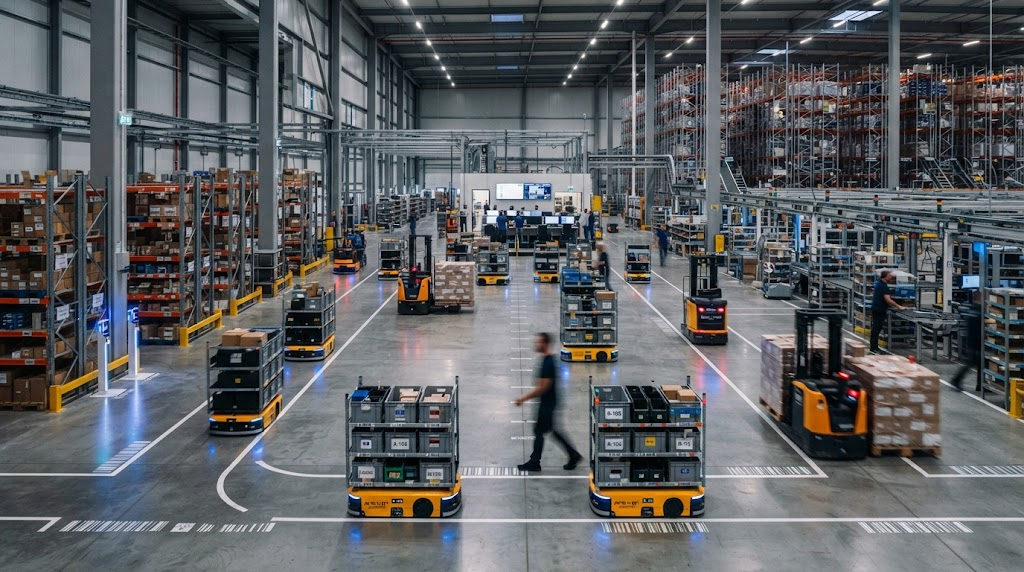
Vector 1: Volumetric Enclosure Matching
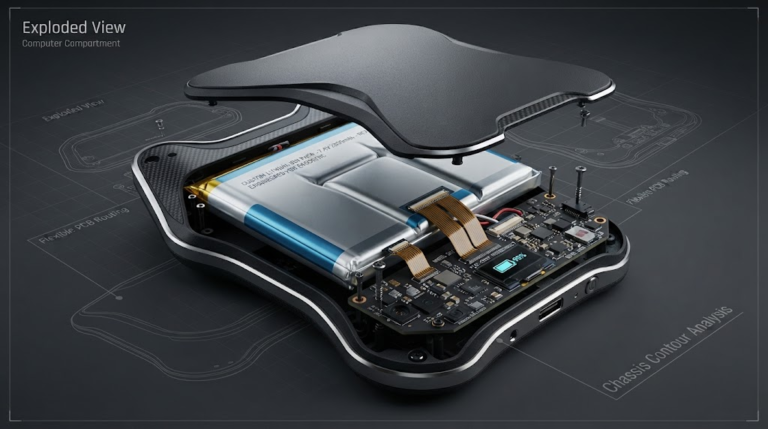
AMR chassis envelopes feature complex internal geometries. Standard rectangular off-the-shelf cases force engineers to compromise on capacity or mechanical structural rigidity.
Vector 1 designs custom sheet-metal (SPCC/AL5052) or cast-aluminum enclosures that double as structural chassis members. This preserves an IP54 to IP67 ingress protection rating while maximizing active cathode mass within the available cubic centimeters.
Vector 2: Dynamic Thermal Equilibrium
Industrial mobile robots generate concentrated heat from drive wheel motors, LiDAR processing units, and high-amp DC-DC buck converters. Battery packs tucked into these unventilated compartments experience elevated ambient operating temperatures.
This vector integrates phase-change thermal interface materials (TIM), precision air channels, and active busbar heat-sinking to keep internal cell-to-cell delta-T below 3°C across continuous multi-hour shifts.
Vector 3: High-Rate C-Curve Profiling
AMR energy consumption is dynamic. Idle navigation draws minimal power (0.1C to 0.2C), while heavy pallet lifting or steep ramp traversal demands instant 3C peak current surges.
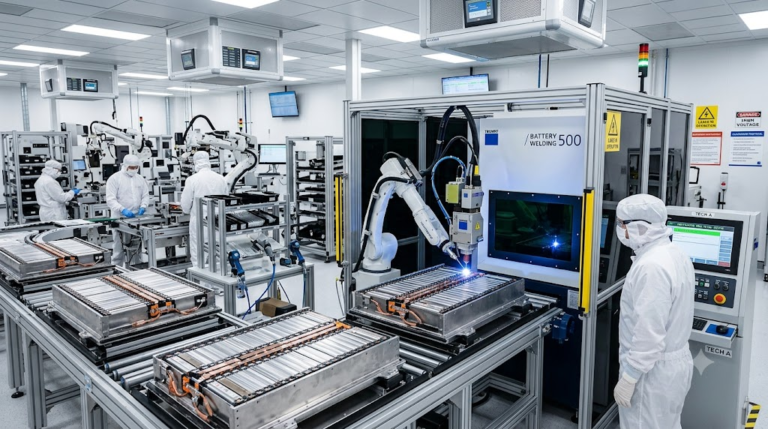
Vector 3 matches internal cell impedance and laser-welded nickel-copper busbar topologies to dynamic robotic acceleration duty cycles. This minimizes voltage sag, preventing unexpected low-voltage cutoffs during heavy mechanical load spikes.
Vector 4: Telemetric Interfacing
An isolated battery pack blinds the Fleet Management System (FMS). Vector 4 implements intelligent, real-time BMS communication pipelines that broadcast cell-level State-of-Charge (SoC), State-of-Health (SoH), and internal fault alerts directly to robotic fleet dispatch algorithms.
Smart BMS Fleet Integration: CANopen, Modbus, and ROS 2
The Battery Management System serves as the central control unit for any robotics power train. Modern automated distribution operations require tight coupling between the power pack and the higher-level robot operating software.
Over 84% of modern industrial warehouse AMRs deploy CANopen or Modbus RS485 communication protocols for active fleet management and state-of-charge dispatching.
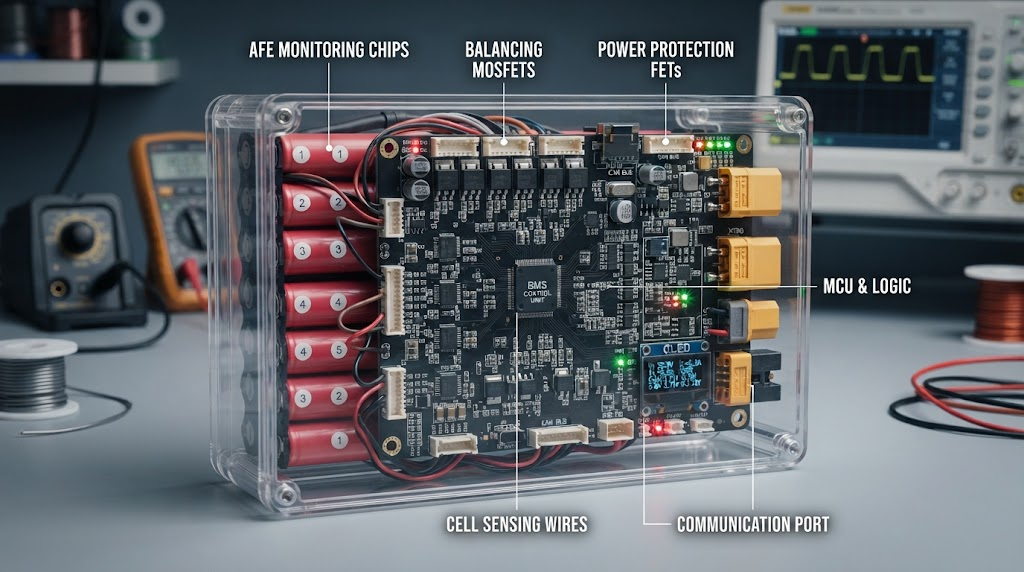
Legacy voltage-threshold fuel gauges are inadequate for automated fleet orchestration. As lithium iron phosphate delivers an exceptionally flat discharge plateau, measuring pack voltage alone yields State-of-Charge estimation errors exceeding 25%.
High-grade AMR battery management systems deploy closed-loop Coulomb counting coupled with Extended Kalman Filter (EKF) algorithms. This ensures SoC accuracy within ±1.5% across the entire discharge curve.
Telemetry Integration Protocols
- CANopen (CiA 418 / CiA 454): The standard fieldbus profile for industrial automated guided vehicles, enabling direct cyclic broadcasting of cell voltages, temperatures, maximum charge current limits (CCL), and discharge limits (DCL).
- Modbus RS485 / TCP: Widely utilized for interfacing with automated charging dock PLCs to modulate power output based on real-time cell thermal feedback.
- ROS / ROS 2 Battery Drivers: Real-time conversion of CAN payloads into native
sensor_msgs/BatteryStatetopics, enabling nav2 stack path planners to automatically schedule charging runs before critical depletion.
Charging Infrastructure: Fast Opportunity Charging vs. Battery Swapping
Designing an AMR operational workflow requires choosing between automated opportunity charging pads and mechanical battery swap stations. Both approaches directly impact fleet size requirements and total cost of ownership (TCO).
Fast opportunity charging at 1C to 2C rates delivers a 98.5% uptime availability rate in 24/7 automated fulfillment operations.
| Operational Attribute | Fast Opportunity Charging (Conductive/Inductive) | Automated Battery Swapping System |
|---|---|---|
| Fleet Robot Ratio | 1:1 (Pack stays in robot permanently) | 1:1.5 to 1:2 (Requires excess packs in rotation) |
| Downtime per Cycle | 8 – 15 minutes during natural conveyor loading pauses | 2 – 4 minutes at dedicated mechanical swap bay |
| Mechanical Complexity | Low (Floor contact plates or wireless magnetic coils) | High (Pneumatic grippers, alignment robotics, wear-prone pins) |
| Floor Footprint | Distributed floor pads across warehouse pathways | Dedicated multi-square-meter charging enclosure kiosk |
Opportunity charging provides the highest operational return for modern warehouse topologies. By applying 1C–2C fast top-ups whenever an AMR waits for a conveyor load or robotic arm picking task, the robot operates indefinitely in a sweet spot of 30% to 80% State-of-Charge. This preserves cathode lattice health and extends total battery life.
Industrial Safety and Regulatory Compliance: UL 2580, IEC 62619, and UN 38.3
Autonomous mobile robotics systems share operating spaces with human workers. Deploying lithium packs in industrial settings requires adherence to rigorous testing certifications.
Refer to testing protocols governed by organizations like the International Electrotechnical Commission (IEC) and standards from Underwriters Laboratories (UL) to maintain compliance with logistics occupational safety frameworks.
Essential AMR Battery Certifications
- IEC 62619: The definitive international safety standard for lithium secondary cells and batteries used in industrial applications, automated guided vehicles, and robotics. Validates resistance to thermal propagation, drop tests, and forced internal short circuits.
- UL 2580: Rigorous North American certification for batteries deployed in electric industrial equipment. Evaluates enclosure integrity under crush forces, fire exposure, overcharge tolerance, and environmental stress.
- UN 38.3: Mandatory United Nations transport certification verifying that battery packs withstand altitude simulation, severe vibration, mechanical shock, external thermal exposure, and short-circuit conditions during worldwide shipping.
- ISO 13849-1 (BMS Functional Safety): Ensures battery safety cutoff circuitry (MOSFET or Contactor disconnects) meets Performance Level d (PLd) or higher to prevent uncommanded system starts or overvoltage faults.
Extreme Cold-Storage and High-Heat AMR Battery Engineering
Cold-chain distribution centers operating at -20°C to -30°C present severe electrochemical challenges for lithium systems. Conventional lithium cells charged below 0°C suffer from lithium metal plating on the anode, resulting in irreversible capacity loss and dangerous internal short circuits.
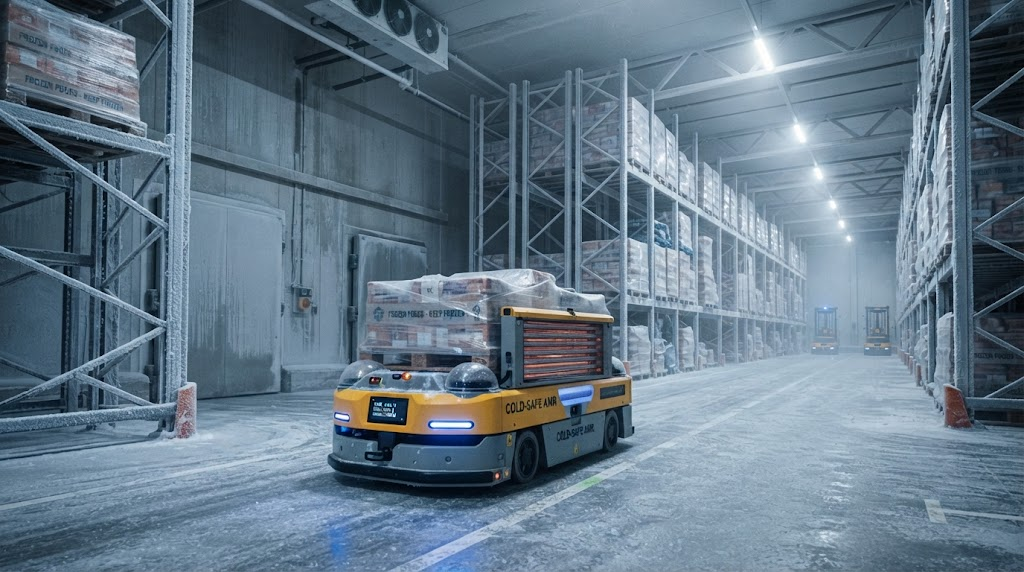
Cold-Chain Engineering Solutions
To operate reliably in cold-storage environments, JHY Battery incorporates internally managed, low-parasitic PTC self-heating silicon elements into the pack core. When an AMR parks at a charging terminal in a -20°C freezer, the BMS routes charging current first to the internal heater plates. Once multi-point thermistors verify the core cell temperature has safely crossed +5°C, the BMS switches full power into the cell matrix, preventing lithium plating.
High-Ambient Manufacturing Floor Strategies
For heavy industrial manufacturing facilities where ambient facility temperatures exceed 45°C, battery packs deploy advanced silicone thermal potting compounds. These transfer heat away from interior cells directly to the external aluminum enclosure walls, preventing thermal hot spots and equalizing pack degradation rates.
OEM/ODM Customization Capabilities by JHY Battery
With more than ten years of manufacturing experience, JHY Battery (Juheyuan Science & Technology Co., Ltd.) provides complete OEM/ODM engineering services for autonomous robotics developers, AGV integrators, and industrial fleet operators worldwide.
Standard catalog packs often force roboticists to alter chassis dimensions or sacrifice payload. JHY Battery designs and manufactures custom lithium-ion battery packs engineered around your precise mechanical, electrical, and environmental envelopes.
End-to-End Engineering Customization Options:
- Form Factor & Enclosure: Custom-machined aluminum alloy, IP65/IP67 sheet metal, specialized damping mounts for high-vibration terrain.
- Electrical Topology: Configurable voltages (24V, 36V, 48V, 51.2V, 72V, 80V) and capacities matching designated runtimes and lift requirements.
- Smart BMS & Communication: Tailored firmware with custom CAN matrices, CANopen, RS485 Modbus, SMBus, or Bluetooth low-energy diagnostics.
- Comprehensive International Certifications: Fully certified production pipelines compliant with ISO9001, CE, UL 2580, IEC 62619, and UN38.3.
よくある質問
How long do LiFePO4 batteries typically last in 24/7 AMR warehouse operations?
In high-throughput 24/7 operations with fast opportunity charging (1C rate between 20% and 80% State-of-Charge), premium LiFePO4 battery packs consistently deliver 3,500 to 5,000+ full equivalent cycles before reaching 80% of original capacity. This translates to 5 to 8 years of continuous industrial operation.
Can we directly retrofit existing lead-acid AGVs with custom lithium battery packs?
Yes. Retrofitting requires engineering a drop-in lithium pack matching the original lead-acid pack’s physical dimensions, center of gravity, and ballast weight. A custom BMS is configured to interface with the existing vehicle controller, replacing the old charge curve with a stable lithium voltage bus.
What is the typical lead time for custom OEM robotics battery prototypes?
Following final 3D CAD envelope approval and BMS communication protocol sign-off, JHY Battery typically delivers fully functional, laboratory-tested functional prototypes within 3 to 5 weeks. Full compliance testing and mass production tooling follow validated prototype approval.
What happens if an AMR battery cell experiences an over-temperature event?
Industrial smart BMS architectures feature independent hardware and firmware safety cutoffs. If internal temperature sensors detect levels above 60°C, the BMS throttles incoming charge current. If temperatures exceed 65°C, dual high-current contactors disconnect the battery from the load bus, isolating the pack and alerting the central Fleet Management System.
Technical Review & Engineering Methodology
This technical guide was developed in collaboration with JHY Battery application engineers and reviewed by our Chief Robotics Power Systems Engineer. All performance curves, lifecycle projections, and charge rates reflect validation data gathered across ISO9001 and UL2580 certified laboratory testing environments.
Our research protocols adhere to strict life-cycle simulation testing, subjecting pack assemblies to multi-axis vibration testing (10–55Hz), thermal shock cycles (-40°C to +65°C), and continuous 2C fast-charge stress testing to verify real-world reliability in mission-critical logistics deployments.
Power Your AMR Fleet with Engineered Lithium Solutions
Submit your robotic chassis dimensions, electrical specs, and BMS protocol requirements to receive 3D CAD schematics and an OEM quotation within 24 hours.