Lithium Battery Supplier Selection Guide: OEM Evaluation
Evaluating an original equipment manufacturer (OEM) requires a methodical engineering assessment across cell chemistry integrity, active safety electronics, extreme environmental resilience, and certified quality management systems.
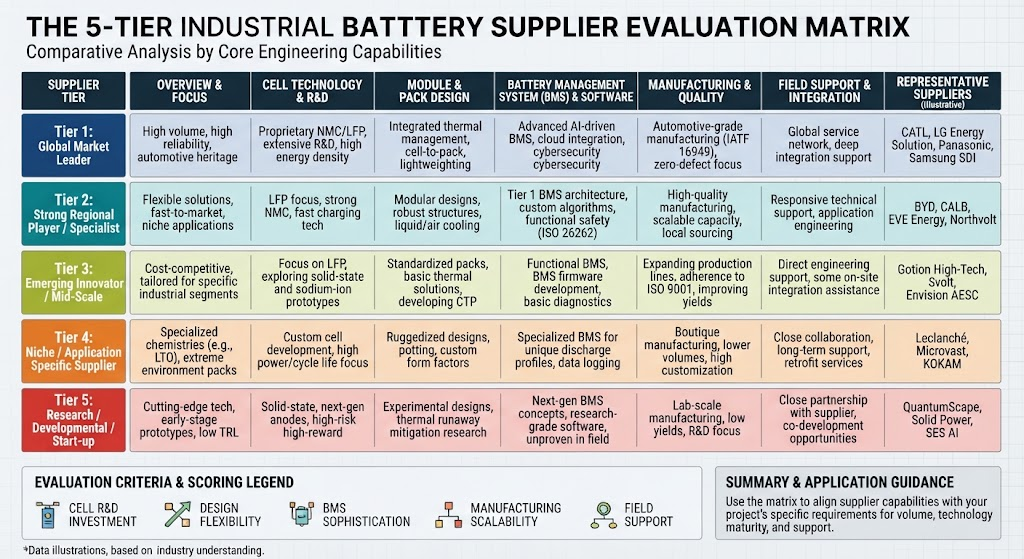
The 5-Tier Industrial Battery Supplier Selection Matrix
Selecting a manufacturing partner requires evaluating five fundamental operational tiers: precision cell sorting, proprietary Battery Management System (BMS) engineering, environmental thermal resilience, global regulatory compliance, and total lifecycle accountability. An integrated manufacturing approach ensures end-to-end quality control from raw cell screening to finished enclosure assembly.
Most procurement pitfalls stem from treating battery manufacturing as simple mechanical packing. Differentiating between trading brokers, contract assemblers, and vertically integrated manufacturers like custom lithium battery packs specialist JHY Battery protects your hardware roadmap from unvetted cell batches and fragmented warranty liabilities.
| Evaluation Dimension | Direct Integrated OEM (JHY Battery) | Contract Pack Assembler | Trading Broker / Reseller |
|---|---|---|---|
| Cell Sorting & Grade Rigor | 100% Automated: ΔOCV < 5mV, ΔACIR < 2mΩ | Manual / Sample-based screening | None (Relies on third-party claims) |
| BMS Architecture & Firmware | In-house custom hardware & firmware (CAN/SMBus) | Off-the-shelf generic PCM/BMS modules | Fixed, non-customizable third-party boards |
| Operating Window | -45°C to +80°C with custom electrolyte | -10°C to +55°C (Standard chemistry) | 0°C to +45°C (Consumer grade) |
| Quality & Traceability | ISO 13485, full MES cell-level tracking | ISO 9001 standard factory lot tracking | No internal MES; batch-level only |
| Defect Rate SLA & Prototyping | ≤ 300 PPM (0.03%); 5-7 business day DFM prototypes | 1,500–3,000 PPM; 3-5 week sample turnaround | > 5,000 PPM; variable lead times |
Tier 1: Cell Chemistry Sourcing, Sorting, and Grade-A Verification
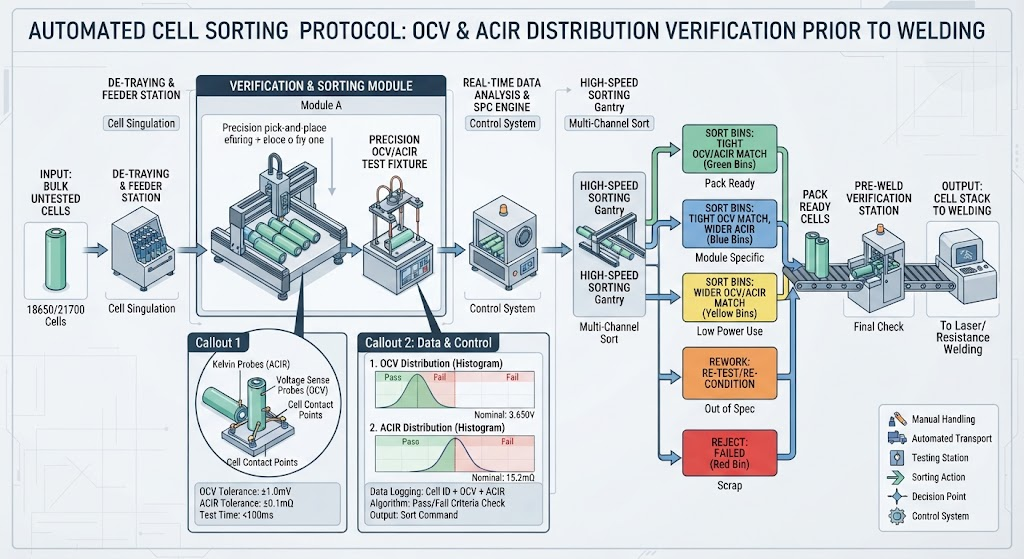
Pack longevity depends directly on individual cell electrochemistry matching. When cells are placed in series-parallel configurations, the pack’s usable capacity is fundamentally constrained by the weakest cell in the string.
In our manufacturing experience at JHY Battery, automated cell binning must enforce an Open Circuit Voltage (OCV) delta under 5mV and an AC Internal Resistance (ACIR at 1kHz) delta under 2mΩ within any single production lot. Skipping automated binning causes accelerated cell divergence during dynamic discharge cycles.
Selecting the optimal chemistry requires balancing energy density against thermal stability and cycle life:
- industrial LiFePO4 battery systems (LFP): Delivers exceptional thermal runaway thresholds (> 270°C) and exceeds 3,000 to 6,000 cycles at 80% Depth of Discharge (DOD). It serves as the baseline for stationary storage, robotics, and utility hardware.
- Nickel Manganese Cobalt (NMC): Provides high gravimetric energy density (up to 260 Wh/kg), making it optimal for weight-sensitive medical ventilators, aerospace telemetry, and portable surgical devices.
- Lithium Cobalt Oxide (LCO): Optimized for ultra-thin pouch cells (down to 0.8mm) in compact smart rings and medical monitoring patches requiring high volumetric efficiency.
Tier 2: In-House Smart BMS Engineering and Multi-Tier Safety Firmware
A generic Battery Management System (BMS) purchased off the shelf cannot adequately protect complex industrial or medical equipment. Proprietary hardware architecture and tuned firmware are required to ensure continuous operational safety and accurate telemetry.
Engineering robust systems requires custom BMS design and architecture featuring dual-layer independent hardware protections. Primary microcontrollers execute fast-response overcurrent and short-circuit interrupts, while secondary analog front-ends (AFEs) provide non-programmable physical trip mechanisms against overvoltage and thermal runaway.
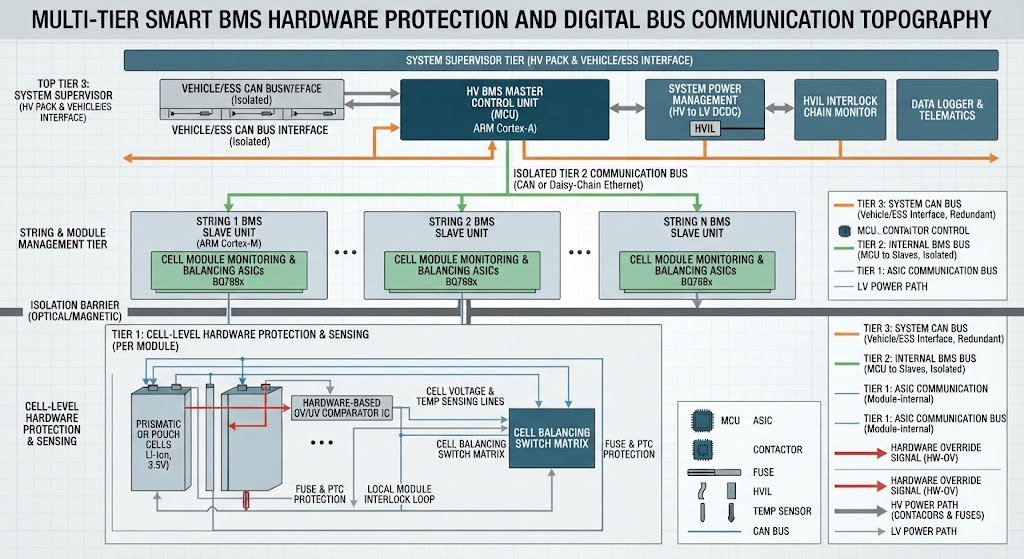
State-of-Charge (SOC) and State-of-Health (SOH) tracking demand dedicated Coulomb-counting algorithms integrated via CANbus, SMBus, RS485, UART, or Bluetooth protocols. Active and passive cell balancing topologies must be calculated to dissipate thermal loads safely across multi-cell strings.
Tier 3: Engineering for Extreme Operating Environments (-45°C to +80°C)
Standard commercial lithium cells suffer severe electrolytic freezing below -10°C, causing lithium plating on the graphite anode, sharp internal impedance spikes, and severe capacity loss. Conversely, prolonged exposure to temperatures above +55°C accelerates Solid Electrolyte Interphase (SEI) layer breakdown and risks catastrophic venting.
Mission-critical deployments require specialized sub-zero low temperature batteries engineered with low-viscosity ternary solvents, fluorinated ethylene carbonate (FEC) additives, and nano-coated electrode surfaces. These advanced chemical formulations maintain ionic conductivity down to -45°C, delivering over 75% capacity retention without external pre-heating.
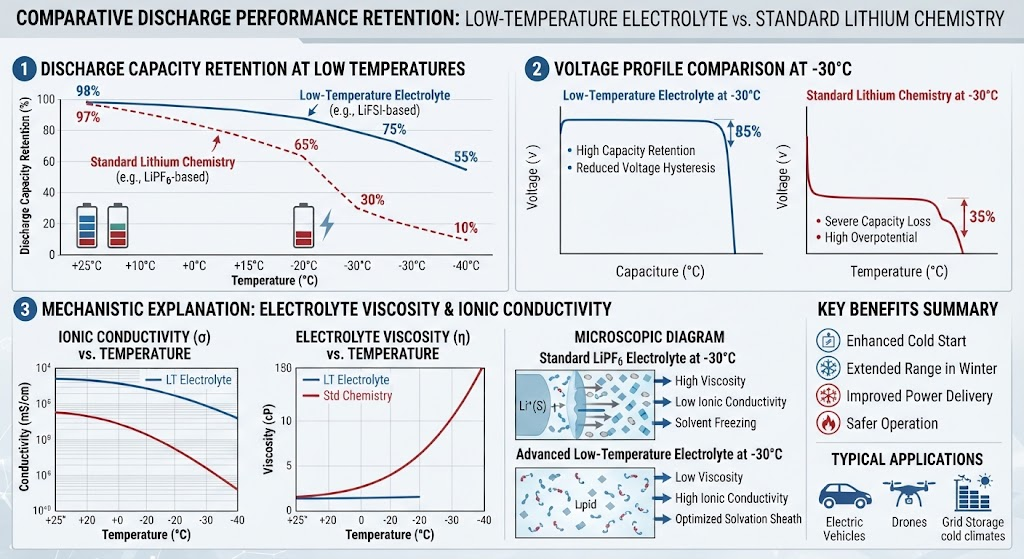
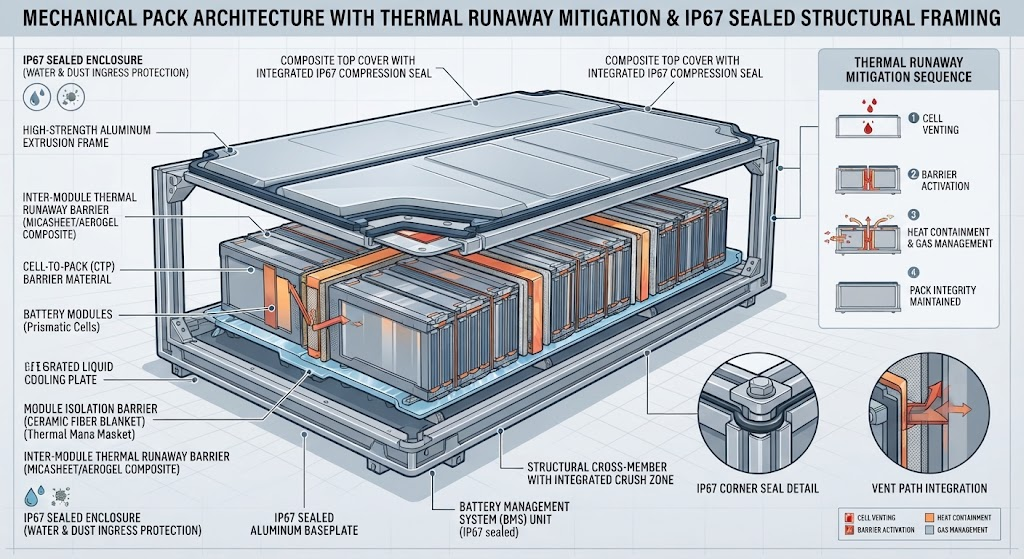
Engineering Rule: For mission-critical cold chain sensors or sub-zero defense telemetry, integrating internal positive temperature coefficient (PTC) heating elements and aerogel thermal barrier insulation prevents localized thermal bridging and stabilizes internal cell core temperatures.
Tier 4: Mission-Critical Medical & Industrial Regulatory Compliance
Developing hardware for critical infrastructure and healthcare demands verifiable audit trails. Off-the-shelf assemblies often fail certification audits due to missing raw material certifications, poor lot traceability, or inconsistent assembly protocols.
Manufacturers supplying clinical hardware must hold accredited certifications for ISO 13485 medical device batteries. This standard establishes complete Manufacturing Execution System (MES) traceability, tracking every cell serial number, automated laser welding resistance metric, and BMS calibration profile down to a guaranteed 0.03% (300 PPM) defect rate.
Key regulatory standards across industrial and medical supply chains include:
- IEC 62133-2: Global standard evaluating portable sealed secondary cells and packs under mechanical, thermal, and electrical fault conditions.
- UL 2054 / UL 1642: Rigorous commercial standards testing pack-level short-circuit resilience, overcharge endurance, and enclosure flame retardancy (UL94 V-0).
- ISO 13485 / ISO 9001: Medical and industrial Quality Management Systems ensuring risk management compliance under ISO 14971.
Tier 5: Global Dangerous Goods Logistics, UN38.3, and Customs Clearance
Lithium batteries are classified as Class 9 Dangerous Goods. Sourcing from a supplier lacking full logistics certification risks international customs seizures, port quarantine fees, and severe line-down assembly delays.
Every custom pack configuration must possess an authenticated UN38.3 Test Summary Report covering tests T1 through T8 (altitude simulation, thermal shock, vibration, impact shock, external short circuit, impact/crush, overcharge, and forced discharge). Shipments must be paired with verified Material Safety Data Sheets (MSDS), 1.2-meter drop test certifications, and compliant packaging according to IATA DGR (UN3480 / UN3481) regulations.
Total Cost of Ownership (TCO) vs Upfront Cell Pricing: The Hidden Financial Equation
Procuring lithium battery systems solely based on the lowest Bill of Materials (BOM) quote represents a major procurement risk. Initial pack purchase prices account for only 35% to 40% of the true lifetime expenditure.
Substandard packs lead to early capacity degradation within 300 cycles, frequent field Return Merchandise Authorizations (RMAs), and expensive emergency engineering changes. Sourcing fully validated battery packs lowers 5-year lifecycle expenditures by 28% to 34% by eliminating catastrophic field downtime.
Supplier Audit Checklist: 10 Critical Questions for Your Next Factory Inspection
Hardware engineering leads and global procurement directors should utilize this 10-point checklist when auditing potential battery manufacturing facilities:
- Automated Cell Screening: Does the facility utilize 100% automated OCV, ACIR, and capacity sorting bins prior to spot welding?
- Welding Quality Verification: Are pack busbars joined using automated fiber laser welding with real-time micro-resistance monitoring and pull-force verification?
- MES Lot Traceability: Can the supplier trace an individual assembled pack’s serial number back to raw cell production batch records and spot-welding thermal parameters?
- BMS Firmware Verification: Is BMS firmware developed in-house with dedicated hardware trip points, or is it licensed from an untraceable third party?
- Environmental Burn-In: Does the facility perform 100% full-cycle charge/discharge burn-in aging on assembled packs in temperature-controlled chambers?
- Cleanroom Assembly Standards: Are high-density pouch cell assemblies and medical packs built inside ISO Class 7 or Class 8 cleanrooms with strict ESD controls?
- In-House Testing Infrastructure: Does the supplier possess internal testing labs for thermal shock, vibration, short-circuit, and nail penetration stress testing?
- Quality Defect Guarantees: Does the supplier formally guarantee manufacturing defect rates under 300 PPM (0.03%) in contractual supply agreements?
- DFM & Turnkey Speed: Can the engineering team deliver full 3D mechanical pack models, thermal dissipation simulations, and functional prototypes within 5 to 7 business days?
- Logistics & Certification Heritage: Does the manufacturer maintain ready access to UN38.3 test summaries, active MSDS reports, and direct Class 9 freight export channels?
Frequently Asked Questions (FAQ)
What is the true Total Cost of Ownership (TCO) difference between Tier-1 Custom Packs and Tier-3 Off-The-Shelf Packs?
While Tier-3 off-the-shelf packs appear 15-25% cheaper upfront, their lack of precision cell binning (resulting in capacity degradation within 300 cycles), uncalibrated BMS protection (causing field shutdown risks), and missing UN38.3/UL certifications lead to customs clearance seizures, high RMA return rates (3-7%), and costly redesigns. JHY Battery custom engineered packs achieve 2,000 to 6,000+ stable cycles with a guaranteed 300 PPM defect rate, lowering overall 5-year TCO by 28% to 34%.
How do LFP, NMC, and LCO chemistries compare for custom OEM hardware selection?
LiFePO4 (LFP) provides superior thermal stability (runaway threshold > 270°C) and long cycle life (3,000 to 6,000+ cycles at 80% DOD), making it ideal for ESS, robotics, and industrial automation. NMC (Nickel Manganese Cobalt) delivers higher volumetric energy density (up to 260 Wh/kg), making it optimal for portable medical devices, UAVs, and power tools. LCO pouch cells are engineered for ultra-thin (down to 0.8mm) consumer IoT and smart wearables requiring maximum gravimetric energy density in compact volumes.
How do you audit and verify whether a battery supplier is using genuine Grade-A cells?
A rigorous supplier audit requires verifying: (1) Automated cell sorting data sheets demonstrating voltage variance under 5mV and AC Internal Resistance (ACIR at 1kHz) variance under 2mΩ within the same batch; (2) Original factory QR code traceability linked to the cell manufacturer’s batch test report; (3) Capacity retention curves tested at 1.0C discharge rates; and (4) Absence of swelling or electrolyte odor after 50 thermal shock cycles (-20°C to +60°C). JHY Battery enforces 100% cell impedance and capacity sorting before pack welding.
What documentation is mandatory for shipping custom lithium battery packs internationally under UN38.3?
International dangerous goods compliance requires: (1) Official UN38.3 Test Summary Report covering T1-T8 tests (altitude simulation, thermal test, vibration, shock, external short circuit, impact/crush, overcharge, forced discharge); (2) Certified Material Safety Data Sheet (MSDS) updated for current IATA DGR and IMDG code; (3) 1.2-Meter Drop Test Report for outer packaging; and (4) Dangerous Goods Declaration (DGD) with proper UN classification (UN3480 for loose cells/packs, UN3481 for batteries packed with or contained in equipment).
Accelerate Your Hardware Development with JHY Battery
Partner with an established industrial manufacturer backed by over 30 years of engineering leadership, 1,200+ team members, 800+ R&D engineers, and accredited ISO 13485 cleanroom production facilities.
Our Seamless 3-Step Action Funnel:
- Step 1: Application Sizing & Requirement Intake — Submit your operating voltage, continuous/peak discharge current, dimensional envelope, environmental limits, and compliance targets.
- Step 2: DFM Review & Custom BMS Architecture — Our engineering team delivers comprehensive 3D CAD models, custom PCM/BMS circuit topologies, thermal simulations, and optimized BOM quotes within 24 hours.
- Step 3: Rapid Prototyping & Validation — Receive fully instrumented, working functional prototypes in 5 to 7 business days for rapid bench testing and pre-compliance audits.
Direct Engineering Consultation Contacts:
Email: Simple@chinabatterymanufacturer.com | joeshen@chinabatterymanufacturer.com
WhatsApp / Direct Technical Line: +86-18575997879