Lithium Forklift Upgrades: Complete Fleet ROI Guide
What Is a Lithium Forklift Upgrade? Key Concepts and Core Architecture
Executing industrial lithium forklift upgrades reduces fleet operational downtime by up to 40% via high-efficiency opportunity charging. Replacing legacy lead-acid motive power with lithium iron phosphate (LiFePO4) systems eliminates manual battery exchanges, provides stable continuous discharge voltage across entire shifts, and maximizes warehouse operational efficiency.
- Lead-Acid Pain Points: Requires 8 hours of charging plus 8 hours of cooling; mandates weekly acid equalization and manual water top-offs; suffers severe voltage drop-off during heavy cycles.
- Lithium Conversion Advantage: Accepts full 1C–2C fast charging during scheduled operator breaks; 100% maintenance-free with zero electrolyte handling; sustains continuous high-torque voltage delivery.
- Infrastructure Optimization: Decommissions centralized battery swapping rooms, returning valuable floor square footage to core storage logistics.
- Cycle Life Superiority: Delivers 3,500 to 5,000 charge cycles, easily outlasting lead-acid alternatives by a 3:1 margin over standard equipment lifecycles.
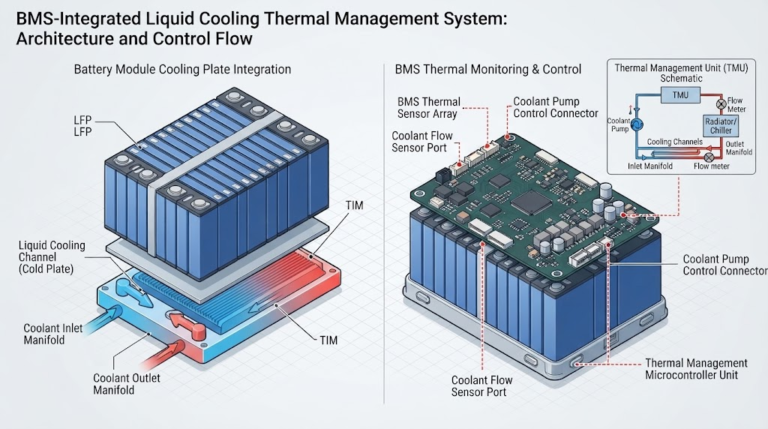
A lithium forklift upgrade is an engineering retrofit where the traditional lead-acid traction battery is replaced by an integrated lithium-ion battery assembly. This assembly includes cell modules, an active Battery Management System (BMS), thermal monitoring arrays, and engineered steel ballast weights designed to match the vehicle chassis specifications.
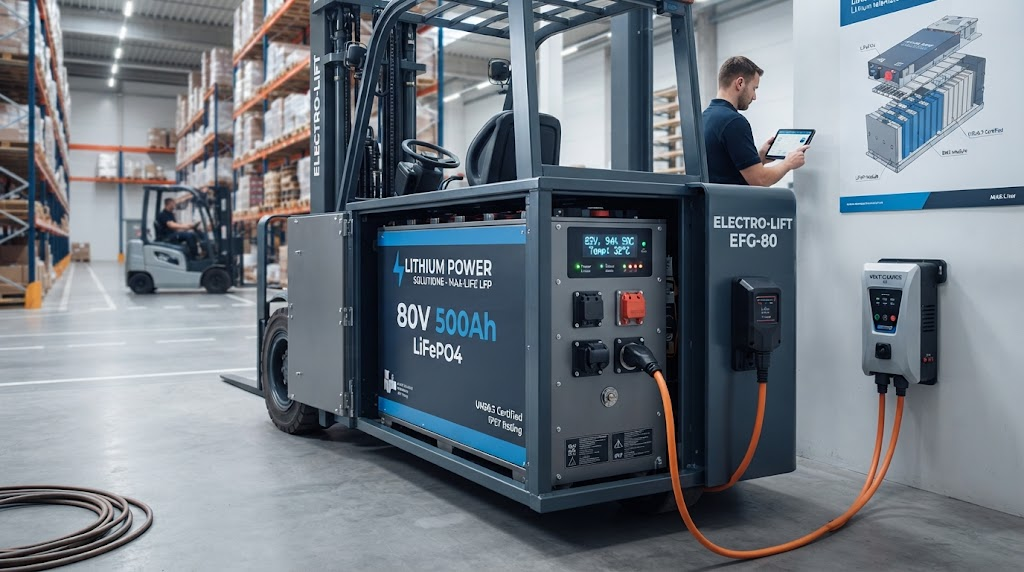
Material handling equipment relies on the battery not only for electrical motive energy, but also as a primary counterweight. Upgrading to a custom lithium solution from JHY Battery ensures that Class I, Class II, and Class III electric forklifts receive purpose-engineered assemblies that preserve strict physical balance tolerances while modernizing power delivery.
“A motive power retrofit is not simply a battery swap; it is a full electro-mechanical integration that aligns vehicle weight distribution, CAN communication, and continuous duty cycles.”
The 4-Stage Precision Retrofit Protocol (PRP) for Material Handling Fleets
Fleet engineers avoid integration failures by applying our systematic methodology: the Precision Retrofit Protocol (PRP). This framework standardizes the conversion process across mixed-brand fleets, ensuring electrical safety and mechanical stability.
- Stage 1: Fleet Power & Duty-Cycle Audit: Collect telematics data to log real energy consumption (kWh/hour), peak current draws during high-mast lifting, ambient operational temperatures, and shift shift patterns.
- Stage 2: Chassis & Ballast Calibration: Calculate the exact physical weight delta between the removed lead-acid battery and the prospective lithium pack. Mill precision structural ballast plates to maintain OEM counterweight requirements within ±2%.
- Stage 3: BMS & CAN Protocol Mapping: Integrate proprietary or open-source digital communications between the internal battery management system and the forklift’s vehicle control unit (VCU), preventing nuisance fault codes and enabling dashboard state-of-charge (SoC) precision.
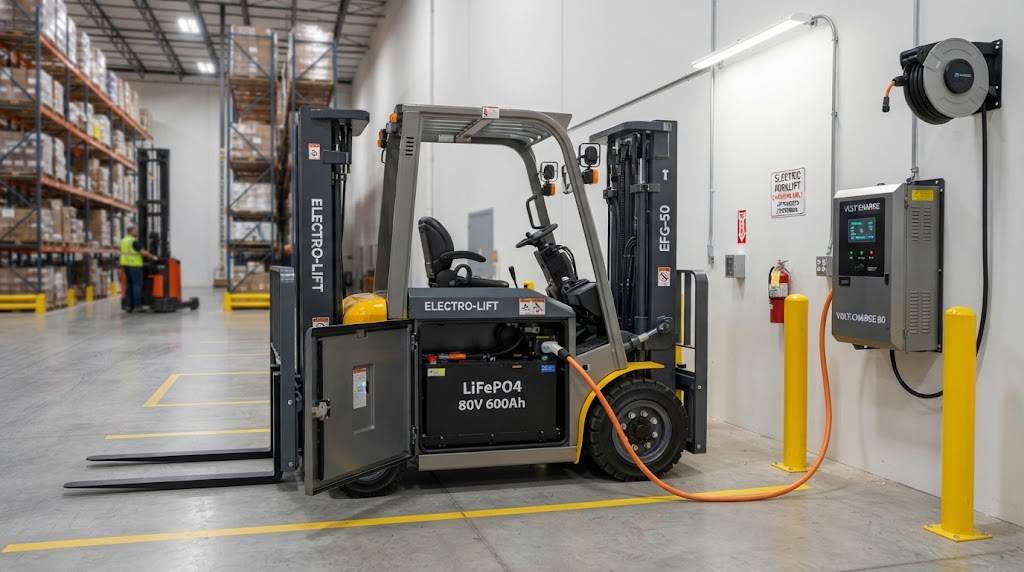
- Stage 4: Charger Decentralization: Decommission central battery rooms and install modular high-frequency chargers near break rooms, loading docks, and high-traffic staging areas to leverage opportunity charging.
Mechanical & Electrical Conversion: Ballast Plates and CAN Bus Telematics
Replacing heavy chemical batteries with high-density lithium chemistry presents two immediate engineering challenges: weight loss and digital communications. Resolving these issues correctly protects operator safety and equipment longevity.
Counterweight Sizing and Chassis Center-of-Gravity Calibration
Electric counterbalance forklifts depend entirely on battery mass to offset the load on the forks. Traditional lead-acid batteries weigh significantly more than lithium packs of equivalent capacity. Removing that weight without compensation dangerously shifts the forklift’s center of gravity forward, risking tip-overs during rated capacity lifts.
According to safety guidelines maintained by the Occupational Safety and Health Administration (OSHA), every industrial truck must operate within the manufacturer’s specified minimum and maximum battery service weights.
We calculate ballast requirements using the following standard equation:
Required Ballast Weight = Minimum OEM Battery Weight – Lithium Pack Core Weight
Ballast is not added loose. Structural carbon steel plates are integrated directly into the bottom of the battery tray enclosure. This lowers the vehicle’s overall center of gravity below original lead-acid baselines, enhancing chassis stability during cornering.
Resolving CAN Bus, Telematics, and Instrument Cluster Error Codes
Modern electric lift trucks communicate via digital bus networks. When an OEM controller cannot detect its expected battery telemetry, it flags communication errors, puts the vehicle into limp mode, or refuses to lift.
Engineered lithium retrofits bridge this gap by deploying programmable CAN transceivers that translate internal BMS data to the forklift’s native communication protocol:
- SAE J1939 Integration: Configured for high-throughput telematics, transmitting cell voltages, temperatures, total pack amperage, and high-frequency fault alerts.
- CANopen Profiles (CiA 418/454): Configured for European truck architectures, enabling direct instrument cluster display of true lithium State of Charge (SoC).
- Analog Interlocking: For legacy lift trucks without CAN bus networks, programmable current-loop outputs emulate standard lead-acid discharge curves to prevent premature lift-interrupt activation.
| Technical Parameter | Lead-Acid Traction | Industrial LiFePO4 Retrofit |
|---|---|---|
| Usable DoD Range | 50% – 80% maximum | Up to 95% continuous |
| Cycle Life (80% DoD) | 1,200 – 1,500 cycles | 3,500 – 5,000+ cycles |
| Energy Efficiency | 70% – 75% | 95% – 98% |
| Maintenance Demand | Weekly watering, equalization, wash-downs | Zero routine maintenance (BMS self-managed) |
| Charging Profile | 8h Charge + 8h Cool-down | 1h – 2h Full Charge / Opportunity Charge |
Facility Blueprint: Transitioning from Battery Rooms to Decentralized Opportunity Charging
Traditional multi-shift operations require centralized charging rooms equipped with overhead gantry cranes, acid spill containment kits, eye-wash stations, and heavy ventilation for off-gassing hydrogen. This footprint consumes thousands of square feet of usable logistics space.
Opportunity charging fundamentally shifts this dynamic. Opportunity charging during scheduled 15-to-30-minute breaks yields up to 40% higher truck utilization in multi-shift warehouse operations. Instead of parking trucks for extensive battery swaps, operators simply plug into localized fast-charging kiosks distributed throughout the facility.
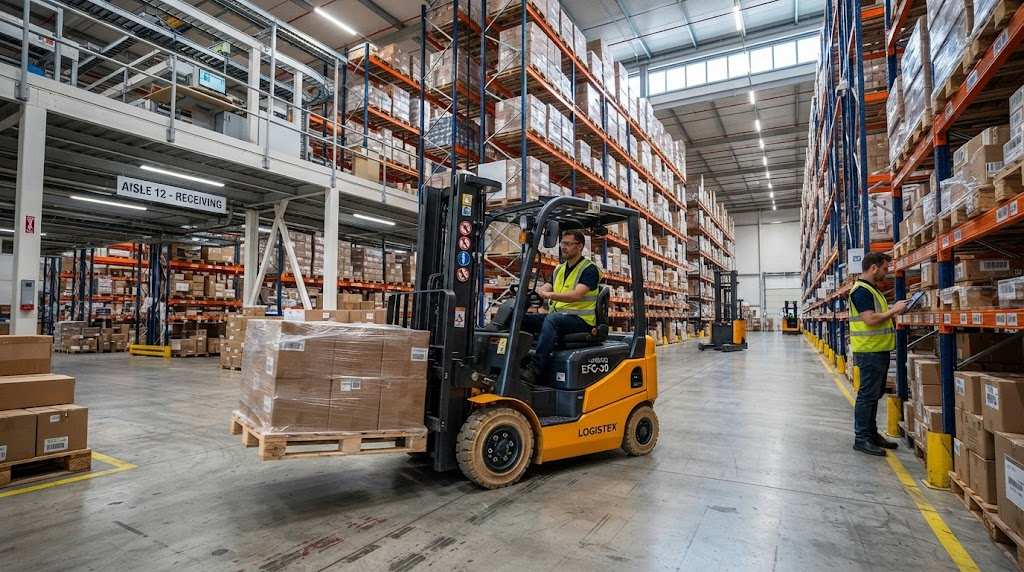
Decommissioning central battery rooms unlocks measurable operational benefits:
- Floor Space Recovery: Convert legacy battery storage bays directly into active pallet racking, picking zones, or staging docks.
- Elimination of Swap Hazards: Removing overhead hoists and physical battery exchanges reduces operator crush injuries and acidic chemical exposure.
- Optimized Electrical Distribution: Distributed modular chargers draw clean, high-power-factor energy without the thermal and current spikes associated with large lead-acid banks.
Financial Modeling: TCO, Direct Labor Savings, and Multi-Shift Payback
While the upfront acquisition cost for an industrial lithium pack is higher than that of lead-acid, total fleet economics strongly favor lithium over a standard 3-to-5-year operating window. Upgrading from lead-acid to lithium-ion eliminates up to 85% of battery-related maintenance labor costs within the first year.
Consider the total operational metrics for a typical 24/7 distribution facility running 20 Class I counterweight forklifts across 3 continuous shifts:
- Battery Fleet Ratio: Lead-acid requires a 3:1 or 2:1 battery-to-truck ratio (40–60 packs total) to allow for cooling and charging cycles. Lithium requires a simple 1:1 ratio (20 packs total).
- Labor Reductions: Deletes daily battery exchange routines (averaging 15–20 minutes per truck, twice per day) and eliminates weekly deionized water topping tasks.
- Utility Efficiency: Lithium systems operate at 95%+ round-trip coulombic efficiency versus ~70% for lead-acid, yielding immediate utility electricity savings on heavy draw cycles.
“In multi-shift warehouse fleets, the capital payback on engineered lithium retrofits is typically realized within 10 to 14 months purely on eliminated swap labor and charging efficiency.”
Regulatory Compliance: Fire Safety, Battery Passports, and UL Standards
Deploying motive power retrofits requires compliance with international functional safety standards. Industrial conversions must adhere to strict fire suppression and cell safety protocols.
Engineering standards to verify before purchasing retrofit packs include:
- UL 2580: Validates safety compliance for batteries used in electric vehicles, covering crushing, impact, short-circuit, and thermal runaway containment.
- UL 9540A: Evaluates large-scale thermal runaway fire propagation, ensuring that cell-level thermal events cannot spread across the module or ignite adjacent warehouse assets. Refer to engineering frameworks from NFPA standards for stationary and mobile industrial storage fire protection.
- Battery Passports & Traceability: Conforming to global digital passport protocols, which mandate transparent traceability of raw material sourcing, state-of-health tracking, and standardized circular end-of-life recycling pathways.
Downloadable Pre-Conversion Inspection Checklist for Maintenance Teams
Before ordering custom lithium retrofit packs, your internal fleet engineers or maintenance supervisors should confirm the physical and electrical parameters below:
- Compartment Geometry: Measure inside battery well dimensions (Length × Width × Height in mm) down to the millimeter, taking note of tapered sidewalls or internal cable conduits.
- OEM Weight Plate Verification: Inspect the vehicle chassis nameplate to record the exact Minimum Battery Weight そして Maximum Battery Weight parameters.
- Cable Exit Location & Length: Identify whether top, side, or dual-exit cabling is required, and specify the correct Anderson/Euro connector standard (e.g., DIN 160A, DIN 320A, SB350).
- Voltage Range Compatibility: Ensure controller operating voltage windows (e.g., 24V, 36V, 48V, or 80V nominal) align with the lithium pack’s peak charging and low-voltage cutoff limits.
- On-Board Telematics Interface: Determine whether CAN bus communication is mandatory for dash display integration or if an external state-of-charge dashboard meter is acceptable.
Frequently Asked Questions About Lithium Forklift Conversions
How do lithium forklift batteries perform in cold storage and blast freezers?
Unlike lead-acid batteries, which lose up to 50% of their usable capacity in freezing temperatures, industrial lithium packs equipped with internal BMS-controlled heating elements operate continuously down to -30°C (-22°F). The integrated thermal management system pre-warms the cells during opportunity charging, allowing high current draw and standard charge acceptance inside cold environments.
Does retrofitting a third-party lithium battery void the forklift OEM warranty?
Under standard commercial equipment law and warranty guidelines, an OEM cannot void a truck’s overall chassis or hydraulic warranty simply because a third-party battery is installed, provided the battery meets the OEM’s specified voltage, current, and counterweight limits. High-quality custom lithium manufacturers design systems to match OEM engineering tolerances precisely.
Can we operate a mixed fleet of lead-acid and lithium forklifts during our transition?
Yes. Facilities frequently migrate one department or shift at a time. The key is implementing dedicated, marked opportunity-charging locations for lithium trucks while maintaining designated charging stations for remaining lead-acid units during the transition period.
About the Author & Engineering Verification Standards
This technical guide was authored by the motive power systems engineering team at JHY Battery. Our industrial engineering group specializes in custom LiFePO4 battery architectures, ballast integration, and CAN-based telemetry for heavy material handling platforms.
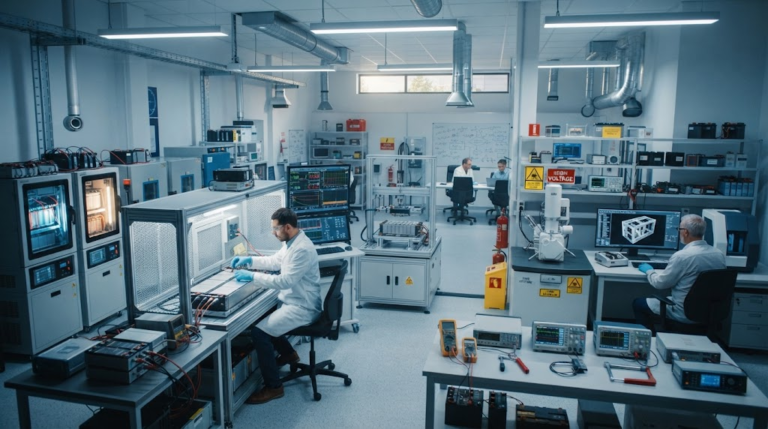
Every engineering metric and integration standard documented here is validated through empirical dynamometer stress testing, thermal cycling analysis, and real-world multi-shift warehouse trials conforming to ISO 9001 and UL safety mandates.
Upgrade Your Forklift Fleet to Engineered Lithium Power
Eliminate battery maintenance downtime, optimize counterweight balance, and reduce operating costs with custom drop-in retrofit packs designed for your equipment.