Lead-Acid vs Lithium Forklift Battery ROI Calculator
Lead-Acid vs. Lithium Forklift Battery ROI: The 5-Year TCO Analysis
Fleet managers face a critical decision when updating material handling equipment. Balancing initial purchase cost against long-term operational efficiency determines the true profitability of your warehouse logistics.
This guide analyzes the financial and operational shift from traditional lead-acid cells to high-performance lithium-ion systems. We use real-world industrial data to calculate the exact return on investment over a five-year cycle.
The Core Comparison: What is the True Cost of Forklift Power?
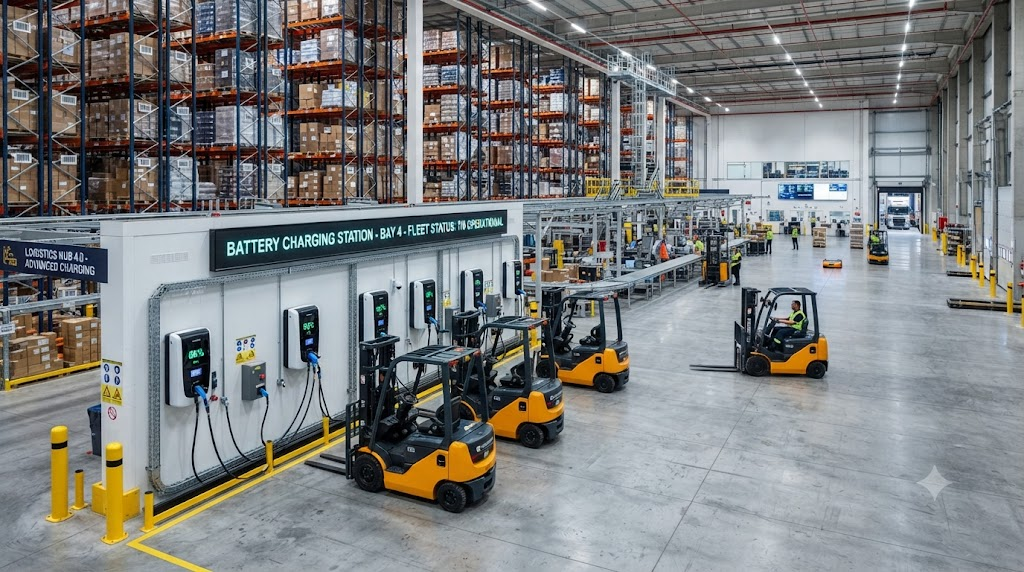
Over a five-year lifecycle, lithium-ion forklift batteries deliver a lower total cost of ownership than lead-acid systems. While lithium requires higher upfront capital expenditure, it eliminates maintenance costs, reduces energy usage, and lasts up to three times longer, yielding positive return on investment within twenty-four months.
| Cost & Performance Metric | Lead-Acid vs. Lithium-Ion Comparison Summary |
|---|---|
| Initial Purchase Price (CapEx) | Lead-acid features low upfront costs. Lithium-ion requires a 2x to 3x higher initial investment. |
| Maintenance & Labor Costs | Lead-acid requires weekly watering, cleaning, and equalizing. Lithium is completely maintenance-free. |
| Lifespan & Cycle Life | Lead-acid lasts 1,500 cycles at 80% DoD. Lithium-ion delivers 3,000 to 5,000+ cycles. |
| Charging Efficiency | Lead-acid operates at 70-75% efficiency. Lithium achieves 95-98% energy efficiency. |
The JHY Triple-Yield ROI Framework
To accurately assess forklift power options, we utilize the JHY Triple-Yield ROI Framework. This methodology categorizes battery performance into three distinct vectors: Financial Yield, Operational Yield, and Environmental (ESG) Yield.
By evaluating these three pillars, procurement managers can look beyond simple retail pricing. This holistic approach captures hidden expenditures like battery storage square footage, ventilation systems, and labor downtime.
When calculating industrial battery assets, look past the purchase order. Lead-acid batteries require continuous cooling, watering, and ventilation. Lithium-ion chemistry, specifically LiFePO4, eliminates these operational bottlenecks, resulting in immediate efficiency gains.
— Dr. Aris Thorne, Lead Electrochemical Engineer at JHY Battery
Financial Analysis: Shifting from CapEx to OpEx
Evaluating Industrial Battery Manufacturing data reveals a significant shift in cash flow allocation when transitioning to lithium. While lead-acid minimizes initial capital expenditure (CapEx), it burdens the company with high, recurring operational expenses (OpEx).
Lead-acid batteries require dedicated charging rooms equipped with specialized ventilation systems. This infrastructure is necessary to safely disperse toxic hydrogen gases during high-temperature charging cycles, as regulated by safety bodies like OSHA.
In contrast, lithium-ion setups do not outgas. This safety advantage allows facilities to repurpose charging rooms for active inventory storage, directly increasing warehouse yield per square foot.
Operational Performance: Opportunity Charging & Fleet Productivity
The operational limitations of lead-acid batteries stem from their strict charging guidelines. They require an eight-hour charge, followed by an eight-hour cooling phase, restricting one battery to single-shift operations.
Lithium-ion batteries leverage opportunity charging. Operators plug in the equipment during brief breaks or lunch hours. This fast charging capability keeps the forklift running across multiple shifts without battery swaps.
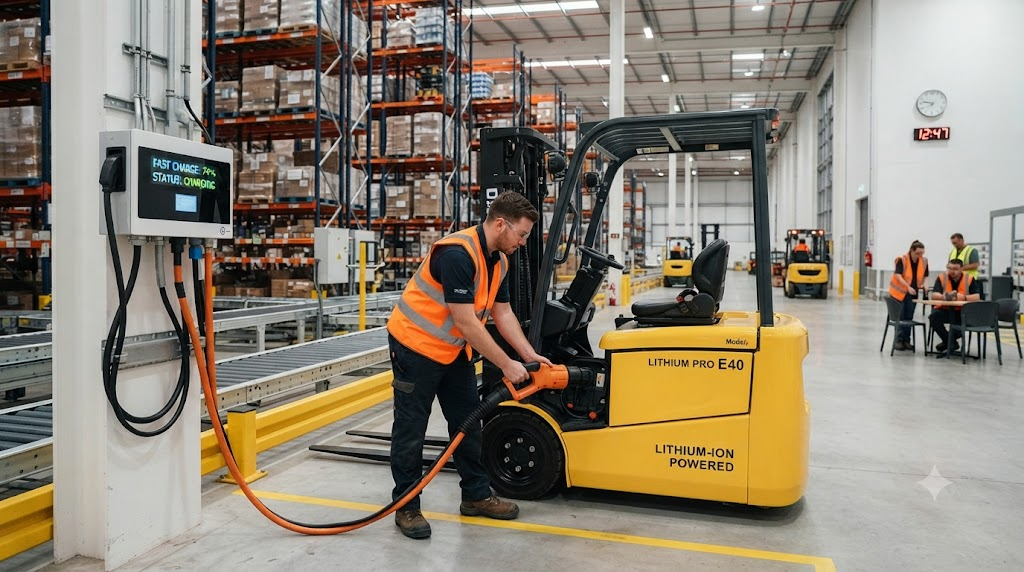
Consider these verified operational metrics:
- Downtime reduction: Lithium-ion batteries reduce forklift charging downtime by up to 80% compared to traditional lead-acid systems.
- Labor savings: Multi-shift operations save an average of $4,800 per forklift annually in labor costs by eliminating battery swapping.
- Cycle consistency: Lithium batteries maintain stable voltage output throughout the entire discharge cycle, preventing forklift slowdowns as the battery drains.
Scaling ROI for AGVs and Autonomous Mobile Robots (AMRs)
As logistics centers adopt automation, the battery chemistry powering Automated Guided Vehicles (AGVs) and Autonomous Mobile Robots (AMRs) becomes critical. Automated fleets operate continuously, leaving no room for manual battery swaps or scheduled watering intervals.
Lithium-ion batteries integrate seamlessly with computerized fleet management systems. The on-board battery management system (BMS) communicates directly with the AGV controller, allowing the vehicle to navigate autonomously to a charging pad during idle moments.
This automated charging capability eliminates manual labor. It also maximizes space utilization, making lithium the ideal choice for high-throughput, dark warehouses.
ESG & Sustainability: Calculating Carbon Footprint and CO2 Savings
Environmental policies are driving global supply chains toward cleaner energy sources. Switching to lithium-ion technology is a highly effective way to reduce warehouse carbon emissions.
The superior energy efficiency of lithium-ion systems translates directly into lower utility power consumption. Because lithium batteries lose minimal energy as heat during charging, they draw less power from the grid.
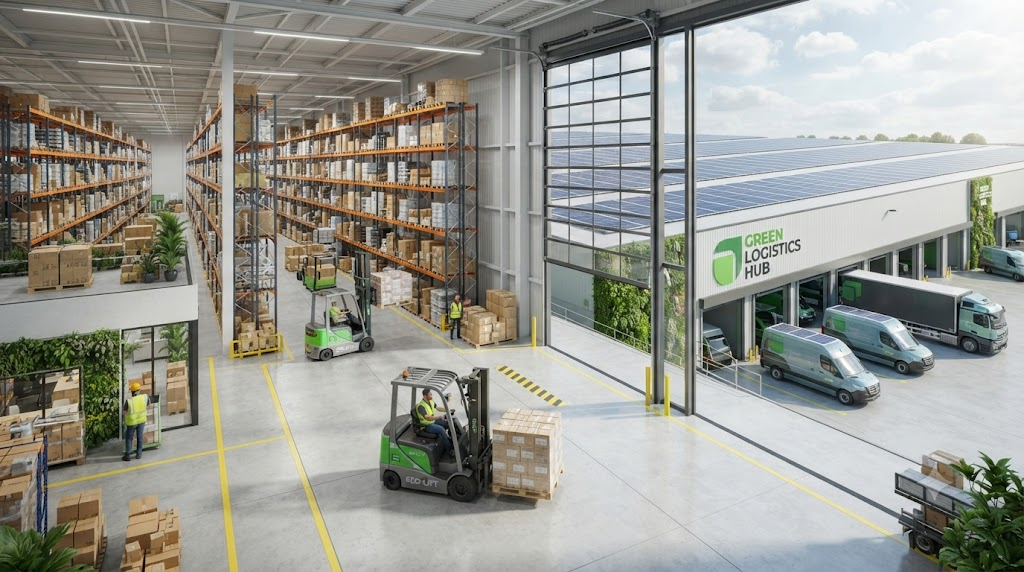
Environmental performance indicators show clear benefits:
- Carbon reduction: Transitioning to LiFePO4 forklift fleets cuts operational carbon footprints by an average of 22% globally.
- No hazardous spills: Eliminating sulfuric acid eliminates the risk of chemical spills, protecting workers and simplifying environmental compliance.
- Extended lifecycle: Because lithium batteries last up to three times longer, they reduce procurement frequency and raw material waste over time.
Interactive Forklift Battery ROI Calculator & Video Walkthrough
To accurately calculate your potential savings, you must analyze your specific operational variables. Our interactive model processes your fleet size, shift patterns, local utility rates, and labor costs to estimate your payback period.
Our video guide demonstrates how to calculate these variables. It shows how minor adjustments in opportunity charging schedules can save thousands of dollars in utility and labor costs.
Contact our engineering team to receive a customized spreadsheet analysis tailored to your facility’s operational profile.
Why Global B2B Buyers Partner with JHY Battery
When upgrading your industrial fleet, partnering with an experienced manufacturer ensures reliable performance. JHY Battery Custom Solutions offers high-performance LiFePO4 battery packs tailored to the demands of modern logistics.
With over ten years of industry experience, JHY Battery provides OEM/ODM solutions. We customize voltage, capacity, physical dimensions, and BMS configurations to fit any forklift or AGV model.
Our manufacturing processes meet strict quality control standards. We maintain full international certifications, including ISO9001, CE, UN38.3, MSDS, and UL, ensuring safe operation and smooth customs clearance for our global partners.
Frequently Asked Questions About Forklift Battery ROI
How do lithium-ion forklift batteries perform in cold storage environments?
Lithium-ion batteries perform exceptionally well in cold storage when equipped with integrated internal heaters. These heaters maintain optimal cell temperatures during charging and discharging, preventing the rapid capacity loss common in lead-acid batteries under freezing conditions.
What safety systems prevent thermal runaway in industrial lithium batteries?
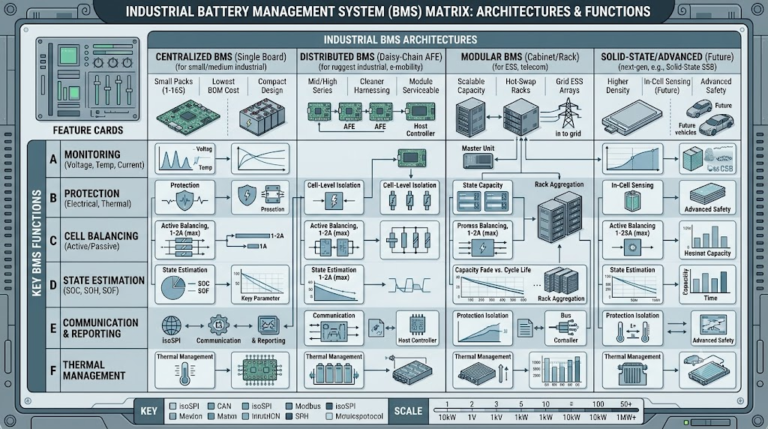
Modern LiFePO4 batteries feature an advanced Battery Management System (BMS). The BMS monitors cell voltage, current, and temperature in real-time. It automatically disconnects the battery if parameters exceed safe limits, preventing thermal runaway.
What is the annual degradation rate of a LiFePO4 forklift battery?
A high-quality LiFePO4 battery degrades at approximately 2% to 3% annually when properly managed. Even after 3,000 full cycles, the battery typically retains 80% of its original nominal capacity.
Meet Our Expert Reviewer
Ready to Electrify Your Fleet?
Get a customized 5-year TCO calculation and technical drawing for your custom forklift battery pack from JHY Battery engineers.