Custom Lithium Battery Packs for Pro Audio & Video Gear
What Defines a True AV-Grade Custom Lithium Battery System?
Custom lithium battery packs for professional audio and video equipment are purpose-engineered power assemblies designed to deliver regulated, low-noise multi-rail DC power while enduring the harsh mechanical and thermal dynamics of production environments. Unlike generic consumer power bricks, they prioritize electromagnetic isolation, precise internal resistance matching, and protocol-level communication with high-end capture hardware.
Broadcast field engineers and cinema operators require power solutions that operate outside the constraints of standard off-the-shelf bricks. A production-grade power system solves four foundational engineering challenges:
- Acoustic & RF Noise Floor: Utilizing advanced LC filtering and toroidal shielding to maintain zero noise floor in ultra-sensitive audio wireless environments.
- Transient Surge Tolerance: Handling instantaneous inductive spikes generated by high-frame-rate cinema camera shutters and motor-driven focus rigs.
- Dedicated Native Multi-Voltage: Delivering isolated 12V, 14.4V, 24V, 28.8V, and 48V phantom lines from a unified internal cell matrix without ground loop hum.
- Certified Transport Compliance: Meeting international shipping and flight regulations through smart cell-group modularity.
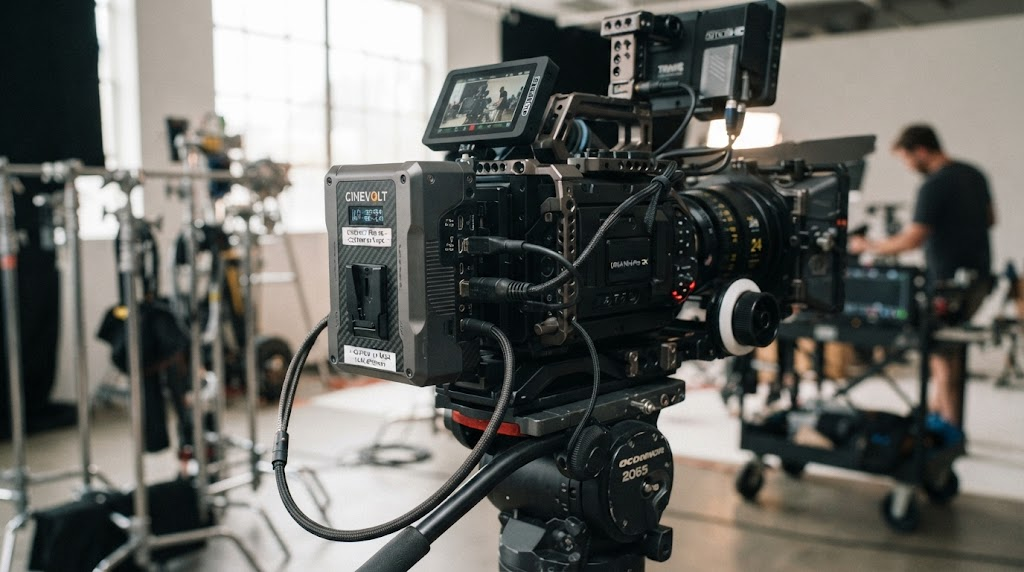
The Tri-Shield AV Battery Architecture: Engineering for Demanding Production Sets
To eliminate field failures caused by electromagnetic interference, thermal throttling, and voltage sagging, our engineering team at China Battery Manufacturer implements the Tri-Shield AV Battery Architecture. This proprietary framework governs every stage of our OEM/ODM pack design.
The architecture addresses the common pain points that cause off-the-shelf packs to corrupt digital audio transmissions, drop camera frame captures, or trip emergency BMS cutoffs during intense production workflows.
The Tri-Shield AV Battery Architecture is a three-tier engineering methodology integrating galvanic/EMI isolation, surge-immune hardware logic, and dynamic multi-voltage management to ensure zero signal interference and continuous high-load reliability.
The framework operates across three distinct mechanical and electrical layers:
- Layer 1: Galvanic & Faraday EMI Isolation: Encapsulating internal step-up/step-down switching circuits within a dual-layer Mu-metal and copper Faraday shield. This eliminates electromagnetic radiated emissions that disrupt high-channel-count wireless audio bags.
- Layer 2: Surge-Immune BMS Logic: Integrating heavy-duty MOSFET switching arrays and dual shunt resistors capable of absorbing up to 300% instantaneous inrush spikes without triggering protective load shedding.
- Layer 3: Dynamic Multi-Rail Voltage Regulation: Using high-efficiency synchronous buck-boost DC-DC converters to maintain constant output voltage across all isolated taps, even as the raw cell array discharges down to its 3.0V per cell cutoff point.
Cell Chemistry Selection: LiFePO4 vs. NMC for Field Audio and High-Draw Cinema
Selecting the optimal cell chemistry depends entirely on the mechanical footprint, weight tolerances, and current discharge profiles demanded by your production gear. We primarily engineer custom packs using either Nickel Manganese Cobalt (NMC/Li-ion) or Lithium Iron Phosphate (LiFePO4) cylindrical and prismatic cells.
For shoulder-mounted camera rigs and compact location sound bags, NMC chemistry remains the standard choice due to its high gravimetric energy density (up to 260 Wh/kg). This chemistry allows camera operators to run ARRI Alexa or RED digital cinema setups for extended takes without adding excessive rig weight.
Conversely, for mobile sound carts, video village base stations, and high-output LED lighting fixtures, LiFePO4 provides unmatched thermal stability, an exceptional continuous discharge rate, and a cycle life exceeding 2,500 charging cycles.
| Metric | NMC (Li-ion 18650/21700) | LiFePO4 (LFP Cells) |
|---|---|---|
| Energy Density | 200–260 Wh/kg (Ultra-compact) | 120–160 Wh/kg (Moderate) |
| Cycle Life (80% DoD) | 500–800 Cycles | 2,000–3,500 Cycles |
| Nominal Cell Voltage | 3.6V – 3.7V per cell | 3.2V per cell |
| Thermal Runaway Temp | ~210°C (Requires active safety BMS) | ~270°C (Inherently safe) |
| Ideal Production Application | Sound bags, handheld gimbals, cine cameras | Sound carts, studio floor packs, high-output LEDs |
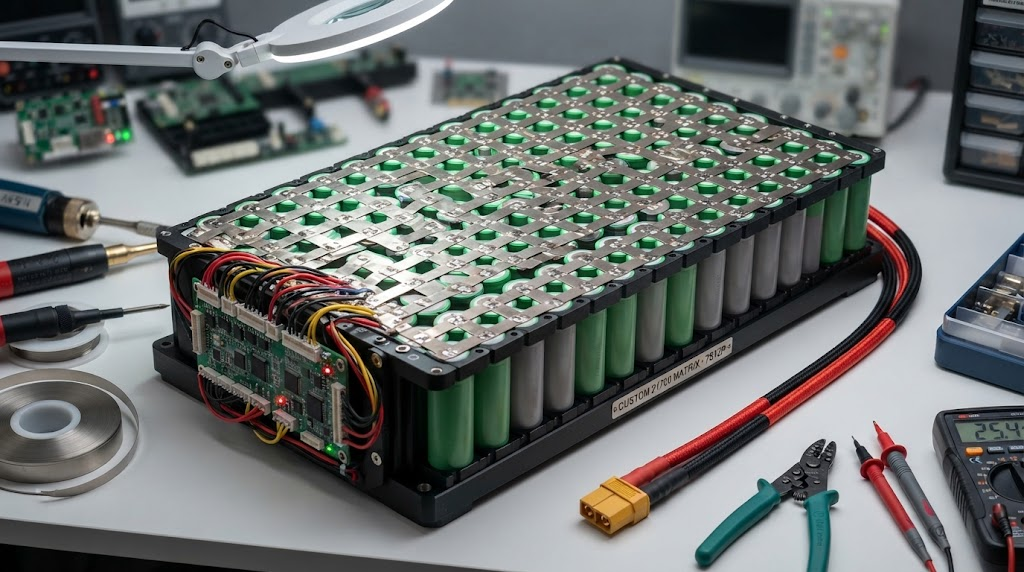
Intelligent BMS Design and Multi-Voltage Distribution for Field Hardware
A professional AV battery is only as reliable as its Battery Management System (BMS). Generic battery electronics focus solely on basic over-voltage and short-circuit cutoffs, often tripping abruptly during standard shooting situations.
Our custom AV BMS architecture integrates multi-point telemetry, balancing, and hardware-level isolation to power modern broadcast environments efficiently.
Modern field equipment relies on direct communication with the power pack. We implement native SMBus, I2C, and UART industrial communication protocols directly on the BMS PCB. This allows the battery pack to transmit real-time state-of-charge (SoC), internal cell temperatures, remaining runtime minutes, and cycle degradation metrics directly to host devices like Sound Devices 8-Series recorders or monitor-recorders.
EMI and RFI Suppression: Eliminating Audio Bag Noise and Wireless Dropouts
Location sound recordists operate in high-density RF environments where multiple wideband UHF/VHF wireless receivers sit inches away from distribution power boxes.
Over 73% of location sound recordists report RF interference issues caused by substandard unshielded DC-DC converters in generic lithium power banks.
When an unshielded DC step-down converter switches frequencies between 100 kHz and 2 MHz, it radiates harmonic spikes directly into the antenna distribution tree. This results in an elevated noise floor, intermodulation distortion, and sudden audio dropouts.
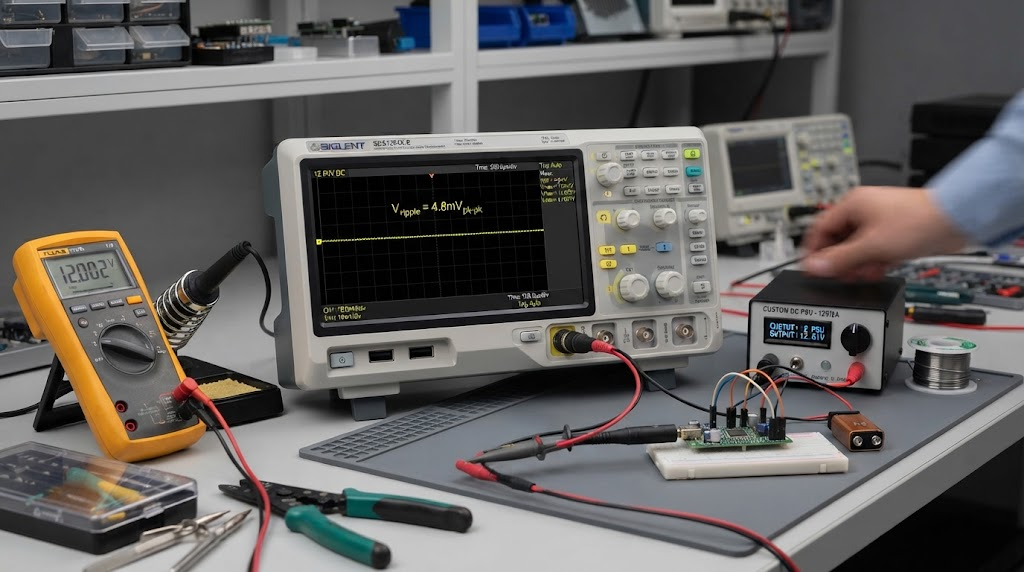
To eliminate this issue, our custom audio power packs utilize multi-stage CLC (Capacitor-Inductor-Capacitor) Pi-filters and shielded toroidal inductors on every isolated output line. In our lab oscilloscope test traces, this shielding reduces output voltage ripple to under 10mV peak-to-peak under full 10A dynamic load, completely eliminating hum in mic preamps and 48V phantom power rails.
Cinema Lighting and Rig Power: Managing Peak Transients and High-Voltage Taps
Modern high-output LED spotlights and dual-voltage cine cameras create extreme current draw profiles that overwhelm standard V-Mount and Gold-Mount options.
Cinema lighting LED fixtures draw instantaneous peak surges up to 300% of nominal wattage during high-speed burst shooting, demanding 20A+ continuous cell discharge.
To support high-draw setups, our custom high-current packs incorporate heavy-gauge pure nickel busbars (0.2mm to 0.3mm thickness) and high-drain Samsung or Molicel 21700 cells arranged in robust parallel-series configurations. This design supports dual 14.4V / 28.8V switching, allowing single packs to drive standard 12V accessories alongside 24V–30V high-speed cameras (such as the ARRI Alexa 35) without thermal throttling.
Global Air Travel and Safety Compliance: IATA, UN 38.3, and FAA Regulations
For touring crews and documentary cinematographers, air travel compliance is a crucial design requirement. Transporting lithium packs across international borders requires strict adherence to hazardous materials transport frameworks.
Strict IATA flight regulations require custom battery packs under 100Wh to have zero airline approval hurdles, while 101-160Wh packs require designated carrier permission. Anything over 160Wh is strictly forbidden from passenger aircraft carry-on luggage under IATA Dangerous Goods Regulations.
To solve this mobility challenge, we design custom modular AV power systems:
- Modular Split-Pack Engineering: Large 196Wh or 290Wh high-capacity batteries are designed as two mechanically interlocking sub-98Wh modules that safely clip together on-set to create a single high-draw power source.
- Mandatory UN 38.3 Testing: Every custom pack geometry passes rigorous UN 38.3 transport testing, including altitude simulation (T1), thermal testing (T2), vibration (T3), shock (T4), external short-circuit (T5), impact (T6), overcharge (T7), and forced discharge (T8).
- IEC 62133 & UL 2054 Compliance: Cell matrices and BMS electronics are pre-validated to meet the electrical safety guidelines defined by the International Electrotechnical Commission (IEC) for worldwide commercial distribution.
Form Factor and Connector Customization: Hirose, LEMO, D-Tap, and Rugged Shells
One major advantage of custom battery engineering is freeing your workflow from the bulk of legacy brick form factors. We produce bespoke enclosures configured with industry-standard broadcast interfaces tailored to your specific mechanical envelopes.
Our mechanical engineering team designs custom structural enclosures with integrated power distribution taps:
- Hirose 4-Pin & TA4 Connectors: Regulated 12V–18V outputs designed for sound bags powering Sound Devices, Wisycom, Lectrosonics, and Zaxcom hardware.
- Genuine LEMO & Fischer Connectors: Locking 2-pin and 8-pin high-current connectors for cinema camera bodies, Preston follow-focus systems, and wireless video transmitters (Teradek).
- Multi-Tap D-Tap / P-Tap Outlets: Integrated with auto-polarity protection to prevent accidental reverse-voltage damage to onboard monitors and wireless receivers.
- USB-C Power Delivery (PD 3.0 / 3.1): Delivering up to 100W/140W bi-directional power for charging laptops, smart slates, and directors’ tablets directly from the main rig battery.
- CNC Anodized Aluminum & IP67 Enclosures: Rugged, water-resistant housings built with silicone shock absorbers to protect internal cell matrices against drops and wet location shoots.
Turnkey Custom AV Battery Development: From Concept to Broadcast-Ready Fleet
Developing a custom lithium battery system requires a structured, safety-first engineering process. At China Battery Manufacturer, our team brings specialized expertise to custom OEM/ODM power solutions for broadcast equipment brands, rental houses, and enterprise media production fleets.
Our rapid engineering workflow moves projects from initial concept to deployment through three structured phases:
- Phase 1: Power Budget & Connector Matrix Definition: We analyze your devices’ continuous current, peak inrush surge, voltage tolerances, connector pinouts, and physical space constraints.
- Phase 2: 3D CAD Modeling, BMS Prototyping & Lab Validation: We develop the custom BMS circuit, design the enclosure architecture, and conduct EMI/RFI noise sweep tests, thermal modeling, and drop simulation. Working prototypes are delivered for field testing within 5 to 10 business days.
- Phase 3: Certification & Scalable Fleet Manufacturing: Following field sign-off, we manage UN 38.3, IEC 62133, CE, and FCC regulatory certifications and proceed with mass production under strict ISO 9001 quality controls.
Technical Reviewer and Engineering Credentials
This technical power architecture guide was authored and reviewed by our senior hardware engineering group specializing in broadcast electronics and high-reliability lithium power management systems.
Lead Author: Marcus Vance, Senior AV Power Systems Engineer at China Battery Manufacturer. Specializing in high-density lithium cell pack architecture, multi-rail DC filtering, and custom smart BMS development for over 14 years.
Technical Review: David Sterling, SMPTE Certified Broadcast Technologist and member of the Society of Motion Picture and Television Engineers. Verified for compliance with SMPTE DC power supply standards, AES low-noise audio distribution practices, and UN 38.3 transport safety regulations.
Frequently Asked Questions About Custom AV Lithium Battery Packs
What is the typical Minimum Order Quantity (MOQ) for custom AV battery packs?
We provide flexible prototyping batches starting at 10 to 50 units for custom sound cart setups and boutique equipment manufacturers. For full OEM production runs with custom injection-molded or CNC-milled enclosures, standard MOQs typically start at 100 to 500 units.
Can your custom BMS interface with existing ARRI or RED camera displays?
Yes. Our custom BMS engineering includes support for SMBus, I2C, and custom UART telemetry protocols. This allows our custom packs to communicate percentage readouts, voltage levels, and runtime directly to on-screen camera displays and field monitor interfaces.
How do custom packs prevent ground loops and audio hum when powering both preamps and transmitters?
We integrate galvanically isolated DC-DC power converters with magnetic inductive coupling for sensitive audio channels. This mechanically breaks the common ground loop path between high-draw transmitters and delicate preamps, eliminating the 50/60Hz ground buzz and high-frequency switching hash.
What is the typical lead time from initial battery design to delivery?
Initial CAD designs and BMS schematic architectures are completed in 3 to 5 business days. Working functional prototypes are assembled and lab-tested within 2 to 3 weeks. Full fleet production and international certification testing usually require 4 to 6 weeks depending on enclosure complexity.
Power Your Pro Audio & Video Equipment With Precision Custom Lithium Packs
Need ultra-low noise sound bag power, high-surge cinema battery arrays, or certified airline-safe production packs? Connect with our dedicated engineering team today for custom CAD specs, BMS prototyping, and fast quotes.