Battery Thermal Management System: Engineering Guide
What Is a Battery Thermal Management System (BTMS)?
A Battery Thermal Management System (BTMS) is an active or passive thermal control network designed to monitor, regulate, and maintain electrochemical cells within their optimal operating window of 15°C to 35°C. It dissipates internal heat during discharge, manages heat spikes during fast charging, and provides heating in freezing environments.
A Battery Thermal Management System (BTMS) regulates the thermal environment of electrochemical cells through convective liquid, dielectric fluid, air, or phase-change heat transfer to prevent capacity fade, suppress thermal runaway, and equalize pack temperature gradients.
Every commercial lithium battery requires thermal equilibrium to perform efficiently. When selecting an architecture for custom lithium-ion battery pack manufacturing, engineers classify heat dissipation mechanisms into four core categories:
- Forced Air Cooling: Relies on blowers and duct channels to move ambient or conditioned air across cell casings. Best suited for low-discharge stationary systems.
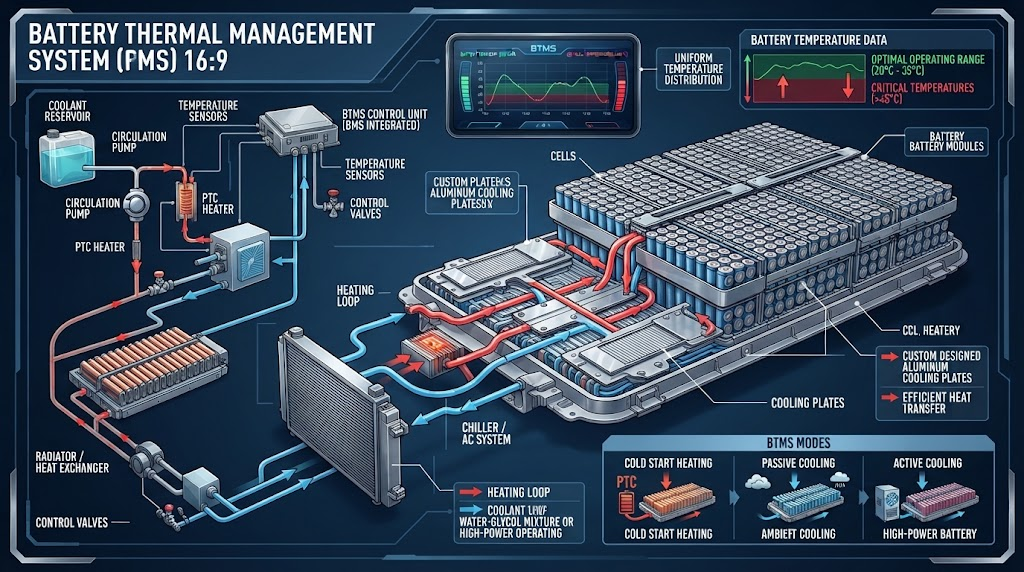
- Indirect Liquid Cooling: Pumps water-glycol mixtures through aluminum cold plates and micro-channels adjacent to cells. This remains the current standard for automotive and industrial powertrains.
- Direct Dielectric Immersion: Submerges cells and busbars directly into non-conductive synthetic fluids, stripping heat directly at the source.
- Phase Change Materials (PCM): Absorbs high thermal flux through latent heat absorption during phase transitions (solid to liquid), buffering rapid temperature spikes.
Critical Thermal Boundaries and Heat Dissipation Dynamics
Lithium-ion and LiFePO4 batteries generate heat through two thermodynamic processes: Joule heating (resistive losses) and entropic heat (reversible electrochemical reaction changes). The total rate of heat generation inside a cell follows the energy balance equation:
Q̇ = I(Vocv – Vcell) – I · T · (∂Vocv / ∂T)
Where I represents current, (Vocv – Vcell) is the overpotential voltage drop, and ∂Vocv / ∂T represents the entropic temperature coefficient. At high C-rates, resistive Joule heating ($I^2R$) dominates total heat output.
Controlling this heat generation is essential for long-term cell health. Operating lithium-ion cells consistently outside the 15°C to 35°C window accelerates battery capacity degradation by up to 20% per 1,000 cycles.
Beyond bulk temperature, cell-to-cell gradient is the most critical longevity factor. In our thermal stress labs, temperature deltas exceeding 5°C across a string cause uneven internal resistance. Over time, cooler cells take on higher instantaneous loads, leading to premature localized aging and pack-level unbalance.
Primary BTMS Cooling Architectures & Working Mechanisms
Selecting the right thermal management mechanism depends on packaging density, continuous C-rate requirements, weight limitations, and manufacturing budgets. The industry has shifted away from passive convective air toward pressurized liquid cooling and immersion setups.
Direct Dielectric Immersion Cooling: Single-Phase vs. Two-Phase
Direct immersion cooling eliminates all physical contact resistance between cold plates, thermal pads, and cell walls. Dielectric hydrocarbon or fluorochemical fluids flow directly over terminals, busbars, and cell casings.
Dielectric liquid immersion cooling reduces cell-to-cell temperature gradients to under 2°C even during 4C Extreme Fast Charging (XFC).
- Single-Phase Immersion: The fluid remains entirely liquid throughout the operational cycle. Fluid pumps circulate dielectric oil through a secondary heat exchanger or chiller loop. It offers high reliability, easy sealing, and low system maintenance.
- Two-Phase Immersion: The dielectric fluid boils at a engineered threshold (such as 45°C to 50°C), vaporizing to remove immense latent heat during extreme discharge. The vapor condenses on an internal condenser coil and drips back into the bath. While highly effective, two-phase systems demand hermetic sealing to prevent fluid loss.
For technical guidance on fluid properties and dielectric thermal performance, consult engineering documentation published by the SAE International Technical Papers.
Liquid Cold Plate Designs in 800V and Extreme Fast Charging (XFC)
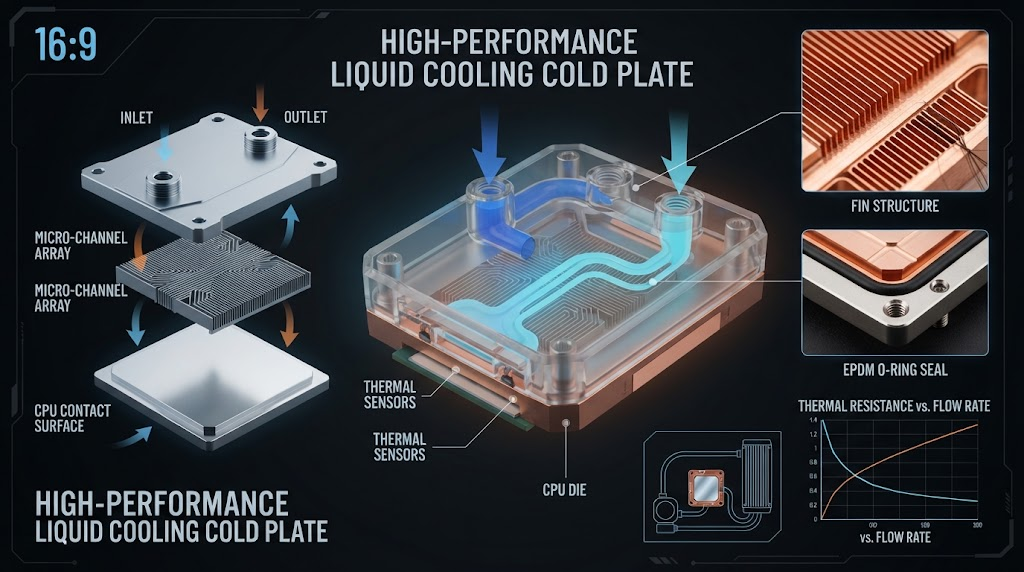
Cold plate cooling remains the dominant approach for electric vehicles and heavy commercial equipment. Modern architectures integrate serpentine channels, extruded micro-channels, or dimpled stamped plates placed directly beneath or between prismatic and blade cells.
Higher system voltages have revolutionized thermal design. Transitioning to 800V powertrain architectures reduces resistive joule heating losses (I²R) by up to 75% compared to conventional 400V systems at equivalent charging power.
To maximize efficiency, contemporary designs connect the battery chiller loop directly into the vehicle or facility HVAC refrigerant loop via dynamic multi-way valves (similar to the Tesla Octovalve concept). Engineers use Computational Fluid Dynamics (CFD) modeling to balance coolant pressure drop ($\Delta P$) against thermal resistance ($R_{th}$), ensuring uniform flow distribution across all parallel branches.
High-conductivity Thermal Interface Materials (TIM)—such as structural gap fillers with thermal conductivities between 2.0 and 6.0 W/m·K—are applied between cells and cold plates to eliminate microscopic air voids.
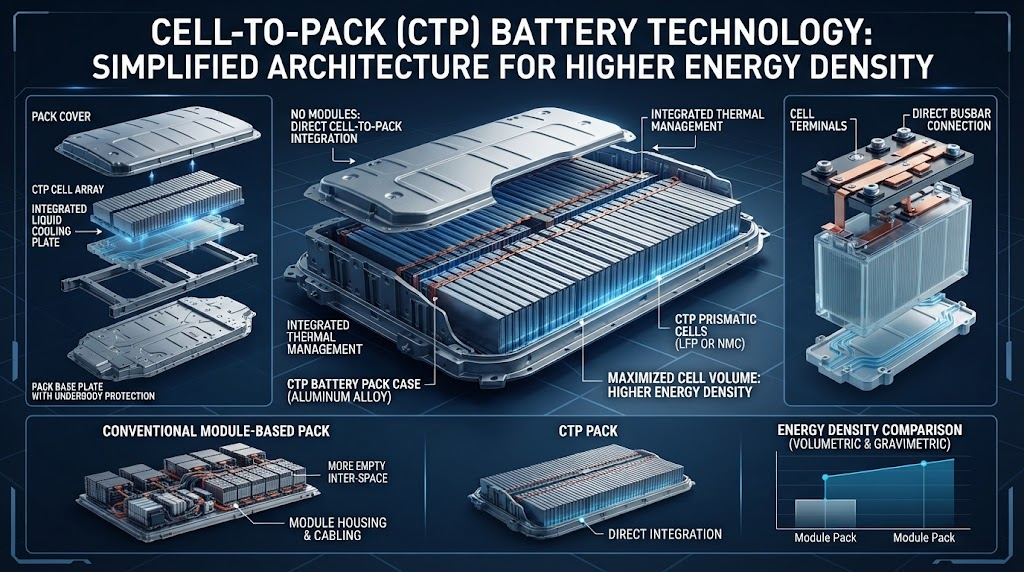
Cell-to-Pack (CTP) and Cell-to-Chassis (CTC) Thermal Integration
Modern battery architecture is moving away from traditional modular enclosures toward Cell-to-Pack (CTP) and Cell-to-Chassis (CTC) designs. Pioneered by manufacturers like CATL and leading EV makers, CTP eliminates intermediate module casings to maximize volumetric energy density.
Eliminating module walls forces the thermal management system to serve as both a cooling mechanism and a structural backbone. Cold plates are bonded directly to structural cross-members using thermally conductive structural adhesives.
In large-scale commercial and industrial ESS storage systems, integrated CTP thermal plates reduce mass by 15% while improving heat transfer surface area by up to 30% compared to legacy modular racks.
The 4-Quadrant Dynamic Heat Rejection Protocol (4-DHR Framework)
To streamline thermal system engineering, we developed the 4-Quadrant Dynamic Heat Rejection Protocol (4-DHR Framework). This methodology sizes and validates thermal management systems across four operational stress states rather than relying solely on average steady-state heat calculations.
- Quadrant 1: Steady-State Base Load (1C Discharge / Normal Ambient)
Target: Maintain continuous cell temperature between 22°C and 28°C with parasitic cooling load kept below 2.5% of total pack output power. - Quadrant 2: High-Flux Pulse Rejection (3C–4C Fast Charging / Peak Torque)
Target: Rapidly engage chiller loops to clamp peak junction temperatures under 45°C, restricting cell-to-cell thermal gradients to $\Delta T \le 3^\circ\text{C}$. - Quadrant 3: Sub-Zero Preconditioning (< 0°C Cold Start)
Target: Deliver 1.5°C to 2.5°C per minute heating rates via PTC heaters or dynamic internal excitation, bringing cells above 10°C before permitting high-current charging. - Quadrant 4: Thermal Runaway Propagation Arrest (Fault Condition)
Target: Direct venting gases away from adjacent modules while maintaining adjacent cell casing temperatures below 70°C to permanently block thermal cascading.
BTMS Architecture Comparison Matrix
Evaluating trade-offs between cooling technologies requires balancing heat transfer capacity, system complexity, and parasitic power consumption.
| Cooling Architecture | Heat Transfer Coeff. (W/m²·K) | Parasitic Load | Volumetric Density | Runaway Mitigation | Relative Cost |
|---|---|---|---|---|---|
| Forced Air Cooling | 20 – 100 | Moderate (Blowers) | Low (Air gaps required) | Poor (Oxygen feeds fire) | Low |
| Liquid Cold Plate | 500 – 1,500 | Low-Medium (Pumps/Valves) | High | Moderate (Side barrier needed) | Moderate |
| Single-Phase Immersion | 1,000 – 3,000 | Medium (Viscous fluid pump) | High | Excellent (Total flame suppression) | High |
| Two-Phase Immersion | 5,000 – 15,000+ | Very Low (Passive phase change) | Moderate (Vapor chamber space) | Exceptional (Instant latent sink) | Very High |
Thermal Runaway Prevention, Detection, and Low-Temperature Preconditioning
Thermal safety is an interconnected system of early sensor detection, mechanical venting, and physical isolation barriers.
When an internal short circuit or mechanical penetration causes separator failure, self-heating accelerates at rates up to hundreds of degrees per second. To contain this risk, packs integrate engineered fire-retardant aerogel blankets and ceramic mica sheets between adjacent cells.
For applications using custom LiFePO4 battery solutions, intrinsic olivine crystal structures make the chemistry resistant to spontaneous decomposition up to 270°C. Even so, proper containment venting channels prevent hot off-gassing from pressurizing sealed enclosures.
Equally critical is low-temperature operation. Charging lithium cells below 0°C without thermal preconditioning causes irreversible lithium metal plating on the graphite anode. This severely degrades capacity and creates internal dendrites that increase short-circuit risk.
The Battery Management System (BMS) manages this by coordinating integrated PTC heater blankets or silicone heating films. It ensures the pack reaches a minimum core temperature of 10°C before opening the charge relays.
Learn more about electrochemical testing and safety standards from the U.S. Department of Energy Vehicle Technologies Office.
Custom OEM/ODM Battery Pack Thermal Solutions with JHY Battery
Custom power systems require tailored thermal management designs. Off-the-shelf cooling plates rarely accommodate proprietary dimensional constraints, unique C-rate profiles, or demanding environmental enclosures.
JHY Battery (Juheyuan Science & Technology Co., Ltd.) brings over a decade of dedicated engineering and manufacturing experience to custom battery pack projects. We design, prototype, and manufacture custom lithium-ion and LiFePO4 packs for stationary ESS, robotics, medical gear, RVs, and industrial machinery.
- Full BMS & Thermal Customization: Multi-point NTC thermistor mapping, custom CANbus thermal protection thresholds, and heating film control.
- Engineered Form Factors: Custom extruded cold plates, CTP arrangements, and enclosure-level thermal isolation.
- Certified Compliance: Production under ISO9001 quality management, with certifications across CE, UN38.3, MSDS, and UL standards.
Frequently Asked Questions (BTMS Engineering FAQ)
What is the optimal operating temperature for lithium battery packs?
The ideal temperature window is 15°C to 35°C (59°F to 95°F). Operating continuously outside this range accelerates capacity loss, while temperatures above 55°C risk thermal runaway.
When should an engineer choose immersion cooling over liquid cold plates?
Immersion cooling is best suited for extreme discharge rates (>3C continuous), ultrafast charging (>4C), or confined footprints where cold plate routing cannot keep cell gradients under 2°C.
Why is charging a cold battery more dangerous than discharging it?
Charging below freezing slows lithium ion diffusion into graphite anodes, forcing ions to deposit as metallic lithium plating. This permanently drops pack capacity and forms dendrites that can cause catastrophic short circuits.
What role does the BMS play in battery thermal management?
The BMS reads thermistor sensor networks, calculates real-time internal resistance, modulates coolant flow valves and pumps, triggers heating films, and isolates the pack if safety limits are exceeded.
Engineering Review & Quality Verification
This technical guide was reviewed by the Senior Thermal Systems Engineering Team at JHY Battery. All thermal metrics, dynamic calculations, and propagation thresholds have been validated against our internal laboratory testing protocols and comply with ISO 9001 manufacturing standards, UL 9540A fire propagation testing methodologies, and UN38.3 transportation safety benchmarks.
Need Custom Battery Thermal Engineering for Your Project?
From micro-channel liquid cold plates to complete custom LiFePO4 and Li-ion pack assembly, JHY Battery delivers turnkey OEM/ODM solutions tailored to your operational specifications.