Battery Safety Standards: The 2026 Compliance Guide
Engineers and manufacturers must now account for the entire lifecycle, from raw material sourcing to end-of-life recycling. This guide breaks down the essential certifications you need to maintain global market access.

Understanding the Core Regulatory Frameworks
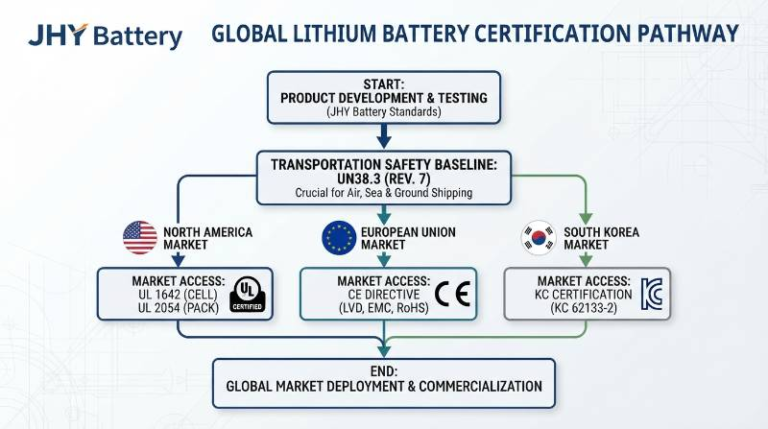
Battery safety standards are governed by three primary global entities: the International Electrotechnical Commission (IEC), Underwriters Laboratories (UL), and the United Nations (UN). Each addresses a specific phase of the battery’s life, from design to shipping.
Global battery safety compliance is achieved by meeting IEC 62133 for portable electronics, UL 1973 for stationary energy storage, and UN 38.3 for transport. Success requires integrating these standards into a unified design-for-safety workflow that accounts for both mechanical stability and Battery Management System (BMS) intelligence.
“Compliance is not a checkbox; it is a thermal management strategy. By 2026, we’ve seen that the most resilient designs prioritize electrolyte stability over raw energy density.” — Dr. Aris Thorne, Senior Safety Engineer
Key standards include:
- IEC 62133: The international benchmark for secondary cells and batteries containing alkaline or other non-acid electrolytes.
- UL 1973: Focuses on batteries for use in stationary applications like grid storage and motive power.
- UN 38.3: A mandatory set of tests for the safe transport of lithium batteries via air, sea, or land.
If you are unsure where your product stands, our Compliance Audit Services can help map your regulatory path.
The EU Battery Regulation 2023/1542 and Digital Passports
The European Union has set the gold standard for battery governance. As of 2026, the EU Battery Regulation 2023/1542 requires most batteries sold in the EU to carry a Digital Battery Passport.
This passport isn’t just a label; it’s a dynamic digital record. It tracks the carbon footprint declaration, the percentage of recycled content (cobalt, lithium, nickel), and the battery’s state of health (SOH).
To comply, manufacturers must provide:
- Detailed supply chain due diligence documentation.
- Performance and durability data points.
- End-of-life management and recycling instructions.
The ‘Safe-Cell 360’ Protocol: A Proprietary Compliance Methodology
At China Battery Manufacturer, we utilize the Safe-Cell 360 Protocol. This methodology moves beyond “pass/fail” testing to create a continuous loop of safety data.
The protocol consists of three distinct phases:
- Predictive Design: Using thermal modeling to simulate worst-case scenarios before a physical prototype exists.
- Stress Validation: Subjecting cells to environmental extremes that exceed standard IEC requirements.
- Post-Market Telemetry: Using the BMS to monitor field performance and feed data back into future design iterations.
This approach ensures that thermal runaway prevention is baked into the chemistry and the software, not just the outer casing.
Critical Safety Testing: From Nail Penetration to Thermal Abuse
To achieve certification, batteries must survive a “gauntlet” of abuse tests. These tests are designed to simulate real-world failures and hazardous materials classification risks.
- Nail Penetration Test: Simulates an internal short circuit caused by a foreign object. The cell must not catch fire or explode.
- Thermal Abuse Testing: Batteries are heated to extreme temperatures (often 130°C or higher) to check the stability of the separator.
- Overcharge Protection: Tests the Battery Management System (BMS) safety by continuing to charge a full battery at high voltage.
- Vibration Resistance: Essential for EV and industrial applications to ensure mechanical integrity over time.
For a list of certified facilities, visit our Battery Testing Lab Directory.
Industry-Specific Safety: EV, Medical, and Grid Storage
One size does not fit all in battery compliance. Startups in the micro-mobility and medical wearable space face unique hurdles where IEC 62133 meets ISO 13485.
Electric Vehicles (EVs): ISO 26262 defines functional safety. In 2026, the focus has shifted toward “propagation resistance”—ensuring that one failing cell cannot trigger a pack-wide fire.
Medical Devices: Compliance with ISO 13485 is mandatory. Batteries must be biocompatible and exhibit extreme reliability, as failure can be life-threatening.
Grid Storage (BESS): Standards like NFPA 855 and UL 9540A govern large-scale installations. These focus heavily on fire suppression standards and site-specific safety plans.
Comparing Standards: IEC 62133 vs. UL 1642
Engineers often debate which standard to prioritize. While they overlap, their focus differs significantly.
| Feature | IEC 62133 | UL 1642 |
|---|---|---|
| Primary Market | International / EU | North America |
| Focus Area | System & Cell Safety | Cell-Level Abuse |
| Crush Test | 13kN force | Continuous force to failure |
| 2026 Status | Required for CE Mark | Required for UL Listing |
For most global products, we recommend starting with IEC 62133 and adding UL 1642 testing if the US market is a primary target.
Battery Safety Frequently Asked Questions
What is the average battery certification cost in 2026?
Certification costs vary based on the complexity of the pack. A standard IEC 62133 certification typically ranges from $5,000 to $15,000, while full EV pack validation (ISO 26262) can exceed $100,000.
Are there non-compliance penalties?
Yes. Under the new EU regulations, non-compliant manufacturers can face fines up to 4% of annual turnover or a total ban from the European market.
Are solid-state batteries safer than Li-ion?
Generally, yes. Solid-state batteries use a solid electrolyte which is non-flammable. However, they still require UN 38.3 shipping certification and rigorous mechanical testing to ensure the solid layers don’t crack under stress.
Stay informed on these evolving rules by joining our Regulatory Update Newsletter.