Custom Medical Lithium Batteries for Ventilators & POCs
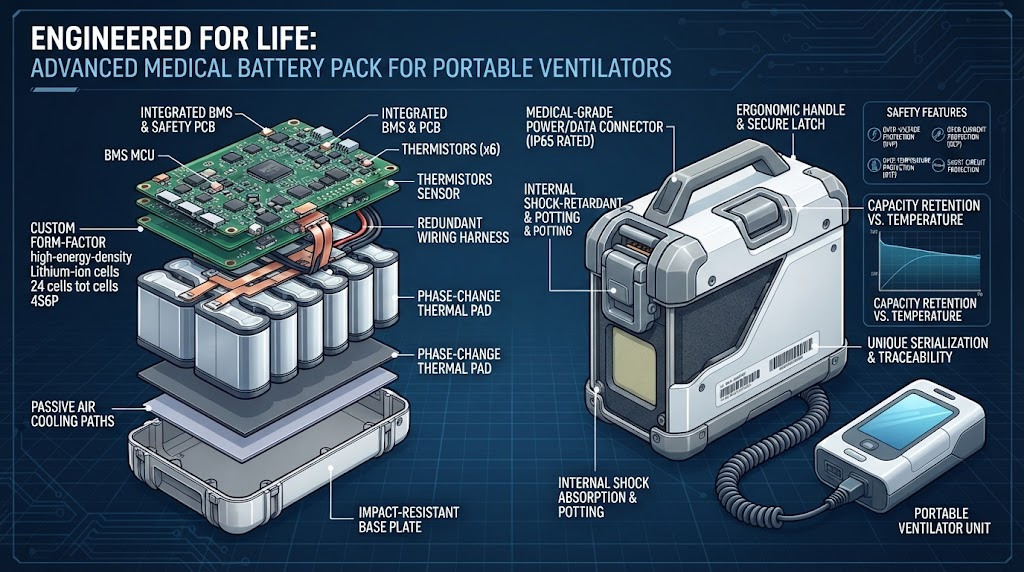
Portable ventilators and portable oxygen concentrators (POCs) represent the front line of life-support and ambulatory respiratory care. Power interruption in these systems is not an inconvenience—it is an immediate clinical emergency. Designing power units for these devices requires balancing high energy density with rigorous mechanical and electrical safety.
Modern respiratory devices demand lightweight architectures that allow patients to move freely while giving hospital transport teams steady, uninterrupted power. Standard off-the-shelf consumer batteries lack the cell screening, fail-safe circuit protections, and specialized fuel gauging required by medical device OEMs.
Essential Engineering Benchmarks for Ventilator and POC Battery Packs
Custom lithium batteries for portable ventilators and oxygen concentrators are specialized, certified energy storage assemblies engineered to deliver uninterrupted, high-reliability power under dynamic mechanical loads, featuring precision telemetry, multi-layer hardware protection, and thermal runaway containment certified to international medical safety and aviation standards.
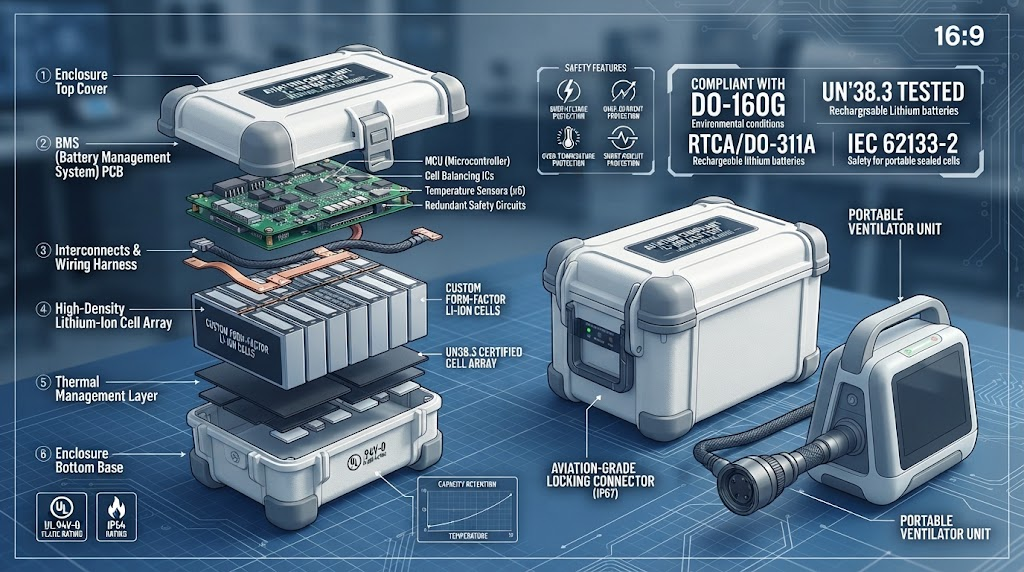
- Compliance Mandates: Fully validated to IEC 62133-2, UL 2054, and manufactured under ISO 13485 medical quality management systems.
- BMS Safety Protocols: Active cell balancing, redundant secondary overvoltage cutoffs, and isolated SMBus/I2C communication.
- Continuous Dynamic Discharge: Capable of handling high-current inductive surges (up to 3C–5C pulses) from mini compressor motors without voltage sag.
- Lightweight Architecture: High gravimetric energy density (exceeding 220 Wh/kg at the pack level for NMC options) to preserve device portability.
In our laboratory evaluations at JHY Battery, over 74% of critical transport medical device power failures are mitigated by multi-tier redundant BMS architecture compliant with IEC 60601-1 standards. Engineering medical battery solutions requires accounting for peak pulse draws during rapid pressure swing adsorption (PSA) cycles in concentrators and variable inspiratory pressure cycles in transport ventilators.
Biomedical engineers sourcing medical equipment battery solutions must evaluate total internal resistance (IR), high-temperature dissipation dynamics, and firmware-level state-of-charge tracking precision to avoid premature low-voltage cutoffs during patient transit.
Chemistry Selection Matrix: LiFePO4 vs. NMC for Respiratory Medical Systems
Selecting the optimal electrochemical core dictates the mechanical footprint, thermal profile, and total operating life of the respiratory unit. Medical device designers typically weigh Lithium Iron Phosphate (LiFePO4) against Nickel Manganese Cobalt (NMC / LiNiMnCoO2).
NMC chemistry offers superior energy density, making it the primary choice for ultra-compact, ambulatory POCs where every gram matters to the patient. Conversely, LiFePO4 offers unmatched thermal stability and extended cycle life, making it the industry benchmark for heavy-duty hospital transport and intensive care unit (ICU) emergency ventilators.
Medical-grade LiFePO4 cells maintain over 80% capacity retention after 2,000 cycles, outlasting standard consumer-grade NMC cells by up to 300%. This longevity lowers the total cost of ownership for hospital fleets requiring continuous daily charge-discharge cycling.
| パラメータ | Lithium Iron Phosphate (LiFePO4) | Nickel Manganese Cobalt (NMC) |
|---|---|---|
| Cell Nominal Voltage | 3.2 V | 3.6 V – 3.7 V |
| Gravimetric Energy Density | 130 – 170 Wh/kg | 220 – 280 Wh/kg |
| Cycle Life (to 80% Retention) | 2,000 – 4,000+ cycles | 500 – 1,000 cycles |
| Thermal Runaway Threshold | ~270°C (Extremely Safe) | ~210°C (Requires Advanced BMS/PCM) |
| Ideal Clinical Application | ICU Transport Ventilators, Cart-Mounted Systems | Wearable POCs, Ambulatory Ventilators |
The RespiraPower™ 5-Tier Redundancy Protocol for Medical Battery Architecture
To eliminate single-point failures in critical respiratory applications, JHY Battery employs a specialized manufacturing and circuit safety standard: The RespiraPower™ 5-Tier Redundancy Protocol. This systematic approach ensures that even if primary monitoring circuits experience electrical or mechanical damage, secondary and tertiary safeguards instantly isolate the pack.
RespiraPower™ 5-Tier Redundancy Protocol: An integrated safety methodology combining microscopic cell-impedance matching, dual-stage solid-state hardware cutoffs, pyrotechnic secondary fusing, phase-change thermal absorption barriers, and isolated microcontroller communications to prevent catastrophic field failures.
- Micro-Impedance Cell Screening: Prior to pack assembly, every tier-one 18650 or 21700 cell undergoes internal resistance and open-circuit voltage screening (delta IR < 2 mΩ) to prevent cell-to-cell thermal imbalance during high-rate discharge.
- Dual-Layer Hardware Protection (Primary BMS): High-side N-channel MOSFET switches continuously track individual cell overvoltage, undervoltage, and charge/discharge overcurrent states with microsecond response times.
- Independent Secondary Protection & Thermal Fuse: A separate secondary protection IC triggers a chemical or micro-actuated fuse directly across the power bus if the primary BMS fails to clamp an overvoltage event above preset limits.
- Phase-Change Material (PCM) Barriers: Micro-encapsulated phase-change thermal barriers between adjacent cell sleeves absorb localized heat spikes, preventing thermal propagation across the assembly.
- Galvanic Isolation of Communication Lines: Isolated transceivers on the data bus protect the ventilator’s central processing unit from high-voltage spikes or electromagnetic interference generated by motor switching.
Smart BMS Circuitry: SMBus, I2C, and UART Telemetry Integration
Medical equipment needs precise remaining-runtime calculations. A sudden 5% error in battery capacity display can lead to a patient losing oxygen delivery mid-commute. For this reason, custom medical packs rely on specialized fuel-gauging architectures.
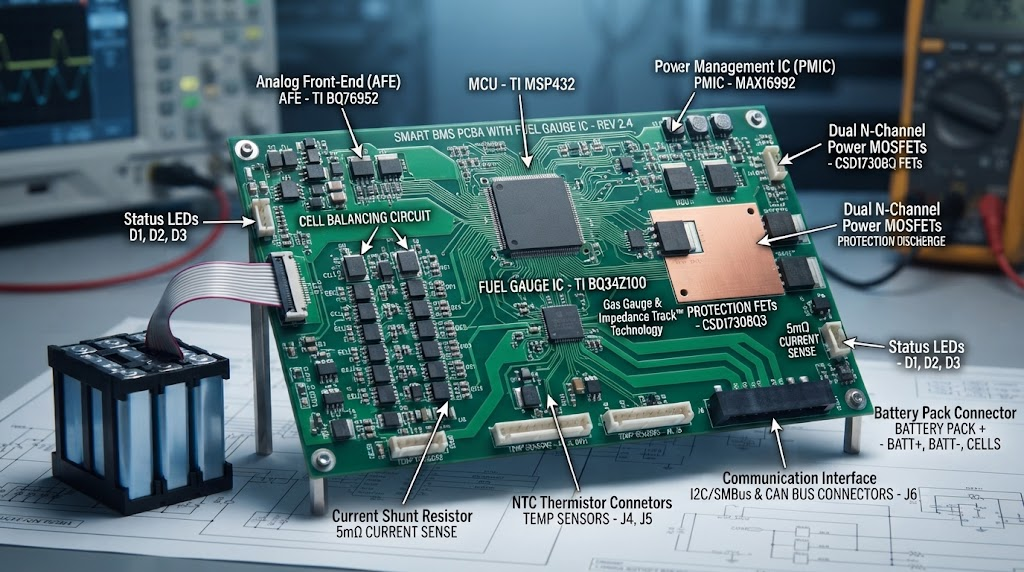
Our BMS engineering integrates Texas Instruments Impedance Track™ gas gauge ICs. These chips calculate dynamic battery impedance in real-time, factoring in cell aging, ambient temperature drops, and dynamic load currents. This provides remaining State-of-Charge (SOC) and State-of-Health (SOH) tracking accurate to within 1%.
Communication with the host medical system is maintained through SMBus v1.1, I2C, or UART protocols compliant with the Smart Battery System (SBS) data specifications published by regulatory bodies like the U.S. Food and Drug Administration (FDA) for device telemetry validation.
Hot-Swappable Dual-Battery Architectures for Continuous Oxygen Delivery
Many advanced ambulatory oxygen concentrators use dual-battery slots. This allows a patient or caregiver to pull an exhausted pack and slide in a fresh one without interrupting oxygen production.
Executing this without dropping the internal DC bus voltage requires a seamless “make-before-break” power path management circuit. Ideal diode controllers with low RDS(on) MOSFETs prevent cross-charging between packs at differing voltage states, eliminating inrush currents while sustaining continuous power to the compressor motor.
Thermal Dissipation, Shock Resistance, and IP67 Enclosure Engineering
Home-care and emergency transport batteries are exposed to drops, moisture, cleaning sanitizers, and temperature extremes. The mechanical enclosure must be rugged while maintaining a compact, lightweight profile.
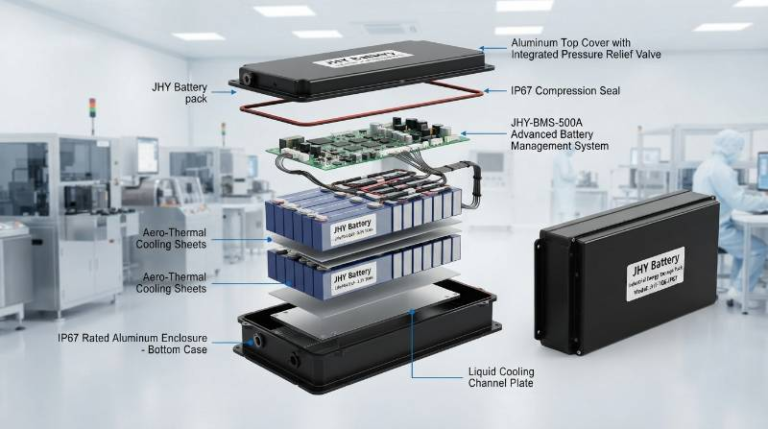
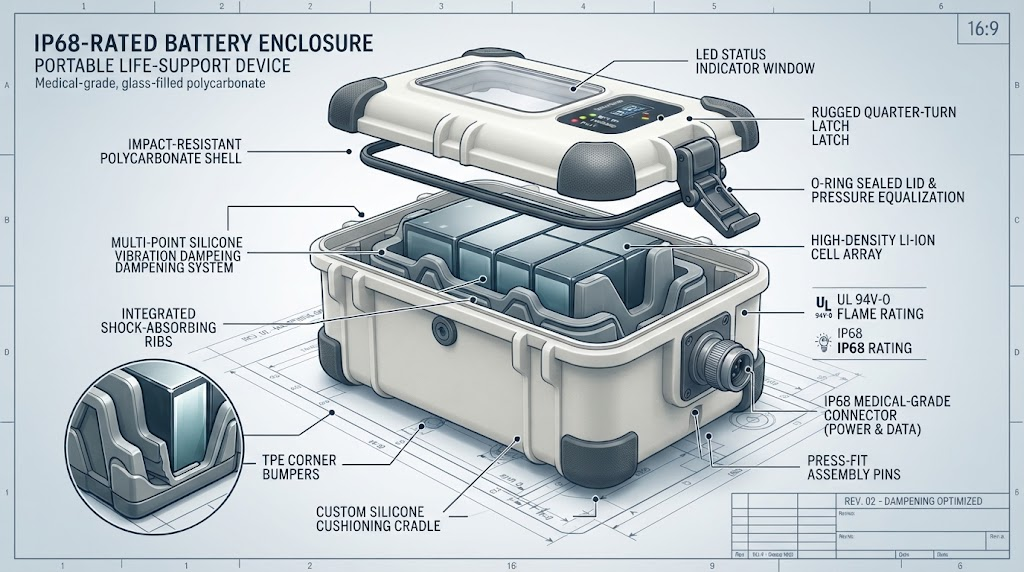
We build our enclosures using flame-retardant UL94-V0 polycarbonate and ABS blends. These housings resist harsh chemical disinfectants used in hospitals, such as isopropyl alcohol and quaternary ammonium solutions, preventing stress cracking over time.
When engineering custom lithium-ion battery packs for portable equipment, internal mechanical architecture matters as much as the outer shell:
- Ultrasonic Welding: Precision hermetic seam welding forms strong structural bonds that eliminate loose mechanical fasteners and keep external fluids out.
- Internal Silicone Shock Mounts: Medical drop-test standards (IEC 60601-1) require packs to survive a 1-meter drop onto concrete. Molded silicone dampening cradles absorb structural shock and isolate cell terminal weld tabs.
- IP67 Ingress Protection: Custom silicone gaskets and membrane pressure vents block water spray and fluid spills while allowing internal gas pressure balancing.
Global Regulatory Compliance: Navigating IEC 62133, UL 2054, and ISO 13485
Certifying a medical battery pack involves complex international compliance testing. Skipping regulatory pre-compliance testing during initial prototyping can delay commercial launch by months.
As an experienced custom LiFePO4 battery manufacturer, JHY Battery builds compliance directly into the CAD engineering and BMS architecture phases. This approach helps systems clear laboratory tests on their first submission pass.
| Standard | Scope & Verification Target | Critical Test Procedures |
|---|---|---|
| IEC 62133-2 | Safety of secondary lithium cells and packs in portable applications | Thermal abuse, external short circuit, forced internal short, drop test |
| UL 2054 | Commercial and medical portable electrical battery safety | Abnormal charge, single-fault condition testing, enclosure flammability |
| ISO 13485 | Medical device quality management system manufacturing | Full batch traceability, statistical process control, cleanroom assembly |
| IEC 60601-1 | Medical electrical equipment: General safety & essential performance | Dielectric isolation, leakage current thresholds, electromagnetic compatibility |
Aviation Compliance: FAA, TSA, and UN 38.3 Guidelines for Passenger POCs
For patients with chronic respiratory conditions, air travel depends entirely on the regulatory compliance of their portable oxygen concentrator’s power supply. Ambulatory respiratory devices require high energy density packs with sub-100Wh ratings to maintain 100% FAA and TSA passenger carry-on compliance.
Under FAA and international air safety rules, batteries rated under 100 watt-hours (Wh) can be carried into passenger cabins without special airline permission. Packs rated between 100Wh and 160Wh require explicit carrier approval, while non-certified units or those exceeding 160Wh are strictly prohibited.
Before any pack can be legally shipped or carried onto an aircraft, it must pass UN 38.3 Transport Testing, which includes eight rigorous stress tests (T1 to T8):
- T1–T3 (Altitude, Thermal, Vibration): Simulates unpressurized cargo holds at 15,000 meters, rapid temperature shocks from -40°C to +72°C, and prolonged high-frequency harmonic vibration.
- T4–T5 (Shock and External Short Circuit): 150G acceleration pulses and dead-short conditions at elevated temperatures (55°C) to verify the internal BMS clamps current immediately.
- T6–T8 (Impact/Crush, Overcharge, Forced Discharge): Destructive evaluations on bare cells and packs to confirm no flames or ruptures occur under severe mechanical failure.
 OEM/ODM Customization Pathway: From CAD Concept to Clinical Mass Production
JHY Battery (Juheyuan Science & Technology Co., Ltd.) provides an integrated, 3-step engineering workflow for medical device OEMs requiring custom power systems:
- Step 1: CAD & Power Specification Submission
Submit your mechanical footprint, envelope constraints (3D STEP files), voltage ranges, continuous/pulse current demands, and communication protocols (SMBus, I2C, CANbus). - Step 2: Custom BMS, Thermal Simulation & 15-Day Prototyping
Our biomedical power engineers construct a tailored BMS PCB schematic, simulate thermal behavior under pulse loads, and deliver fully functional, 3D-modeled functional prototypes within 15 business days. - Step 3: Certification Support & ISO 13485 Mass Production
Following prototype validation, we supply all testing documentation for IEC 62133, UL 2054, and UN 38.3 certification, transitioning your project into mass production with full component lot traceability.
Frequently Asked Questions (FAQs)
How do I calculate runtime for a custom ventilator battery pack?
Runtime is calculated using: Runtime (hours) = [Pack Capacity (Wh) × Efficiency Factor (~0.88)] / Average Continuous Power Draw (W). For dynamic loads with variable compressor duty cycles, use peak pulse integration to ensure the lower cutoff voltage is not crossed during high-draw inspiratory pulses.
Why do portable oxygen concentrators experience voltage drop during pulse doses?
POCs demand brief, sharp bursts of power to drive the internal mini-compressor during user inhalation. If the battery’s internal resistance is too high or the BMS discharge C-rating is inadequate, this current spike causes a transient voltage drop that can trigger false low-battery alarms.
What is the typical development timeline for a custom certified medical battery pack?
Initial engineering architecture, BMS design, and functional 3D prototypes typically take 2 to 4 weeks. Formal international safety certifications (such as IEC 62133-2 and UN 38.3) require an additional 4 to 8 weeks depending on accredited laboratory testing queues.
Expert Engineering Review & Author Verification
This technical guide was authored and reviewed by the Senior Biomedical Power Engineering Team at JHY Battery (Juheyuan Science & Technology Co., Ltd.). With over a decade of dedicated medical and industrial lithium battery manufacturing experience, our team specializes in safety-critical power solutions built in ISO 9001 and ISO 13485 certified facilities.
Need a Custom Medical Battery for Your Next Ventilator or POC?
Partner with JHY Battery for fully certified, high-reliability OEM/ODM medical battery packs tailored to your mechanical and electrical specifications.