Industrial Lead-Acid vs Lithium Cost Comparison (2026)
The 2026 Industrial Battery Cost Paradigm Shift
Industrial lead-acid vs lithium battery cost comparisons reveal that while lead-acid offers a lower upfront purchase price, lithium-ion options deliver a dramatically lower Total Cost of Ownership. Thanks to superior lifespan, zero maintenance, and 95% efficiency, lithium batteries offset their initial premium within two years.
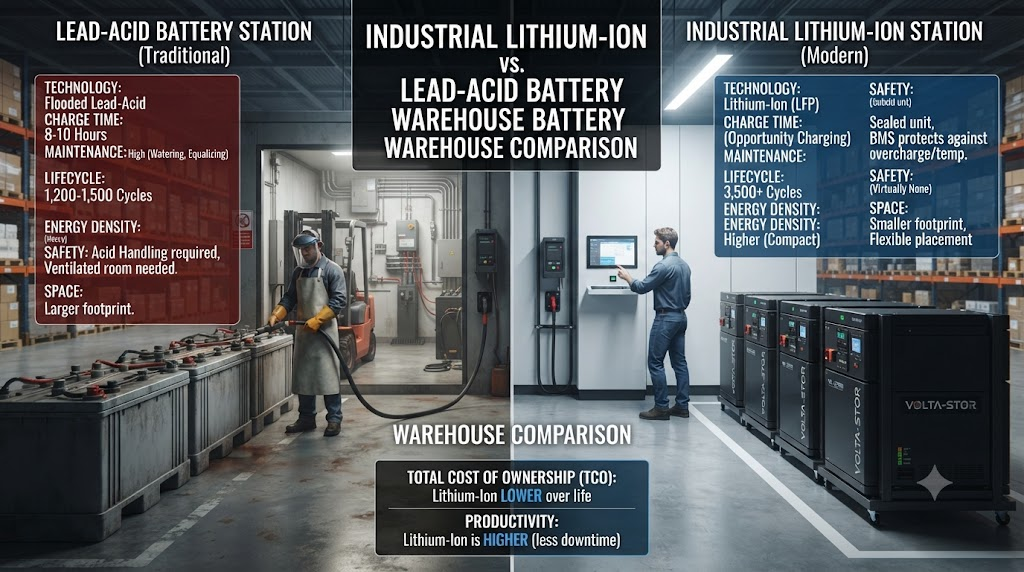
Procurement teams often struggle to justify the higher initial cost of lithium batteries to CFOs. On paper, lead-acid appears significantly cheaper.
However, this initial price tag is highly deceptive. In modern heavy-duty environments, the operational expenses of lead-acid quickly accumulate.
To help you evaluate these options, we have structured a direct comparison of the key financial and physical metrics.
| Cost Metric | Lead-Acid vs. Lithium Comparison |
|---|---|
| Purchase Price | Lead-acid remains cheaper upfront. However, the price gap has narrowed to less than 30% due to the 2026 LFP market stabilization. |
| Lifespan | Lead-acid lasts 1,500 cycles at 50% DOD. Lithium (LFP) delivers 3,500 to 10,000 cycles at 80% DOD, lasting up to 5x longer. |
| Maintenance | Lead-acid requires weekly watering, acid equalizations, and cleaning. Lithium is entirely maintenance-free with an integrated BMS. |
| Energy Efficiency | Lead-acid loses up to 20% of its energy as heat. Lithium-ion achieves up to 95% round-trip efficiency, lowering utility bills. |
A common misconception in procurement is that lead-acid scrap value offsets its high maintenance costs. In reality, modern environmental recycling penalties in 2026 have almost entirely wiped out this residual asset value, shifting the mathematical advantage even further toward lithium.
Defining the Core Metrics: Upfront Cost vs. Total Cost of Ownership (TCO)
To understand the economics of LiFePO4 batteries compared to lead-acid, we must look beyond the invoice price. We define lead-acid vs lithium battery cost industrial dynamics through the lens of long-term operational efficiency.
Total Cost of Ownership (TCO): The comprehensive financial estimate capturing all direct and indirect costs of acquiring, operating, maintaining, and disposing of an industrial energy asset over its entire operational lifecycle.
The math is simple. LiFePO4 batteries offer 3,500 to 10,000 cycles at 80% DOD, compared to just 1,500 cycles at 50% DOD for premium lead-acid.
Depth of discharge (DOD) directly impacts how much usable energy you can extract. While discharging a lead-acid battery past 50% permanently damages its internal chemistry, lithium-ion chemistry safely handles 80% to 90% DOD.
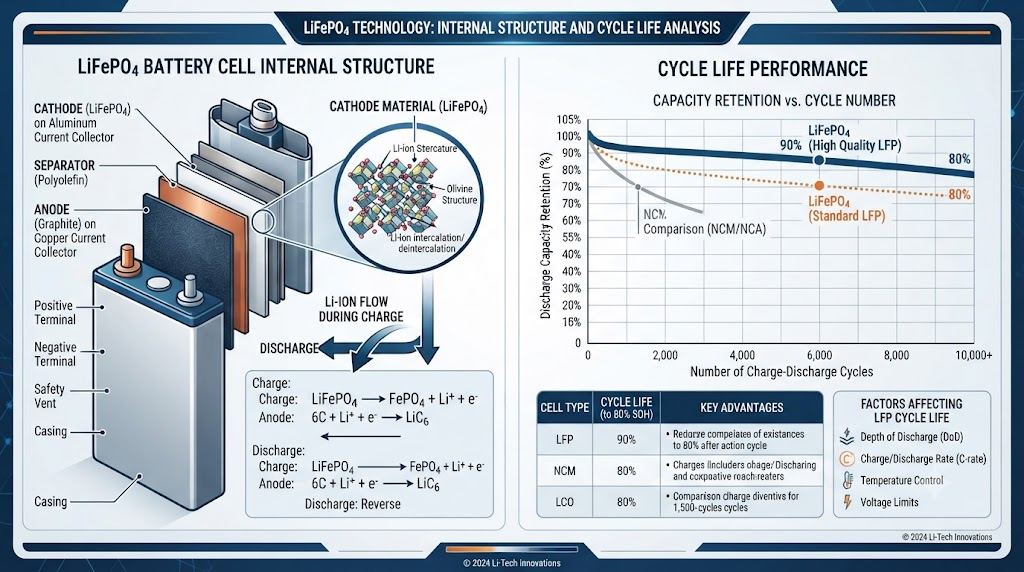
This difference in depth of discharge means you need a much larger physical lead-acid battery to match the usable capacity of a compact lithium pack. This superior energy density lowers the Levelized Cost of Storage (LCOS) over the lifetime of your equipment.
The JHY 3-Tier Industrial Battery ROI Matrix
At JHY Battery, we use a proprietary methodology called the JHY 3-Tier Industrial Battery ROI Matrix to analyze and project cost savings for B2B fleet operations. This framework categorizes savings into three distinct, measurable areas:
Tier 1: Direct Asset Savings
This tier measures the direct cost of the hardware over time. Because lithium lasts 3 to 5 times longer than lead-acid, you avoid 2 to 4 replacement cycles. This eliminates future procurement costs, shipping fees, and installation labor.
Tier 2: Operational Labor Savings
This tier calculates the daily labor saved by switching to a maintenance-free system. Lead-acid batteries require weekly watering, regular washing to prevent acid corrosion, and dedicated personnel for battery swapping between shifts.
By upgrading to custom lithium-ion battery packs, your team can utilize opportunity charging during standard 15-minute breaks, completely eliminating the need to swap batteries.
Tier 3: Infrastructure Savings
Lead-acid batteries release dangerous gases during charging, requiring dedicated charging rooms with heavy-duty ventilation systems. Moving to lithium eliminates these hazards, allowing you to reclaim valuable warehouse square footage and reduce facility utility bills.
Deep-Dive Math: Cost Scenarios Across Key Industrial Applications
Different industries experience distinct payback periods when transitioning to lithium. Let us examine three common applications using real-world performance data.
1. Multi-Shift Cold-Storage Forklift Fleets
In 24/7 cold-storage food distribution, temperature regulation is a major challenge. Lead-acid batteries lose up to 50% of their capacity in sub-zero temperatures.
In contrast, custom industrial equipment batteries featuring integrated thermal management systems maintain high performance even in extreme cold.
By implementing opportunity charging, cold-storage facilities can keep forklifts running continuously across three shifts with a single lithium battery per truck, eliminating the spare batteries and swapping equipment required by lead-acid setups.
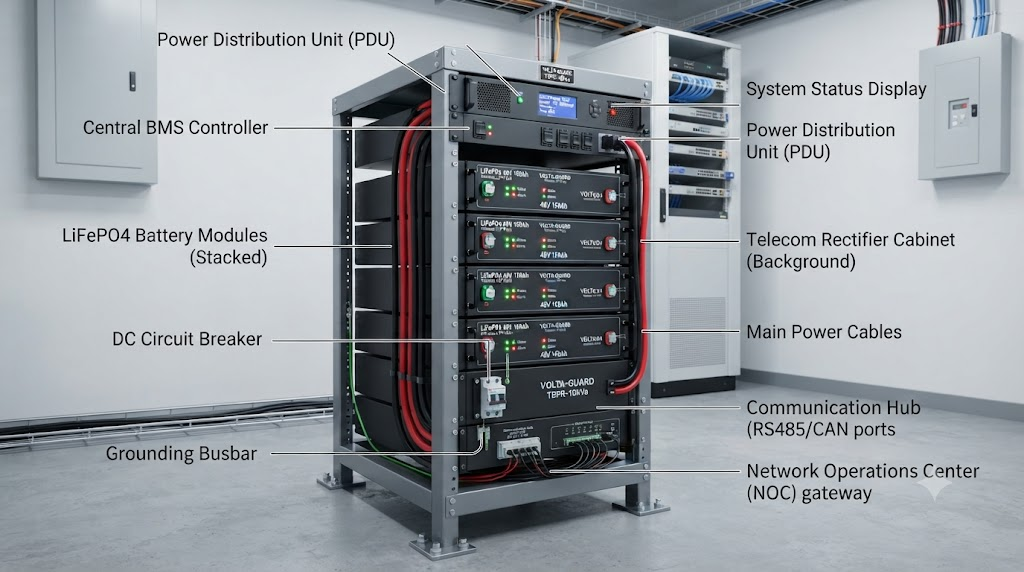
2. Telecom Backup Power (Uninterruptible Power Supply)
Telecom infrastructure requires absolute reliability. Lead-acid batteries in remote towers require frequent maintenance visits and suffer from shortened lifespans in hot climates.
Lithium systems operate reliably in high temperatures without degradation, drastically reducing emergency maintenance visits to remote locations.
3. Grid-Scale Energy Storage Systems (ESS)
For utility-scale energy storage, round-trip efficiency is the primary metric. Lithium-ion batteries achieve up to 95% round-trip efficiency compared to 80% for lead-acid.
This 15% efficiency gap represents massive savings when scaling to megawatt-hour levels, making lithium the clear economic choice for modern grid installations.
According to research from the National Renewable Energy Laboratory (NREL), high round-trip efficiency is a primary driver in lowering the long-term Levelized Cost of Storage.
The 2026 LFP Price Drop and Evolving Infrastructure Realities
The industrial battery market has changed rapidly. The 2026 LFP price drop reduced lithium-ion pack costs to under $80/kWh, narrowing the upfront cost gap with lead-acid to less than 30%.
This price drop has dramatically shortened the payback period for lithium upgrades, with most high-utilization fleets reaching ROI positive status in less than a year.
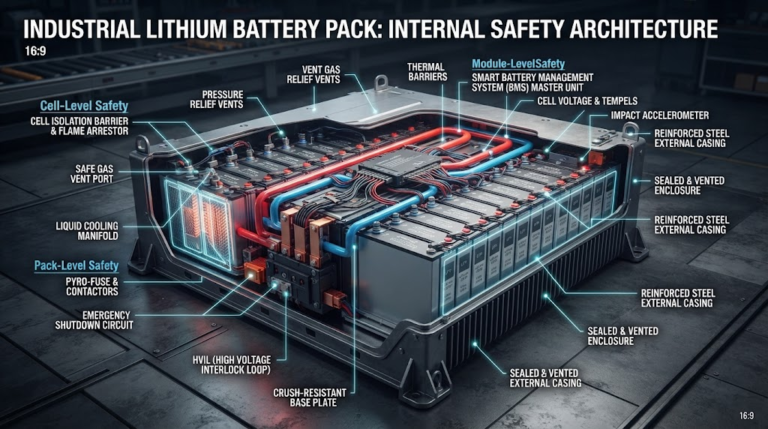
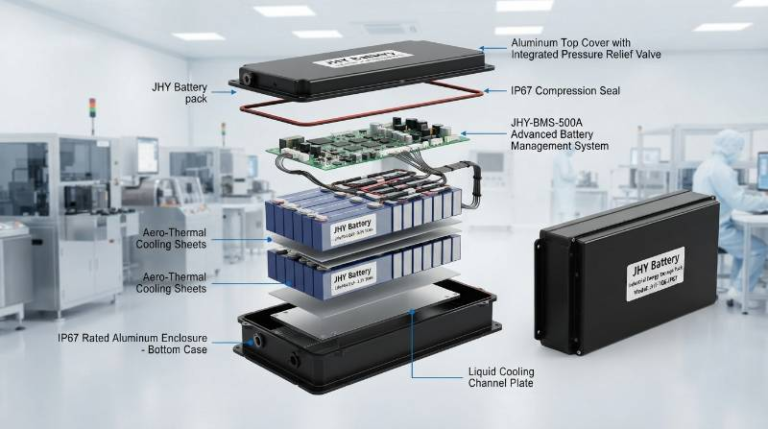
Additionally, safety standards have evolved. Modern lithium-ion packs feature active battery management systems (BMS) that constantly monitor cell voltage and temperature to prevent thermal runaway.
By choosing a certified manufacturer, you ensure compliance with international standards such as ISO9001, CE, UN38.3, and UL, reducing your facility’s insurance risk and ensuring a safe working environment.
Frequently Asked Questions About Industrial Battery Costs
What is the actual lead-acid vs lithium lifespan difference?
In typical industrial applications, a premium lead-acid battery lasts between 1,200 and 1,500 cycles at 50% depth of discharge. A high-quality LiFePO4 battery lasts between 3,500 and 10,000 cycles at 80% depth of discharge, offering up to 5 times the operational life.
Are lithium-ion batteries safe in high-temperature environments?
Yes. Premium lithium-ion packs include an integrated Battery Management System (BMS) that monitors cell temperatures. If temperatures exceed safe operating limits, the BMS automatically shuts down the pack to prevent thermal runaway.
How does BMS customization lower operational costs?
Custom BMS integration allows the battery to communicate directly with your machinery’s controller. This direct integration optimizes power delivery, prevents over-discharging, and provides real-time state-of-charge tracking to eliminate unexpected downtime.
How do lithium batteries perform in cold storage warehouses?
Standard lead-acid batteries lose up to half their capacity in freezing conditions. Custom lithium-ion packs can be built with internal heating elements that allow the battery to charge and discharge efficiently in sub-zero environments, maintaining consistent runtimes.
Meet the Expert: Authoritative B2B Battery Solutions
This guide was developed in collaboration with the engineering and systems team at JHY Battery (Juheyuan Science & Technology Co., Ltd.). With over a decade of experience in custom battery manufacturing, JHY Battery specializes in OEM/ODM solutions for global B2B clients.
“When evaluating lead-acid vs lithium battery cost industrial applications, looking only at the initial invoice is a critical mistake. In multi-shift environments, a custom LFP pack pays for itself in under 18 months by eliminating battery swaps, watering labor, and dedicated charging rooms.” — Senior Systems Engineer, JHY Battery
JHY Battery maintains complete international quality and safety certifications, including ISO9001, CE, UN38.3, MSDS, and UL, ensuring reliable performance in the most demanding industrial environments.
Ready to Calculate Your Fleet’s Savings?
Work with our engineering team to design a custom power solution tailored to your operational needs.
- Use our TCO framework to analyze your current fleet specifications.
- Get a detailed ROI report showing your potential operational savings.
- Schedule a consultation with JHY Battery for a customized pack design.