Battery CE Marking: Guide to European Market Access
1. Understanding CE Marking for Batteries and European Compliance
CE marking for batteries is a mandatory compliance mark required for products sold within the European Economic Area (EEA). It certifies that a battery meets essential European Union safety, health, and environmental protection requirements, enabling legal market access and free movement across all European Union member states.
To secure market access in Europe, manufacturers must follow a systematic compliance process. This structured pathway ensures every battery cell and pack is fully documented, tested, and marked before hitting the European market:
- Classification: Identify battery type, chemistry, and specific EU regulatory category.
- Testing: Execute rigorous safety, performance, and environmental testing (e.g., EN 62133).
- Technical Documentation: Compile a technical file proving compliance.
- Declaration of Conformity: Draft and sign the official EU Declaration of Conformity (DoC).
- Labeling: Affix the CE mark and required symbols legibly to the battery.
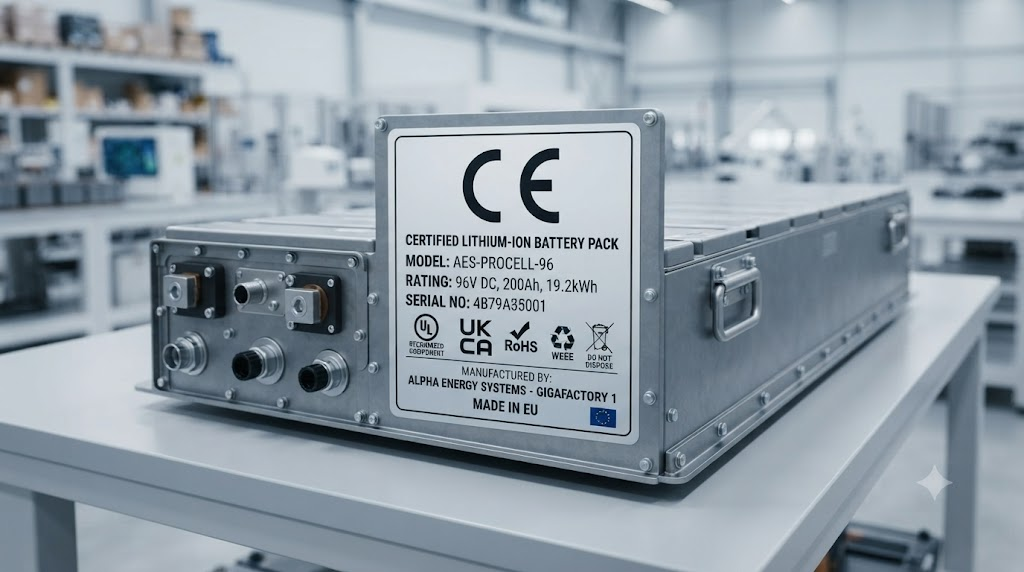
Securing a battery CE marking is not merely an administrative hurdle. It serves as a vital strategic asset that protects intellectual property and builds immediate buyer trust across international borders.
2. The New EU Battery Regulation (EU 2023/1542) Framework
The regulatory landscape for batteries in Europe has shifted dramatically. The old Battery Directive 2006/66/EC has been replaced by the comprehensive EU Battery Regulation (2023/1542).
Unlike the old directive, this regulation applies directly in all EU member states without requiring local national translation. It introduces strict rules covering the entire battery life cycle, from raw material sourcing to end-of-life recycling.
A key focus of this modern framework is environmental impact. High-capacity batteries must now carry carbon footprint declarations, pushing manufacturers to optimize energy efficiency during production.
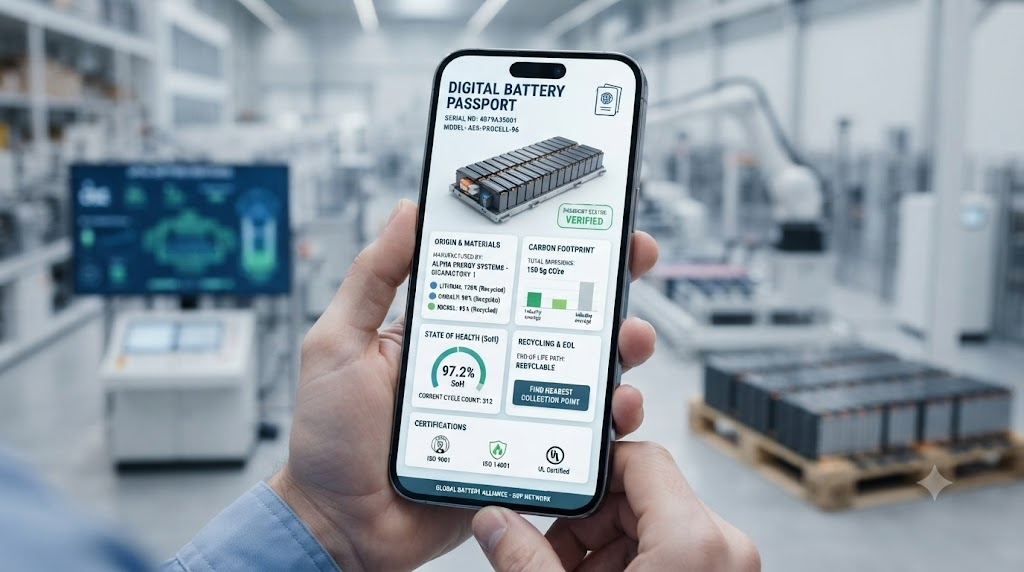
“Under EU Regulation 2023/1542, all industrial and EV batteries over 2 kWh must feature a fully traceable digital Battery Passport by 2027.”
This digital passport will store critical information regarding battery chemistry, carbon footprint, recycled content, and safety certifications, allowing stakeholders to trace the battery’s history instantly.
This shift comes at a time of unprecedented growth. The European battery market is projected to demand over 1,200 GWh of capacity by 2030, representing a 25% annual growth rate. Meeting these strict compliance standards is the only way to secure a share of this rapidly expanding market.
3. Conformity Assessment Procedures: Module A vs. Module D
To apply the CE mark, manufacturers must complete a formal conformity assessment. The appropriate pathway depends on the battery’s specific application, chemistry, and classification.
For most standard custom lithium-ion battery packs, manufacturers choose between Module A and Module D pathways. Understanding the differences between these procedures is vital for timely market entry.
| Feature | Module A (Internal Production Control) | Module D (Production Quality Assurance) |
|---|---|---|
| Involvement of Notified Body | None (Self-declaration possible for lower-risk categories). | Mandatory. A Notified Body audits the production quality system. |
| Quality Management System | Internal controls maintained by the manufacturer. | Approved and audited QMS (typically aligned with ISO 9001). |
| Typical Application | Low-voltage consumer electronics, standard packs. | High-capacity industrial systems, automotive EV batteries. |
If your battery falls into a high-risk category, involving a Notified Body is a legal necessity. This independent organization reviews the technical documentation and issues an EC Certificate of Conformity, verifying that your product meets all essential requirements.
4. Technical Requirements and Testing Standards
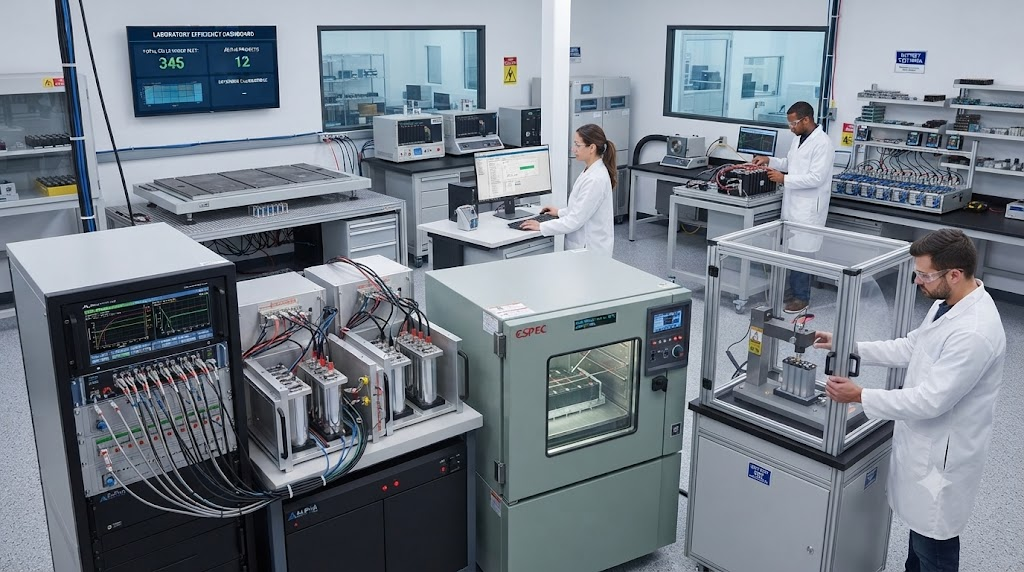
To qualify for a CE marking, batteries must undergo standardized laboratory testing. These tests evaluate electrical, mechanical, and thermal safety under normal and abusive operating conditions.
Safety Standards: EN 62133 vs. IEC 62133
その EN 62133 standard is the European harmonized version of the international IEC 62133 standard. While they share identical technical requirements for lithium-ion battery safety standards, the EN prefix indicates formal adoption by European standardization bodies.
These standards focus on preventing hazards such as thermal runaway, short circuits, overcharging, and physical crushing. Passing these tests is mandatory for any lithium-based power solution seeking European market access.
Transport Safety: UN 38.3
Before any battery can be legally shipped globally or within Europe, it must pass UN 38.3 transport testing. This protocol subjects batteries to extreme environmental simulation, thermal shock, vibration, external short circuits, and impact tests to guarantee transport safety.
Environmental Directives: RoHS, REACH, and WEEE
European compliance requires more than electrical safety testing. Batteries must also comply with strict chemical and environmental directives:
- RoHS Directive: Restricts the use of hazardous substances like lead, cadmium, and mercury in electrical equipment.
- REACH Regulation: Evaluates and controls the chemical substances used to manufacture the battery components.
- WEEE Directive: Governs the disposal and recycling of electrical and electronic waste, requiring clear end-of-life labeling.
5. The JHY SafeShield 4-D Compliance Protocol
Navigating these regulatory layers can be challenging. To streamline this process, JHY Battery utilizes a proprietary methodology: the JHY SafeShield 4-D Compliance Protocol. This systematic approach guarantees that our custom battery packs meet all European safety and environmental standards from day one.

The 4-D Protocol breaks down compliance into four actionable stages:
- Design: We build compliance directly into the initial schematics. Our engineers select premium components and construct smart Battery Management Systems (BMS) that prevent over-voltage, thermal runaway, and balancing issues. This proactive design phase is especially critical for complex chemistries used in our high-performance LiFePO4 batteries.
- Diagnostics: We subject battery prototypes to intensive physical and electrical stress tests inside state-of-the-art testing facilities, verifying safety under harsh conditions.
- Documentation: We compile exhaustive technical documentation, including safety datasheets (MSDS), UN 38.3 test summaries, and draft Declarations of Conformity, making audits straightforward.
- Delivery: We ship fully certified, labeled, and traceable battery packs, complete with all necessary compliance markings for immediate distribution in Europe.
6. Labeling, Symbols, and Market Placement Duties
Physical labeling is a critical component of compliance. If your product is improperly labeled, European customs officials can seize your shipment, regardless of how safe the internal cells are.
Essential Labeling Requirements
Every battery pack entering the European market must feature a permanent, legible label containing:
- The official CE mark graphic (which must maintain its proportions and stand at least 5mm tall).
- その crossed-out wheeled bin symbol, indicating compliance with the WEEE Directive.
- Battery chemistry, capacity, voltage, and safety instructions.
- Manufacturer’s name, registered trade name, and contact address in Europe.
Importer Duties vs. Manufacturer Duties
Responsibility for compliance is shared across the supply chain. While the manufacturer (such as JHY Battery) is responsible for designing, testing, and labeling the product, the European importer also holds critical legal obligations.
Importers must verify that the foreign manufacturer has completed the proper conformity assessment, compiled the technical file, and made the Declaration of Conformity readily available. Importers must also keep a copy of the DoC on file for ten years after the battery is placed on the market.
7. Custom Battery Compliance for Specialized B2B Applications
Compliance requirements vary significantly depending on the battery’s final application. Standard consumer batteries follow basic consumer safety pathways, but specialized B2B sectors require dedicated engineering and certification approaches.
Industrial Equipment Batteries
Powering heavy machinery, logistics robots, or automated guided vehicles (AGVs) requires highly durable industrial equipment batteries. These systems must withstand constant mechanical vibration, rapid charging cycles, and extreme operating temperatures. Compliance for these batteries demands heavy-duty enclosure testing and integration with advanced, redundant BMS safety systems.
医療機器用電池
Batteries integrated into medical diagnostics, patient monitors, or life-support systems must meet the strict standards of the European Medical Device Regulation (MDR). This requires exceptional reliability, zero-failure tolerance, and specialized EN 60601-1 medical safety testing.
Energy Storage Systems (ESS)
Large-scale solar and industrial energy storage systems face unique compliance challenges. Because of their high capacity, they fall under the strictest provisions of the new EU Battery Regulation, requiring detailed carbon footprint calculations and active preparation for the 2027 digital Battery Passport.
8. About the Expert Reviewer: JHY Battery Compliance Team
JHY Battery (Juheyuan Science & Technology Co., Ltd.) is an ISO9001-certified global leader in custom battery manufacturing with over a decade of industry experience. We specialize in OEM/ODM B2B solutions, offering deep customization for voltage, capacity, dimensions, and BMS performance.
Our complete suite of international certifications—including ISO9001, CE, UN38.3, MSDS, and UL—ensures your custom power solutions are safe, reliable, and ready for immediate global market access.
Your 3-Step Path to Certified Compliance
We simplify European market entry with a straightforward, three-step collaborative process:
- Submit Specifications: Provide your custom voltage, capacity, dimension, and application requirements to our engineering team.
- SafeShield Testing: We design, build, and test your prototype under the JHY SafeShield 4-D Compliance Protocol.
- Receive Certified Packs: We deliver fully certified, CE-marked battery packs ready for immediate distribution in Europe.
Ready to Launch Your Certified Battery Project?
Work with our compliance engineering team to design, test, and manufacture fully compliant, CE-marked battery packs tailored to your application.
9. Frequently Asked Questions
Do batteries require a CE mark to enter the European market?
Yes, all stand-alone batteries, battery packs, and devices containing integrated batteries must carry a CE mark to be legally imported and sold within the European Economic Area (EEA).
What is the difference between EN 62133 and IEC 62133?
Technically, they share the same safety requirements. IEC 62133 is the global standard developed by the International Electrotechnical Commission, while EN 62133 is the harmonized version formally adopted by the European Union for CE marking compliance.
What is the new EU Battery Regulation 2023/1542?
It is a comprehensive regulatory framework that replaced the old 2006 Battery Directive. It introduces strict rules regarding battery safety, environmental sustainability, carbon footprint declarations, and mandatory digital Battery Passports by 2027.
How does JHY Battery ensure compliance for custom battery packs?
We utilize our JHY SafeShield 4-D Compliance Protocol, which integrates regulatory standards directly into the design, testing, documentation, and delivery phases of our custom manufacturing process.