ISO 13485 Medical Battery Contract Manufacturing
The Strategic Imperative of ISO 13485 in Medical Battery Contract Manufacturing
ISO 13485 medical battery contract manufacturing governs the specialized design, verification, and automated assembly of custom lithium-ion power systems under rigid quality management controls to eliminate single-point failures in life-sustaining equipment. By aligning every step of production with risk management frameworks like ISO 14971, certified contract manufacturing protects Class II and Class III clinical hardware from thermal runaway, sensor drift, and unexpected voltage collapse.
In medical device engineering, power systems are classified as critical sub-assemblies. A sudden loss of power in an infusion pump or portable ventilator directly threatens patient stability. Commercial battery assemblers optimize for high-speed output and component cost reduction, but medical-grade execution demands strict traceability, validated assembly tolerances, and frozen Bills of Materials (BOM).
ISO 13485:2016 Definition: An internationally recognized standard specifying quality management system (QMS) requirements for organizations involved in the design, development, production, installation, and servicing of medical devices and their critical sub-components.
Securing market authorization via FDA 510(k) premarket notification or the European Medical Device Regulation (EU MDR 2017/745) requires documented design controls. Partnering with an experienced specialist for ISO 13485 medical device batteries ensures that cell qualification, safety architecture, and automated testing are integrated directly into the regulatory submission package.
The 5-Stage Medical Battery Quality & Risk Governance Matrix (MB-QRGM)
To eliminate systemic variability in medical power systems, JHY Battery engineers follow The 5-Stage Medical Battery Quality & Risk Governance Matrix (MB-QRGM). This framework integrates medical-grade quality assurance into the entire engineering lifecycle.
Core Pillars of the MB-QRGM Framework
- Stage 1: ISO 14971 Risk Engineering & DFMEA: Identifying electro-chemical failure modes, component stress derating, and fault tree analyses before physical prototyping begins.
- Stage 2: Multi-Tier Redundant Smart BMS Architecture: Implementing primary digital microcontroller/Analog Front End (AFE) supervision alongside independent hardware-level secondary protectors and active thermal throttling.
- Stage 3: Automated Micro-Welding & Cell Screening: 100% incoming cell sorting (Open Circuit Voltage within ±1mV, AC Internal Resistance within ±0.5mΩ) combined with closed-loop laser weld penetration monitoring.
- Stage 4: Design Transfer & Traceability Rigor: Execution of formal IQ/OQ/PQ validation runs, DHF/DMR documentation compile, serialized barcode tracking, and absolute BOM freezing.
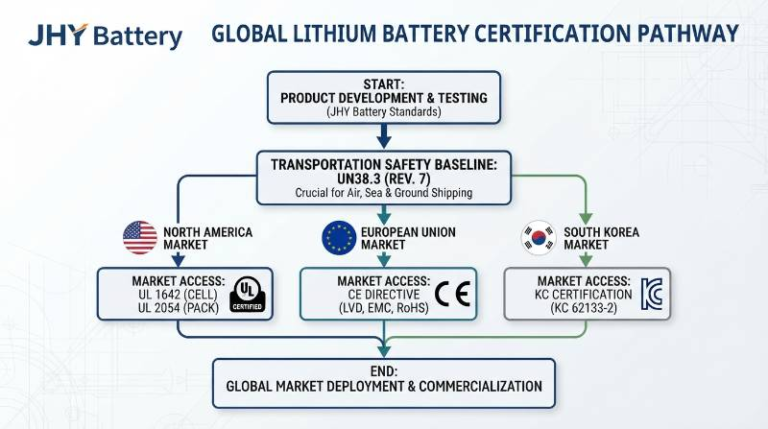
- Stage 5: Pre-Compliance Certification & EOL Cycling: Automated end-of-line verification, helium enclosure leak testing, and certification testing to IEC 62133-2, UL 2054, and UN 38.3.
| Engineering Vector | Standard Industrial Assembly | JHY Battery ISO 13485 Medical CM |
|---|---|---|
| Quality Standard | ISO 9001 (Commercial Quality) | ISO 13485:2016 + ISO 14971 (Medical Risk Management) |
| Defect Rate Ceiling | 1.0% to 2.5% (10,000 – 25,000 PPM) | Guaranteed ≤ 0.03% (300 PPM) |
| BMS Protection Topology | Single AFE with standard dual MOSFETs | Dual-redundant AFE + Secondary Chemical SCP Fuse blowout |
| Incoming Cell Screening | Statistical lot sampling (AQL 1.0) | 100% automated OCV/ACIR sorting (±1mV, ±0.5mΩ) |
| BOM Change Control | Unannounced equivalent substitutions common | Strictly Frozen BOM; ECO requires engineering change approval |
| Lot Traceability | Batch-level invoice tracking | Full MES laser-etched serialized cell-to-pack tracing |
Utilizing dedicated turnkey OEM/ODM battery contract manufacturing ensures that medical OEMs avoid costly production delays while securing a certified supply chain.
Regulatory Compliance Roadmap: Aligning ISO 13485, ISO 14971, and FDA 510(k)
Navigating medical device certifications requires proactive design controls. In our cleanroom manufacturing operations, we map quality records directly into our clients’ Design History Files (DHF) and Device Master Records (DMR) to streamline regulatory audits.
Critical Standards for Medical Battery Packs
- IEC 62133-2: Mandatory global benchmark for secondary lithium cells and batteries in portable applications, covering mechanical shock, vibration, and internal short-circuit safety.
- UL 2054 & UL 1642: Stringent North American safety standards evaluating abusive overcharge, electrical short circuits, and mechanical crush performance at the pack and cell level.
- IEC 60601-1 & IEC 60601-1-2: General requirements for basic safety and essential performance of medical electrical equipment, including insulation resistance, creepage distances, and EMC immunity.
- UN 38.3: United Nations transport safety testing including altitude simulation, thermal tests, vibration, impact, external short circuit, and forced discharge.
JHY Battery coordinates global battery safety certifications (IEC 62133 / UL 2054) directly through accredited NRTL laboratories, delivering comprehensive CB test certificates and test reports alongside working prototypes.
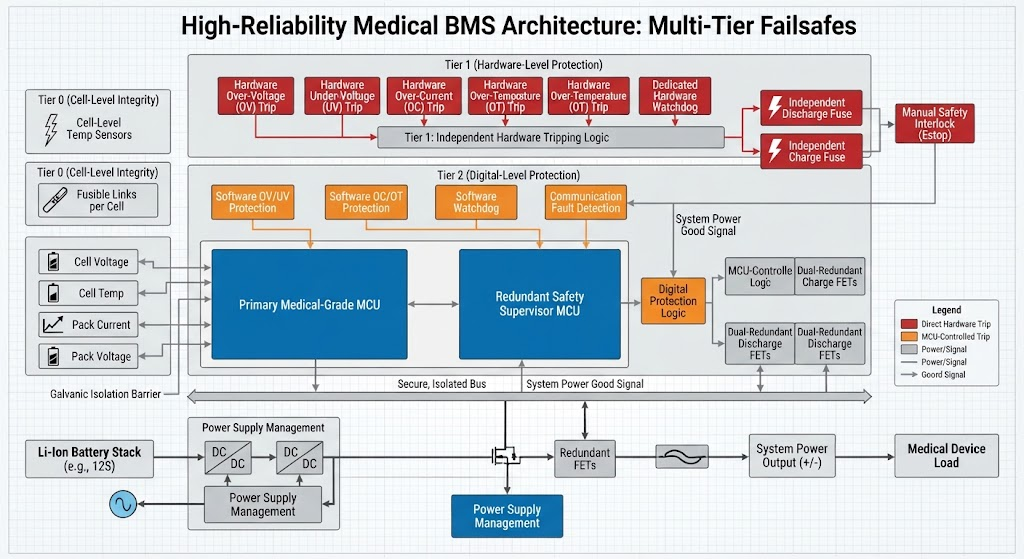
Smart BMS Engineering Architecture: Fail-Safe Redundancy & Telemetry Protocols
Medical electronics require power subsystems with zero single-point failure vulnerability. Standard consumer-grade protection boards shut down on basic overvoltage or overcurrent thresholds. In contrast, medical systems require multi-tiered protection strategies.
Dual-Tier Protection Architecture
Our engineering division designs high-precision smart BMS design and architecture platforms utilizing Texas Instruments and Seiko Analog Front Ends (AFEs). The primary layer manages digital switching via dual high-side N-channel MOSFETs.
If a primary switching FET fails in a shorted state during a severe overcharge event, an independent secondary hardware supervisor detects the threshold breach. It triggers a chemical Self-Control Protector (SCP fuse), permanently opening the circuit before the cell reaches its thermal runaway boundary.
High-Precision Fuel Gauging & Isolated Telemetry
- Impedance Track Fuel Gauging: Measures State-of-Charge (SOC) within ±1% accuracy by dynamically tracking internal cell impedance changes across temperature and cycle life.
- Galvanically Isolated Communication: Prevents medical device ground loops through optically or magnetically isolated SMBus v1.1, I2C, and CANopen bus channels.
- Low Standby Current Draw: Quiescent current consumption engineered below 10μA in deep-sleep storage mode, preventing pack bricking during extended warehouse storage.
- Multi-Point Thermal Arrays: Redundant NTC thermistors continuously monitor individual cell clusters and power FET junction temperatures.
Precision Manufacturing & Welding QA: Achieving the 0.03% (300 PPM) Defect Ceiling
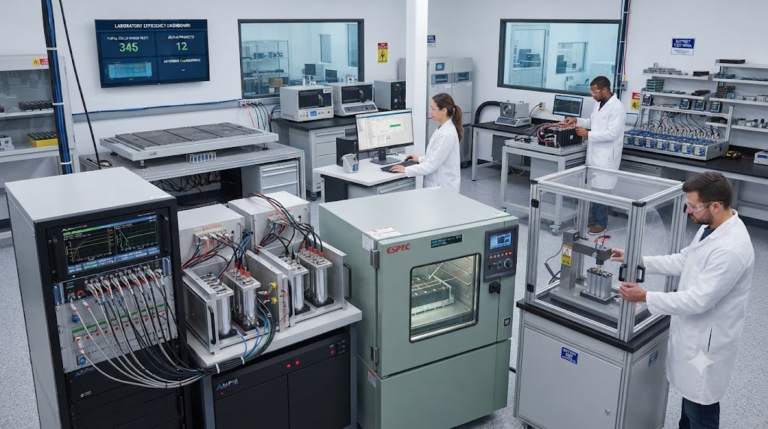
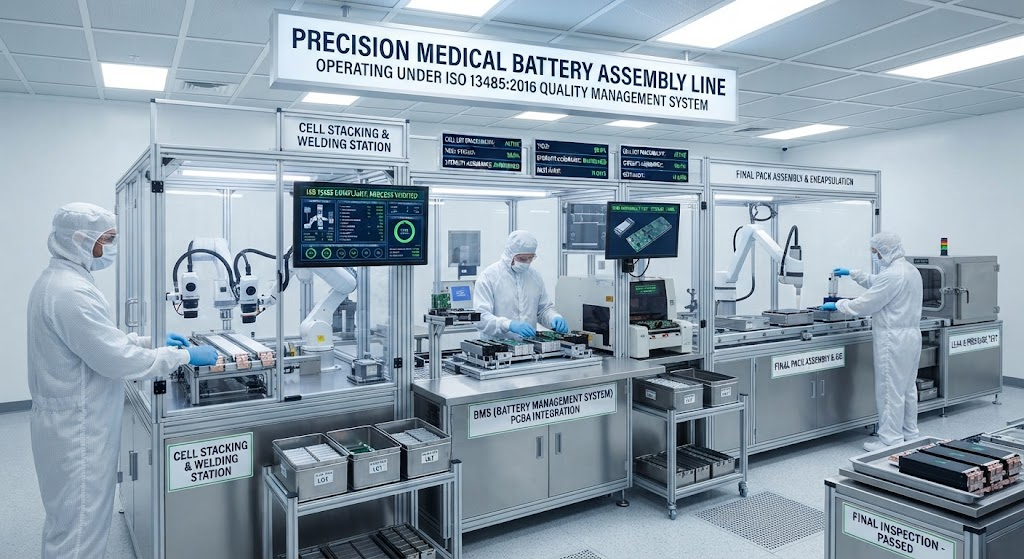
High-end medical device contracts are won or lost on manufacturing repeatability. Operating across Class 10,000 and Class 100,000 cleanroom facilities, JHY Battery maintains a guaranteed defect rate below 0.03% (300 PPM).
This level of precision is achieved through a fully automated manufacturing and testing pipeline:
Automated Process Verification Controls
- 100% Automated Cell Sorting: Grade-A cylindrical (18650, 21700) or prismatic cells are sorted by high-precision robotics, grouping cells within ±1mV OCV and ±0.5mΩ ACIR.
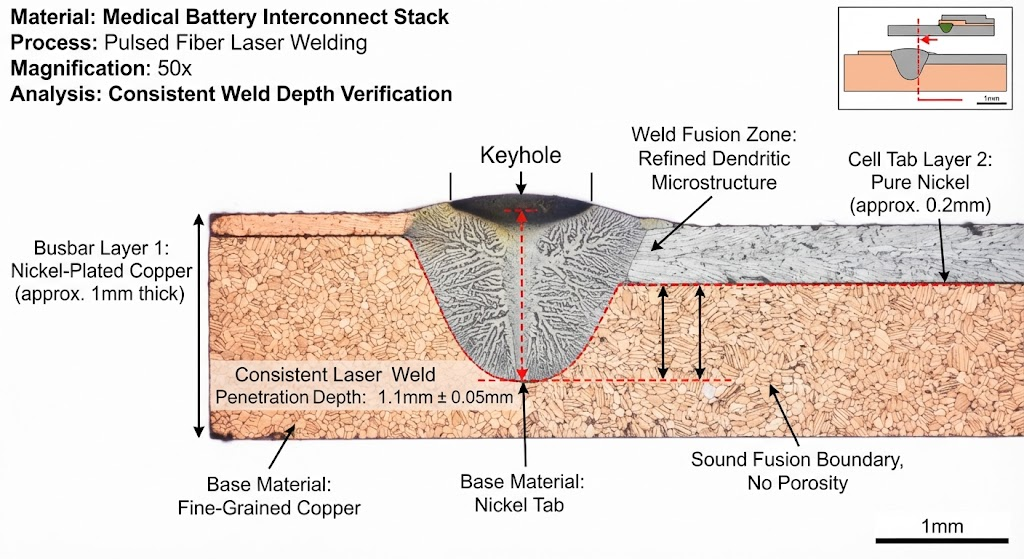
- CNC Fiber Laser Welding: Replaces manual resistance welding with CNC laser welding for nickel-copper busbars, providing consistent weld penetration depth, low thermal transfer to cell seals, and pull strength exceeding 150N.
- Helium Mass Spectrometer Leak Detection: Verifies hermetic seal integrity for IP67 and IP68 waterproof enclosures, preventing fluid ingress during clinical disinfection.
- Automated End-of-Line (EOL) Testing: Full charge/discharge cycling, dynamic load step testing, insulation resistance validation (>100MΩ at 500V DC), and communication handshake verification.
- Complete MES Serialization: Every cell serial number, weld power curve, torque measurement, and operator ID is bound to a unique laser-etched 2D DataMatrix code on the outer battery housing.
Learn more about our structural packaging capabilities in custom lithium battery pack engineering.
Design Transfer Roadmap: From NPI Prototyping to Full-Scale IQ/OQ/PQ Validation
Transitioning from an engineering concept to mass production requires structured Design Transfer protocols aligned with FDA 21 CFR Part 820.30 and ISO 13485 clause 7.3.7.
The 4-Phase Design Transfer Protocol
- Phase 1: Concept & Electro-Chemical Selection: Evaluating application load curves, duty cycles, and dimensional envelopes. Selecting optimal cell chemistries (NMC for energy density vs. LiFePO4 for thermal stability and high cycle life).
- Phase 2: DFM Analysis & Rapid Prototyping: Design for Manufacturability review, thermal simulation, enclosure CAD modeling, and rapid 5-7 business day functional sample delivery.
- Phase 3: Formal Process Validation (IQ/OQ/PQ):
- Installation Qualification (IQ): Verifying that all automated welding, charging, and assembly fixtures are properly calibrated and installed.
- Operational Qualification (OQ): Challenging operating parameters (voltage limits, weld pulse limits) to establish stable process windows.
- Performance Qualification (PQ): Executing consecutive full-speed production runs to prove long-term process capability (Cpk > 1.33).
- Phase 4: BOM Freezing & Mass Production Ramp: Final sign-off of the Device Master Record (DMR). Zero component substitutions are permitted without formal Engineering Change Orders (ECO).
Extreme Mission-Critical Applications: Where Failure Is Not an Option
JHY Battery engineers turnkey battery systems for high-stakes medical device categories worldwide:
1. Portable ICU Ventilators & Respiratory Support
Ventilator power architectures require high pulse currents to power internal blowers and solenoid valves without causing voltage sags. Our packs utilize low-impedance 21700 NMC cells delivering continuous discharge rates up to 15C with integrated hot-swappable communication.
2. Ambulatory Infusion & Dialysis Pumps
Infusion pumps require continuous, uncompromised runtime and linear discharge profiles. We integrate high-density pouch or custom prismatic cells with impedance-tracking fuel gauges, ensuring exact runtime calculations down to the last milliampere-hour.
3. Automated External Defibrillators (AEDs) & Surgical Tools
AED power systems require 5-to-10-year standby shelf stability paired with instant 30A+ discharge capability upon deployment. Surgical power tools demand high-temperature sterilization tolerance and ruggedized IP68 waterproof enclosures to withstand autoclave and chemical wash cycles.
4. Wearable Biosensors & Remote Patient Monitors
For smart patches and clinical monitoring hardware, JHY Battery designs ultra-thin custom lithium polymer cells (down to 0.8mm) with medical-grade biocompatible silicone outer sleeving.
Procurement ROI & Risk Analysis: Certified Medical CM vs. Commercial Assembly
For MedTech procurement leaders, evaluating battery pack suppliers on initial purchase price alone creates substantial lifecycle risk. While standard industrial pack assemblers may offer a 15% to 25% lower piece-part cost, their lack of medical design controls exposes OEMs to significant financial liabilities.
JHY Battery supports medical device lifecycles with guaranteed 7 to 10-year component supply continuity, proactive obsolescence management, and end-of-life replacement strategies.
Frequently Asked Questions (FAQs)
What is the true Total Cost of Ownership (TCO) difference between an ISO 13485 certified medical battery contract manufacturer and a standard consumer-grade battery pack assembler?
While non-certified commercial pack assemblers may present a 15-25% lower upfront unit cost, the lifecycle risk profile is prohibitively high for MedTech. Uncontrolled component substitutions, lack of IQ/OQ/PQ validation, and inadequate PFMEAs lead to field failures, FDA 483 warning letters, or MDR non-compliance recalls costing an average of $2M to $10M+ in corrective actions. ISO 13485 contract manufacturing by JHY Battery guarantees frozen BOMs, automated 300 PPM quality gates, and seamless 510(k) compliance, resulting in a 40% lower overall lifecycle TCO.
How does dual-MOSFET redundant BMS architecture differ from standard commercial protection circuits?
Commercial BMS modules typically rely on a single Analog Front End (AFE) controlling dual N-channel MOSFETs on the low or high side. If a FET suffers a short-circuit failure under continuous overcharge, catastrophic runaway can occur. In contrast, JHY Battery medical BMS architecture incorporates secondary hardware-level thermal fuses (such as three-terminal SCP fuses) triggered by an independent secondary voltage supervisor, optical/galvanic isolation for communication busses (SMBus v1.1/CANopen), and redundant NTC thermistors monitoring cell interconnects and FET junctions independently.
How do MedTech quality teams audit and verify genuine Tier-1 Grade-A cell matching and MES traceability?
Quality teams must audit three points: First, verify batch-specific manufacturer certificates of analysis (CoA) matched with 100% automated incoming OCV/ACIR sorting data (voltage tolerance within ±1mV, AC impedance within ±0.5mΩ). Second, inspect the contract manufacturer’s MES software to verify that individual cell serial numbers, weld power logs, technician IDs, and EOL test profiles are bound to the finished battery pack barcode. JHY Battery provides full MES digital pedigree reports with every production batch.
What documentation is required from the battery contract manufacturer to support FDA 510(k) and EU MDR submissions?
Contract manufacturers must provide a fully signed-off Design History File (DHF) excerpt and Device Master Record (DMR) package. This includes: complete DFMEA/PFMEA aligned with ISO 14971, UL 1642 cell component recognition, IEC 62133-2 CB reports, UN38.3 transport test summaries, UL 2054 pack certification, electromagnetic compatibility (EMC) reports under IEC 60601-1-2, IQ/OQ/PQ production validation reports, and a formal Certificate of Analysis (CoA) with frozen BOM declarations.
Accelerate Your Medical Device Power Architecture with JHY Battery
Partner with an established industrial battery engineering leader backed by over 30 years of manufacturing excellence, 800+ dedicated R&D engineers, and an uncompromising sub-0.03% (300 PPM) defect ceiling.
Our 3-Step Action Funnel
- 手順 1: Electro-Mechanical Requirement Definition & Power Sizing (Voltage, Capacity, C-rate, Form Factor, Ingress Protection).
- ステップ 2: DFM Analysis, Smart BMS Schematic Engineering & ISO 14971 Risk Assessment Simulation.
- ステップ3: Rapid 5-7 Business Day Working Functional Prototype Delivery with Full IQ/OQ Documentation Package.
Direct Medical Battery Engineering Desk: Simple@chinabatterymanufacturer.com | joeshen@chinabatterymanufacturer.com
Direct Hotline / WhatsApp: +86-18575997879
Global Web: https://chinabatterymanufacturer.com