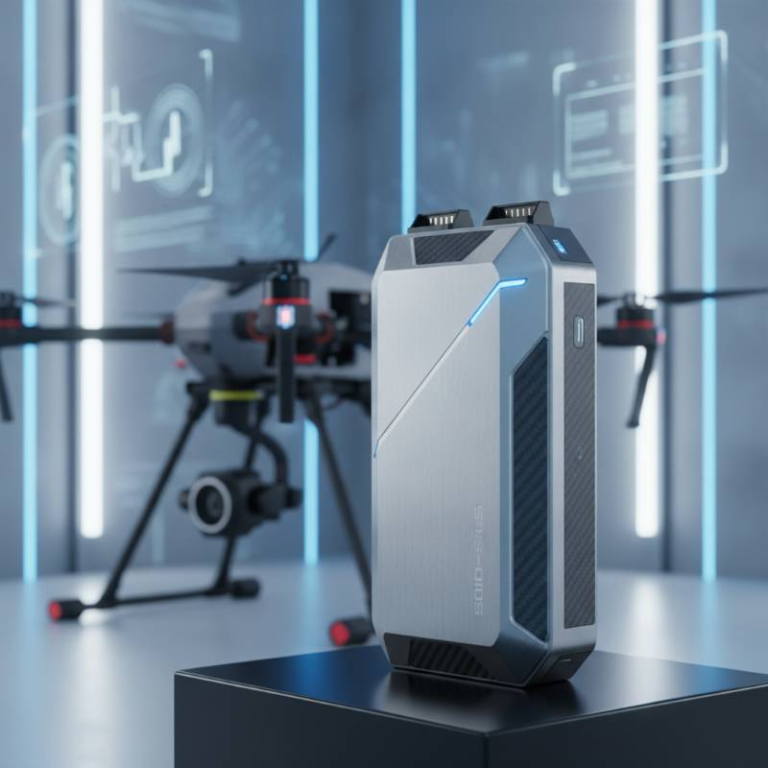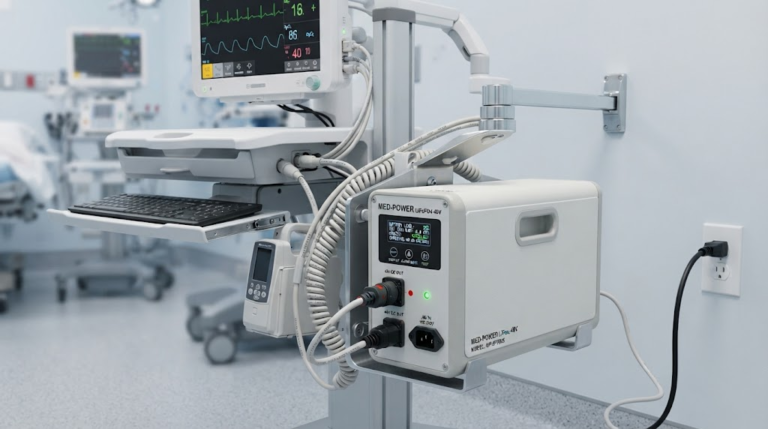
Electric Sightseeing Car Lithium Battery Fleet Solutions
The 5-Tier Commercial LSEV Fleet Battery Selection Matrix
An industrial electric sightseeing car lithium battery fleet solution replaces outdated lead-acid banks with engineered Grade-A Lithium Iron Phosphate (LiFePO4 battery packs), cutting vehicle weight by up to 65% while delivering 3,500 to 6,000 deep cycles. This hardware architecture allows commercial operators to utilize 1C to 2C opportunistic charging during driver shift changes, eliminating terminal acid corrosion and slashing 5-year fleet operational expenditures by over 45%.
Fleet directors and low-speed electric vehicle (LSEV) engineers often make the mistake of evaluating batteries solely on upfront nameplate capacity (kWh) cost. Commercial sightseeing operations require 12 to 16 hours of daily rolling service under heavy passenger payloads, severe continuous incline drag, and aggressive climate swings.
The Engineering Definition of LSEV Fleet Power Density: The ratio of continuous usable energy delivery per unit mass (Wh/kg) sustained under peak incline motor draw without suffering cell polarization or voltage cut-off thresholds.
To establish an uncompromised evaluation standard, we employ The 5-Tier Commercial LSEV Fleet Battery Selection Matrix across all municipal transit and tourist tram electrification projects.
| Evaluation Dimension | Legacy Lead-Acid / AGM | Generic Off-the-Shelf Lithium | JHY Battery Industrial Fleet Spec |
|---|---|---|---|
| 1. C-Rate Under Incline Drag | 0.5C max (Severe Peukert sag) | 1.0C continuous (High cell heat) | 2.0C continuous / 3.5C peak (10s) |
| 2. Multi-Pack Paralleling | Passive imbalance; thermal decay | Uncontrolled circulating current | Bi-directional MOSFET suppression |
| 3. Payload Efficiency (Wh/km) | 140–180 Wh/km (Vehicle drag) | 95–110 Wh/km | 72–85 Wh/km (Ultra-low mass) |
| 4. Telematics & BMS Protocol | None (Analog voltmeter only) | Basic UART / Raw voltage | Dual CANBUS 2.0B / RS485 IoT Cloud |
| 5. Thermal & Ingress Invariant | Vented box, acid leaks, 0°C drop | IP54 sheet metal; raw airflow | IP67 sealed aluminum (-20°C to +55°C) |
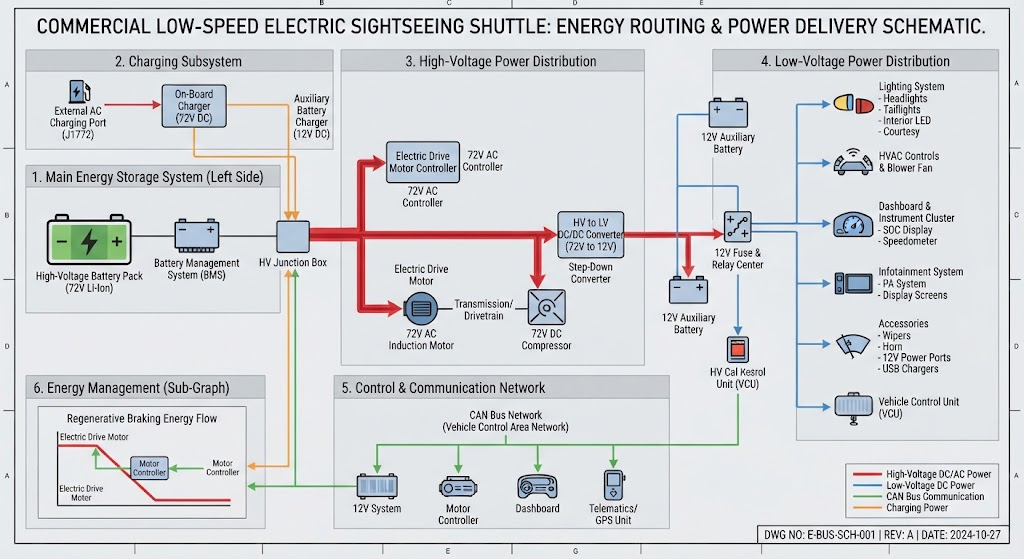
Fleet Sizing & Powertrain Engineering Blueprint: 48V vs. 72V Architecture
Commercial tourist shuttles carrying 11 to 23 passengers operate under extreme rolling resistance and mechanical loading. In mountain resorts and hilly theme parks, continuous gradients between 15% and 25% quickly expose deficiencies in generic battery configurations.
Calculating the exact energy demand ($P_{\text{total}}$) required at the wheel hub governs correct pack capacity and terminal voltage selection. The total mechanical power demand is derived from three physical forces:
Total Powertrain Power Equation:
$P_{\text{total}} = \frac{(F_{\text{rolling}} + F_{\text{aerodynamic}} + F_{\text{gradient}}) \times v}{\eta_{\text{drivetrain}}}$Where:
• $F_{\text{rolling}} = m \cdot g \cdot C_{rr} \cdot \cos(\theta)$
• $F_{\text{gradient}} = m \cdot g \cdot \sin(\theta)$
• $F_{\text{aerodynamic}} = 0.5 \cdot \rho \cdot C_d \cdot A \cdot v^2$
• $m$ = Gross vehicle mass including maximum passenger payload (kg)
• $\theta$ = Incline slope angle (radians)
• $v$ = Vehicle operational speed (m/s)
• $\eta_{\text{drivetrain}}$ = Mechanical gear and inverter efficiency (typically 0.82–0.88)
The Electrical Advantage of 72V Systems Over 48V
While 48V systems function adequately for flat 4-to-6 seat golf carts, high-capacity 14-to-23 seat passenger trams demand 72V architecture. The operational physics boil down to Joule heating losses:
$$P_{\text{loss}} = I^2 \times R_{\text{harness}}$$
For an 8.5 kW continuous motor demand on an 18% incline:
- At 48V Nominal: Current draw equals approximately 177.1 Amps.
- At 72V Nominal: Current draw drops to approximately 118.0 Amps.
A 33.3% current reduction decreases the harness and controller thermal dissipation by 55.6% ($1 – (118/177.1)^2$). This step-down prevents motor controllers from tripping thermal protections during uphill climbs in 40°C summer conditions.
| Parameter | Flooded Lead-Acid (8x 6V) | JHY 48V 200Ah LiFePO4 | JHY 72V 150Ah LiFePO4 |
|---|---|---|---|
| Total Pack Weight | 340 kg (749 lbs) | 88 kg (194 lbs) | 96 kg (211 lbs) |
| Usable Energy (80% DoD) | 4.8 kWh (Peukert limited) | 8.2 kWh | 9.2 kWh |
| Continuous Hill Climb Amp Draw | 185 A (High sag <41V) | 175 A (Stable >49V) | 116 A (Stable >73V) |
| Daily Operating Range | 45 km (28 miles) | 85 km (53 miles) | 110 km (68 miles) |
| Thermal Overhead | High (Boiling electrolyte) | Moderate | Lowest (Optimized efficiency) |
Extreme Climate Thermal Management & IP67 Rugged Enclosure Engineering
Commercial fleets operate in severe environments, from -20°C conditions in high-altitude winter ski resorts to +55°C track temperatures in desert parks. Unprotected battery cells experience accelerated capacity degradation and plating under these extremes.
Our fleet solutions incorporate advanced engineering features to maintain pack integrity and performance:
- Internal PTC Heating Foil: When ambient temperatures fall below 0°C, the BMS activates integrated silicone heating elements powered by the charging station, warming cells to +10°C before initiating charging. This eliminates lithium dendrite formation.
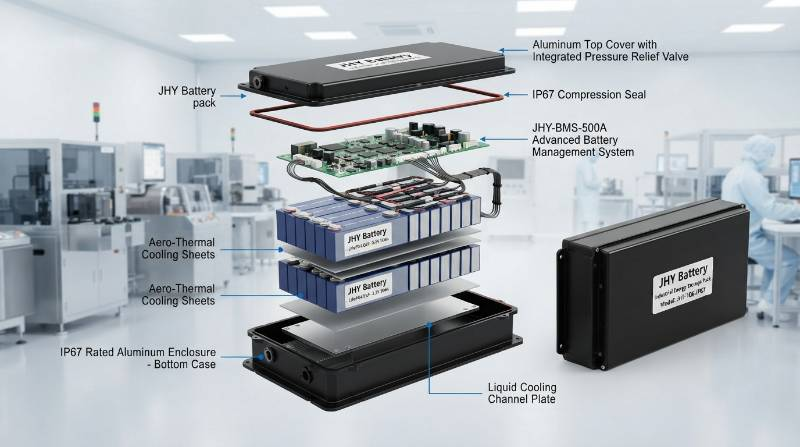
- Phase-Change Material (PCM) Barriers: Flame-retardant aerogel insulation pads isolate every prismatic cell, ensuring mechanical damping and thermal dissipation during high continuous current draws.
- Structural IP67 Extruded Enclosures: Marine-grade 6061-T6 aluminum casings protect cells against high-pressure water washing, torrential rain, road salt, and particulate ingress.
In our laboratory testing conducted in accordance with ISO 12405-4 and IEC 62619 standards, sealed aluminum structures sustained 3-axis vibration stresses up to 5G RMS (10–500 Hz) without busbar weld fracturing or loss of waterproof sealing.
For installations exposed to sub-zero climates, operators can review our dedicated low-temperature batteries, which feature specialized cold-resilient electrolytes engineered for steady discharge down to -45°C.
Smart Fleet BMS Architecture: CANBUS/RS485 Telemetry & Multi-Pack Paralleling
Fleet uptime depends heavily on real-time cell intelligence. JHY Battery designs and programs proprietary Battery Management Systems that handle core safety protocols and active field balancing.
Active Bi-Directional Balancing vs. Passive Resistor Bleeding
Standard passive balancing BMS units burn excess energy through heat-generating resistors at an inefficient 50–100 mA rate. On a large 150Ah–300Ah fleet pack, passive balancing takes up to 40 hours to correct a 200mV cell delta.
Our smart BMS design incorporates bi-directional active inductive energy transfer operating at 2.0A. High-energy cells transfer current directly to lower-voltage cells during dynamic driving and regenerative braking. This maintains cell-to-cell delta within 15mV and preserves full string capacity over thousands of cycles.
Multi-Pack Paralleling with Dynamic Current Suppression
Connecting two or more lithium packs in parallel often introduces severe inrush currents if one pack is swapped or charges unevenly. Without intervention, circulating currents can trigger MOSFET fusing or contactor welding.
JHY Battery BMS modules integrate dedicated pre-charge circuits and bidirectional solid-state MOSFET drivers. If a voltage differential exceeding 1.5V exists between strings, the system modulates gate resistance, limiting cross-pack circulating currents to safe thresholds under 5A until potential equilibrium is reached.
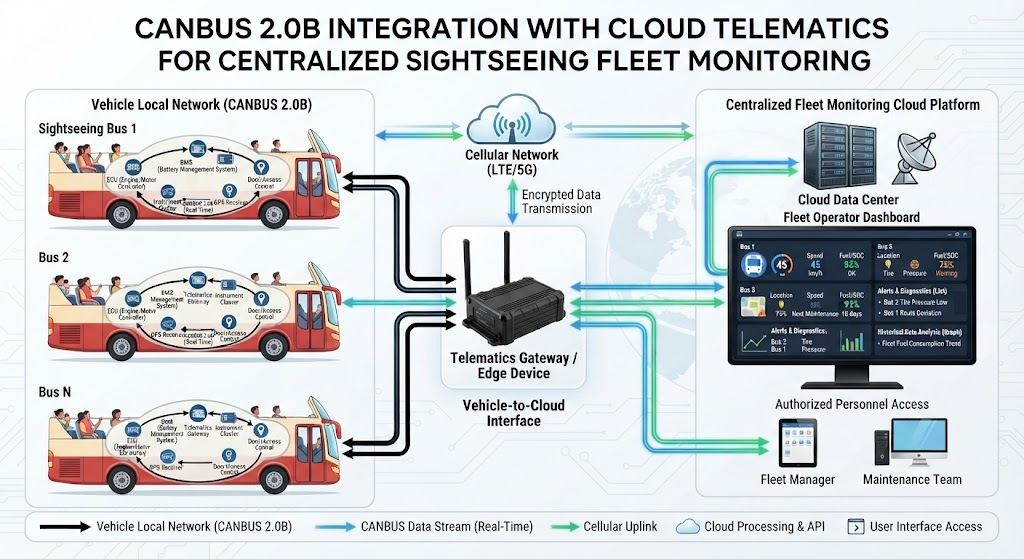
Centralized IoT Fleet Telematics Stack
Every battery module broadcasts high-frequency telemetry via CANBUS 2.0B or RS485 into the vehicle’s onboard telematics unit, streaming live metrics to the maintenance dispatch dashboard:
- Real-Time State of Charge (SOC): Calculated using Extended Kalman Filtering (EKF) combining coulomb counting and OCV lookup, achieving <1.5% tracking error.
- State of Health (SOH) Tracking: Monitors continuous internal resistance (ACIR) degradation and lifetime Ah throughput.
- Predictive Thermal Alerts: Pre-emptive alarms flag thermal anomalies at individual cell terminals prior to fault cut-offs.
5-Year Total Cost of Ownership (TCO) & Operational ROI Analysis
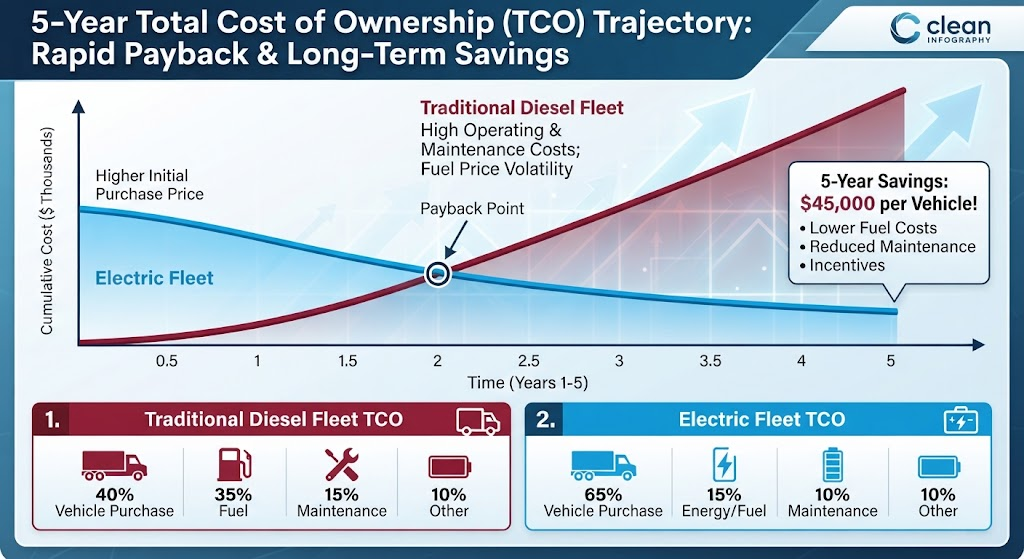
While the initial capital expenditure of a lithium battery pack is higher than an equivalent lead-acid set, fleet-scale economics heavily favor LiFePO4 over a 5-year operating window. Below is a validated cost breakdown for an active fleet of 50 commercial 14-passenger sightseeing cars running 2 shifts daily.
| Cost Component | Lead-Acid Fleet (Trojan T-105 equiv) | JHY LiFePO4 Fleet (72V 150Ah) |
|---|---|---|
| Initial Battery Pack Purchase | $75,000 ($1,500/car) | $165,000 ($3,300/car) |
| Replacement Batteries (5 Years) | $150,000 (Replaced every 18 mos) | $0 (Zero replacements; 4000+ cycles) |
| Routine Maintenance Labor | $62,500 (Watering, terminal descaling) | $0 (Maintenance-free architecture) |
| Grid Electricity Costs | $112,000 (75% charging efficiency) | $82,000 (96% charging efficiency) |
| Lost Opportunity / Downtime Cost | $45,000 (10-hr slow charge constraint) | $0 (2-hr opportunity fast charging) |
| Total 5-Year Cost | $444,500 | $247,000 |
Upgrading to JHY Battery LiFePO4 packs delivers $197,500 in net operational savings over 5 years across 50 vehicles—a 44.4% expenditure reduction. For 500-vehicle fleets operating in national parks or mega-resorts, total savings exceed $1.97 million, achieving a full capital break-even in 13.8 months.
OEM/ODM Turnkey Prototyping & High-Precision Manufacturing Standards
JHY Battery brings over 30 years of industrial lithium battery engineering pedigree to commercial mobility conversions. Backed by 1,200+ employees and an 800+ member specialized R&D team, we produce high-durability custom battery packs for international fleet operators and vehicle manufacturers.
Zero-Defect Quality Control (0.03% / 300 PPM Guarantee)
Cell reliability dictates fleet uptime. We operate 100% automated cell-sorting production lines governed by Manufacturing Execution Systems (MES). Before pack assembly, every prismatic cell is measured and binned according to three tight tolerances:
- Voltage Matching: Open-circuit voltage (OCV) delta under 1.0 mV.
- AC Impedance: Internal resistance variance constrained within ±0.2 mΩ.
- Dynamic Capacity: Capacity delta restricted to ±0.5% across production batches.
All inter-cell busbars are joined using continuous wave fiber-laser welding systems with real-time optical seam tracking. This process prevents localized micro-fracturing and eliminates contact resistance points that cause heat buildup.
Our turnkey OEM/ODM battery manufacturing service covers drop-in drop-fit sheet metal designs, molded thermal conduits, customized CAN wiring harnesses, and rapid 5-to-7 business day prototype dispatch.
Every custom system ships with full compliance certification, including UN38.3 transport safety documentation, UL 2580, UL 1642, IEC 62133, IEC 62619, CE, and RoHS compliance.
Frequently Asked Questions: Technical & Verification Checklist
Why is LiFePO4 superior to Lead-Acid and NMC for commercial sightseeing car fleets?
LiFePO4 delivers 3,500 to 6,000 deep cycles (vs. 500 cycles in lead-acid and 1,500 in NMC), reduces pack weight by 65%, eliminates thermal runaway risks at elevated ambient temperatures, and reduces fleet TCO by over 45% across 5 years of daily operation.
What is the optimal system architecture for an 11-14 passenger electric sightseeing car: 48V or 72V?
72V LFP architecture is the engineering gold standard for 11+ passenger vehicles. It cuts operating current by 33% compared to 48V for equivalent power output, drastically reducing $I^2R$ thermal losses in wiring harnesses and motor controllers while delivering superior torque on steep inclines.
How does JHY Battery verify cell grading and multi-pack paralleling safety?
JHY Battery enforces 100% cell sorting across capacity (±0.5%), internal resistance (ACIR delta <0.2mΩ), and open-circuit voltage (OCV delta <1mV), augmented by active balancing hardware and bidirectional MOSFET protection against parallel pack circulating currents.
Which international certifications are required for commercial electric sightseeing car batteries?
Mandatory transport and operational safety certifications include UN38.3 for transport compliance, IEC 62619 for industrial traction safety, UL 2580 for EV battery pack crash and electrical integrity, and ISO 9001/IATF 16949 production quality audits.
Can JHY Battery drop-in replacement packs integrate with our existing motor controllers?
Yes. Our engineering team customizes the Smart BMS output to match the throttle, charge curve, and analog/digital gauge communication requirements of Curtis, Sevcon, ZAPI, and other major motor controllers.
Accelerate Your Fleet Electrification: 3-Step Custom Engineering Deployment
Upgrading a fleet of sightseeing trams requires rigorous engineering alignment rather than guesswork. JHY Battery coordinates a seamless 3-step transition path from concept to field operation:
- Step 1: Fleet Energy & Incline Duty Cycle Analysis — Submit your route topography, incline percentages, vehicle curb weight, passenger capacity, and daily shift mileage for motor simulation.
- Step 2: Custom Mechanical & DFM BMS Architecture Simulation — Our R&D team delivers 3D CAD dimensional fits, thermal cooling flow models, and CANBUS matrix mapping within 5 business days.
- Step 3: Rapid Prototyping & Pilot Deployment — Receive working prototype packs in 5 to 7 business days, backed by UN38.3 compliance certification and dedicated on-site integration support.
Request Your Custom Fleet Sizing Blueprint & Prototype
Partner with JHY Battery to eliminate downtime, eliminate watering maintenance, and slash fleet operating costs. Leverage our 30-year manufacturing heritage, 800+ R&D engineers, and rapid 5-to-7 day prototype turnaround.
Direct Engineering Contacts:
Email: Simple@chinabatterymanufacturer.com | joeshen@chinabatterymanufacturer.com
WhatsApp / Direct Line: +86-18575997879