Battery Testing & Quality Assurance: Complete Guide
Battery Testing and Quality Assurance: The Definitive Guide
Battery quality assurance is a systematic engineering framework of physical, chemical, and electrical evaluations designed to guarantee the safety, reliability, and performance of electrochemical cells. By mitigating manufacturing variances, this process ensures compliance with global standards and prevents hazardous field failures like thermal runaway.
- Cell Testing: Verifies raw material purity, electrode density, and basic electrochemical properties.
- Module Testing: Evaluates mechanical alignment, weld integrity, and voltage balancing between grouped cells.
- Pack Testing: Assesses the complete structural enclosure, thermal management systems, and high-voltage connections.
- BMS Testing: Validates overcharge protection, state-of-charge calculation, and communication protocol accuracy.
- Environmental Stress Testing: Subjects batteries to extreme thermal, vibration, and altitude conditions to simulate real-world operations.

What is Battery Quality Assurance? Definition & Core Objectives
Battery quality assurance (QA) is not a simple post-production gatekeeper. It is an end-to-end risk mitigation framework that monitors every phase of production, from raw material inspection to final pack deployment.
Battery quality assurance (QA) refers to the continuous, multi-stage protocol of monitoring, validating, and testing materials and assemblies to ensure every battery product meets pre-defined performance, safety, and longevity benchmarks.
In modern manufacturing, relying on end-of-line testing alone is a recipe for high scrap rates. Implementing rigorous controls at the earliest stages prevents defective components from moving down the assembly line.
Early defect detection during the formation and aging process reduces gigafactory scrap rates by up to 35%. This statistical reality drives leading B2B manufacturers to implement continuous monitoring during electrode coating and cell assembly.
For companies sourcing custom lithium-ion battery packs, QA serves as the primary shield against field failures, thermal events, and premature capacity fade.
Global Battery Safety Standards & Compliance Frameworks
Navigating the global regulatory landscape is a major hurdle for hardware engineers. Compliance is not optional; it is the legal ticket to global shipping and commercialization.
Thermal runaway and propagation incidents account for over 60% of battery safety recalls globally. Because of this risk, international standards focus heavily on stress-testing cells under extreme thermal and mechanical abuse.
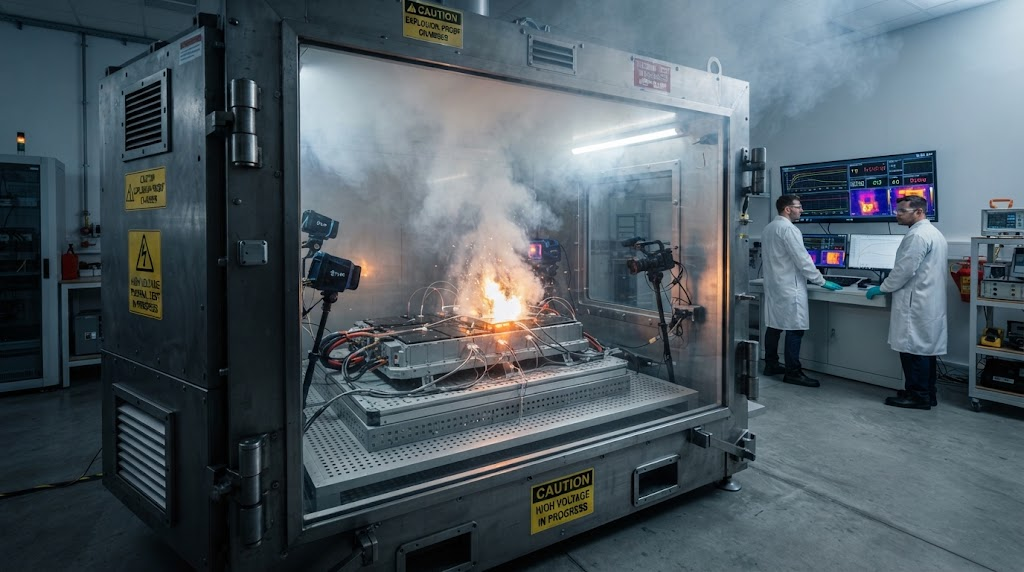
To safely navigate these requirements, engineers rely on three core pillars of international compliance:
- UN 38.3 Transport Testing: A mandatory set of tests simulating transport hazards, including altitude simulation, extreme thermal cycling, vibration, shock, external short circuit, impact, overcharge, and forced discharge.
- IEC 62133 Certification: The global standard established by the International Electrotechnical Commission (IEC) for the safety of portable sealed secondary cells and batteries under intended use and reasonably foreseeable misuse.
- UL 1642 Cell Safety Standards: Formulated by Underwriters Laboratories (UL), this standard tests the resilience of individual lithium cells against electrical, mechanical, and thermal abuses.
For grid-scale and commercial energy projects, compliance has evolved further. Systems must now meet strict UL 9540A thermal propagation standards to ensure a single-cell thermal event cannot cascade into a catastrophic system-wide fire.
Advanced Battery Testing Methodologies & Equipment
As battery chemistry advances, diagnostic tools must keep pace. Legacy testing methods often fail to detect internal micro-defects that lead to field failures months down the line.
Implementing Electrochemical Impedance Spectroscopy (EIS) in production lines improves cell sorting efficiency by 25%. EIS maps the internal resistance of a cell across various frequencies, exposing manufacturing anomalies before the cell is integrated into a pack.
The table below outlines the primary testing methodologies utilized by advanced manufacturers to ensure safety, state of health (SOH), and state of charge (SOC) accuracy:
| Testing Methodology | Primary Target | Key Benefit |
|---|---|---|
| Electrochemical Impedance Spectroscopy (EIS) | Internal resistance, micro-defects | Non-destructive, rapid cell-sorting optimization. |
| HIL (Hardware-in-the-Loop) Testing | BMS validation under edge-case scenarios | Simulates real-world sensor faults without physical risks. |
| Vibration & Mechanical Shock Testing | Structural welds, busbar connections | Ensures physical integrity during transport and rugged operations. |
| Accelerated Degradation Testing | Cycle life testing, SOH forecasting | Predicts long-term wear patterns in specialized environmental chambers. |
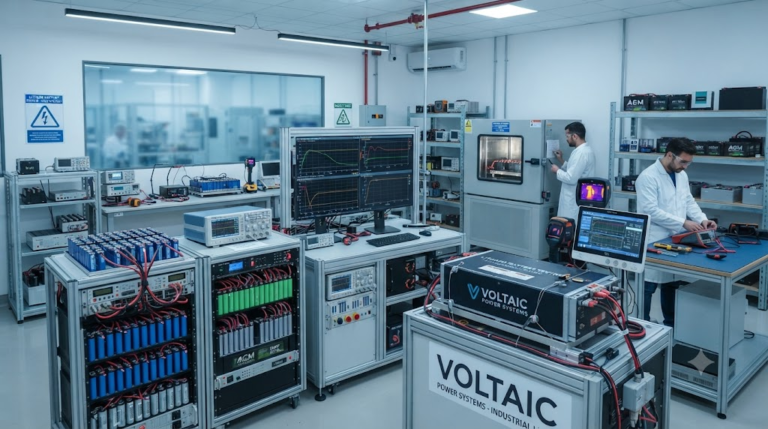
By pairing environmental chamber testing with high-fidelity BMS validation, engineers can simulate decades of wear in a fraction of the time. This predictive approach is vital for critical sectors like medical devices, electric vehicles (EV), and aerospace.
The JHY 5-Core Safety & Quality Assurance Protocol
To handle the rigorous demands of global B2B clients, JHY Battery (Juheyuan Science & Technology Co., Ltd.) developed a proprietary quality framework. This framework guarantees absolute safety for custom LiFePO4 batteries and complex power systems.
“Quality is designed directly into our manufacturing processes, not just verified after production. Our 5-Core protocol ensures that every cell and custom pack operates with maximum safety in the most demanding global environments.”
— Chief Quality Officer, JHY Battery
This strict methodology is broken down into five distinct, uncompromised phases:
Phase 1: Raw Material Verification
We audit and verify all incoming raw materials, including active cathode materials, anodes, separators, and electrolytes. Any batch showing chemical impurities is immediately rejected before entering the production line.
Phase 2: Electrode Coating Defect Detection
Our production lines deploy high-resolution automated optical inspection (AOI) systems. These systems detect microscopic coating voids, uneven thickness, or edge defects that could cause local hotspots or internal short circuits.
Phase 3: Formation and Aging Process Optimization
After cell assembly, we subject cells to controlled formation and aging protocols. By monitoring voltage stability and open-circuit voltage drop over extended periods, we identify and weed out self-discharging cells.
Phase 4: End-of-Line (EOL) Testing
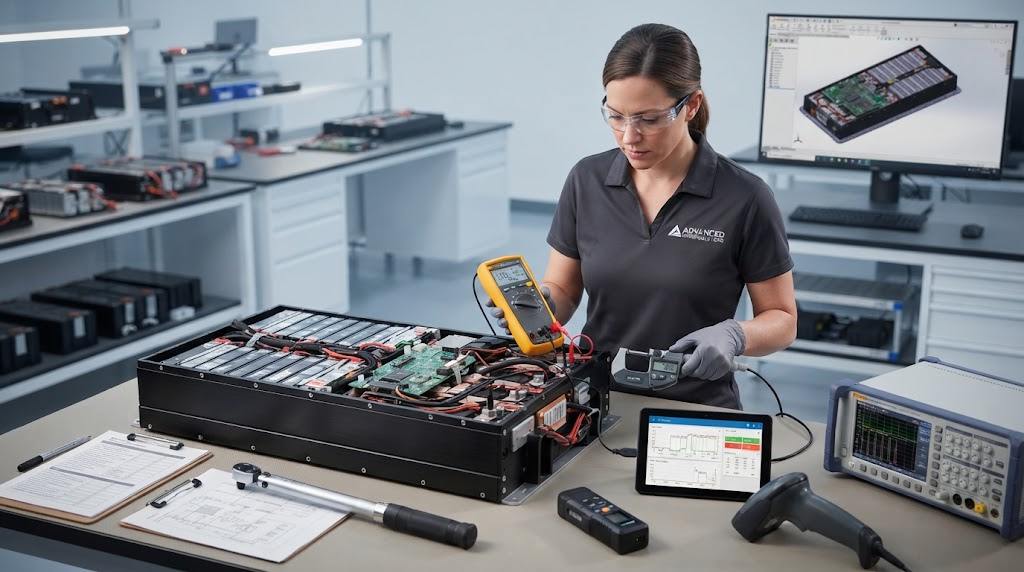
Completed battery packs are subjected to comprehensive electrical, thermal, and functional testing. This includes high-pot insulation testing, charge/discharge profile validation, and complete BMS functional verification.
Phase 5: Traceability in Battery Production
Every single battery pack receives a unique laser-etched QR code. This code links to a digital record containing raw material batch numbers, manufacturing parameters, test results, and shipping logs for absolute accountability.
End-of-Line (EOL) Testing in Custom Battery Pack Manufacturing
End-of-line battery testing represents the final line of defense before a product is shipped to a customer. This step is particularly vital when building complex energy storage systems (ESS) or heavy industrial equipment.
In custom battery pack assembly, EOL systems do not just test cells; they validate the entire integrated system. The tests check if the busbars are welded correctly, if the thermistors are reading thermal states accurately, and if the BMS communicates properly over CANbus or Modbus.
By simulating real-world operational loads, EOL testing guarantees that the battery behaves safely under high-rate discharge conditions. This validation is critical to preventing thermal runaway prevention failures in field environments.
The ROI of Advanced Battery QA: Cost-of-Failure Calculator
Many procurement managers view rigorous QA testing as a cost center. However, the financial consequences of a single field failure can destroy an entire product line and ruin brand equity.
Consider the contrast between investing in preventive quality control versus reacting to field failures:
- Upfront QA Investment: Standardized cell sorting, continuous EIS monitoring, and rigorous EOL testing represent roughly 3% to 5% of total manufacturing costs.
- The Cost of Failure: A single safety recall involves logistics costs, customer replacement fees, legal liabilities, and regulatory fines. This easily exceeds 150 times the cost of preventive testing.
- Long-Term Yield: By reducing field failure rates to less than 10 parts per million (PPM), businesses secure long-term contracts and protect their margins.
By prioritizing comprehensive testing upfront, hardware developers and B2B buyers protect their investments and ensure customer safety from day one.
Frequently Asked Questions About Battery Testing
What is the difference between UN 38.3 and IEC 62133?
UN 38.3 focuses purely on transport safety, ensuring that batteries can withstand extreme environmental and mechanical stress during air, sea, or land transit. IEC 62133 focuses on operational safety, ensuring the battery remains safe under intended use and foreseeable misuse in portable applications.
Why is BMS validation so critical during quality assurance?
The Battery Management System (BMS) acts as the brain of the pack. BMS validation ensures that the system accurately calculates SOC and SOH, while instantly shutting down current flow in the event of overcharge, over-discharge, or short-circuit situations.
How is AI changing battery quality assurance in 2026?
In 2026, AI-driven predictive maintenance utilizes machine learning algorithms to analyze early formation and aging data. This allows manufacturers to predict a cell’s long-term cycle life and degradation characteristics within hours, rather than waiting for months of physical testing.
About the Expert Reviewer
This technical guide was reviewed and validated by the lead QA engineer at JHY Battery (Juheyuan Science & Technology Co., Ltd.). With over 15 years of dedicated experience in lithium-ion manufacturing, compliance auditing, and custom pack validation, our expert oversees all ISO9001 and UL safety testing protocols. Under his guidance, JHY Battery continues to deliver zero-defect B2B power solutions globally.
Ready to Secure Your Custom Battery Solution?
Partner with JHY Battery to design, test, and certify your next-generation power system.