Lead-Acid to Lithium Conversion Troubleshooting Guide
Why Do Lead-Acid to Lithium Conversions Fail?
Swapping out heavy, high-maintenance lead-acid batteries for lightweight, high-energy lithium-iron phosphate (LiFePO4) cells is a massive upgrade. However, many DIYers and fleet managers face unexpected shutdowns, charging errors, or dead systems shortly after installation.
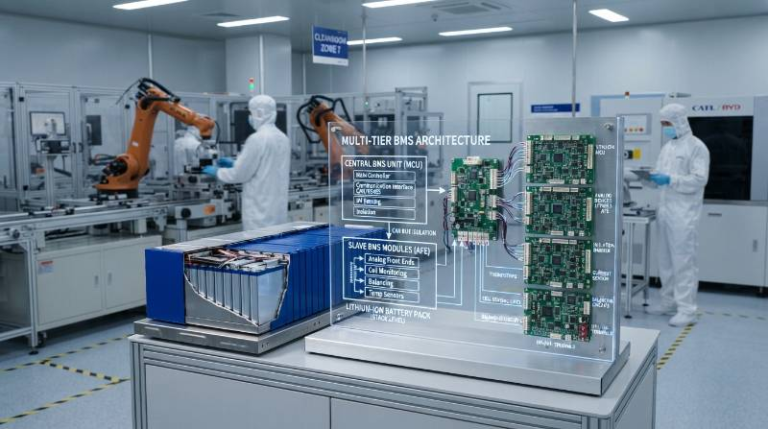
The core conflict comes down to how these two technologies operate. Lead-acid batteries are chemically resilient but electronically dumb; they will sacrifice their lifespan to deliver high currents. Lithium batteries, on the other hand, are highly efficient but strictly self-protecting. They rely on digital brains to survive.
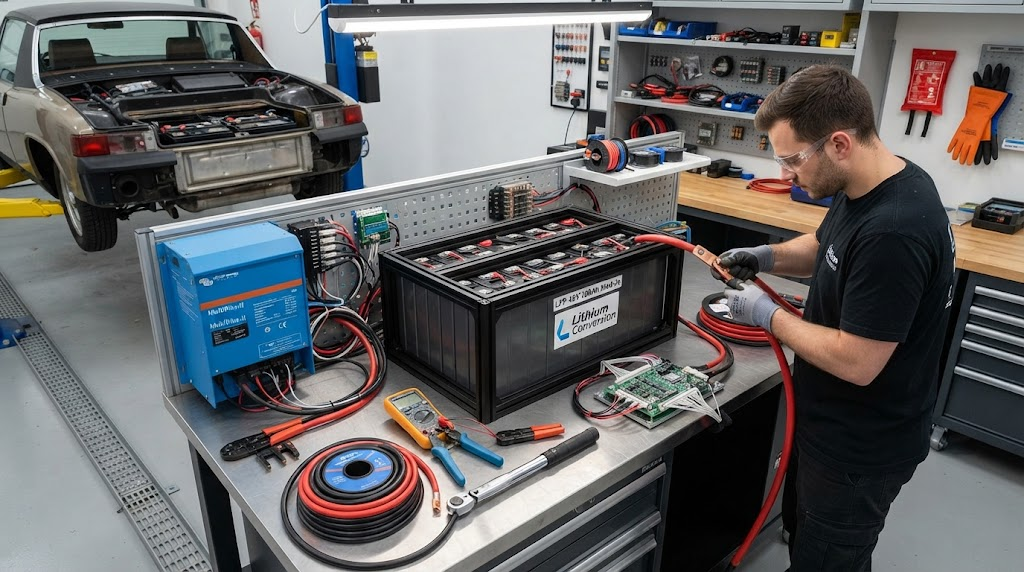
When you perform a conversion, you are not just changing a battery. You are shifting from a passive chemical reservoir to an active digital micro-grid. Understanding this difference is the first step to successful troubleshooting.
Understanding the Shift: Lead-Acid vs. Lithium Battery Dynamics
Lead-acid to lithium conversion failures typically stem from three core issues: unexpected BMS shutoff due to high-current draws, charger mismatch causing chronic cell imbalance, and incorrect voltage-cutoff settings on legacy equipment. These factors trigger system shutdowns because lithium batteries rely on active digital protection rather than passive chemical tolerance.
To pinpoint why your system is failing, follow these four immediate diagnostic steps:
- Measure individual cell voltages using a digital multimeter at rest and under load.
- Verify that the charger’s output profile matches the required LiFePO4 absorption voltage.
- Inspect all battery terminal connections for resistance-inducing corrosion or loose fittings.
- Confirm that your system’s wiring gauge can handle peak current demands without inducing voltage sag.
BMS overcurrent trips account for approximately 62% of all DIY lithium conversion issues.
A classic lead-acid battery features a sloped voltage discharge curve. As it loses charge, its voltage drops gradually, signaling your equipment to slow down or warn you of a low battery.
In contrast, a Lithium Iron Phosphate (LiFePO4) battery maintains a remarkably flat voltage curve. It delivers stable power at nearly 13V to 13.2V throughout almost its entire discharge cycle, then drops off precipitously.
If your system controller still expects a lead-acid discharge curve, it may miscalculate the true State of Charge (SoC). This leads to sudden, unannounced power cuts when the Battery Management System (BMS) steps in to prevent over-discharge.
The JHY 4-Point Diagnostic Protocol (V.A.M.P.)
To simplify troubleshooting, our engineering team developed the V.A.M.P. Diagnostic Protocol. This systematic bench-testing framework isolates whether your system fault is chemical, mechanical, or electronic.
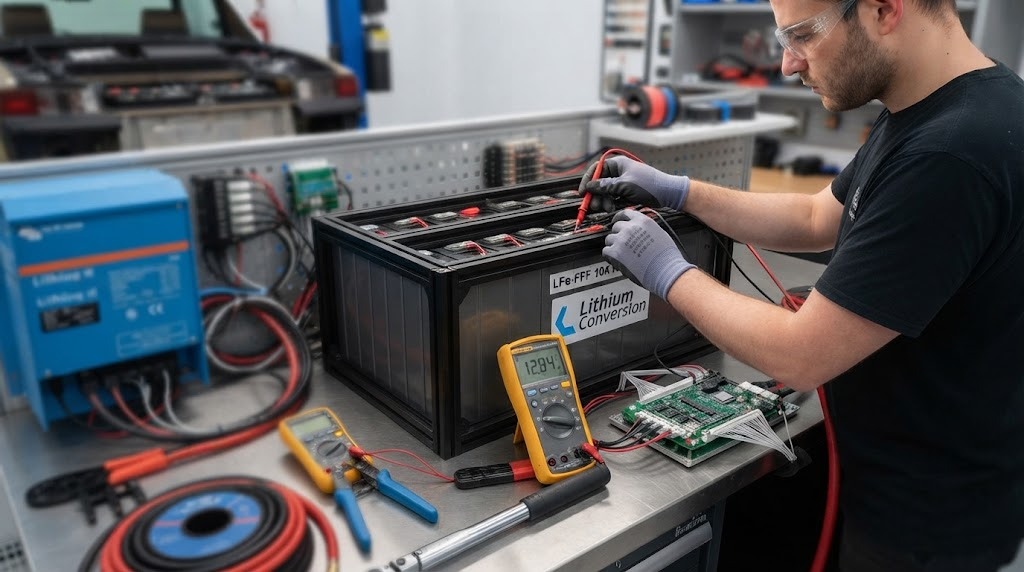
1. Voltage (V) – Static and Dynamic Checks
First, measure the open-circuit voltage at the battery terminals using a high-quality digital multimeter. A fully charged 12V LiFePO4 battery should read around 13.6V to 14.4V while charging, settling to 13.3V–13.4V at rest.
Next, keep the multimeter leads on the terminals while starting your high-load equipment. If the voltage drops instantly below 10V and the system cuts out, the BMS has tripped its low-voltage or overcurrent protection.
2. Amperage (A) – Inrush Analysis
Use a clamp-on DC ammeter on the main positive cable. Monitor the peak current draw when your device starts up. If the peak current exceeds the rated continuous or surge output of your BMS, the system will shut down to protect the internal cells.
3. Management (M) – BMS Query
If your lithium pack has Bluetooth capability, open the companion app. Check the real-time status for active fault codes. Look for indicators like “Cell Overvoltage,” “Under-Temperature Protection,” or “Short Circuit.”
4. Profile (P) – Charger Validation
Verify the charge controller settings. Ensure the bulk/absorption voltage is set correctly for LiFePO4 (typically 14.4V–14.6V for a 12V system) and that the float voltage is set to 13.5V–13.8V. Disable any automatic desulfation or equalization stages.
Troubleshooting BMS and Electrical Issues
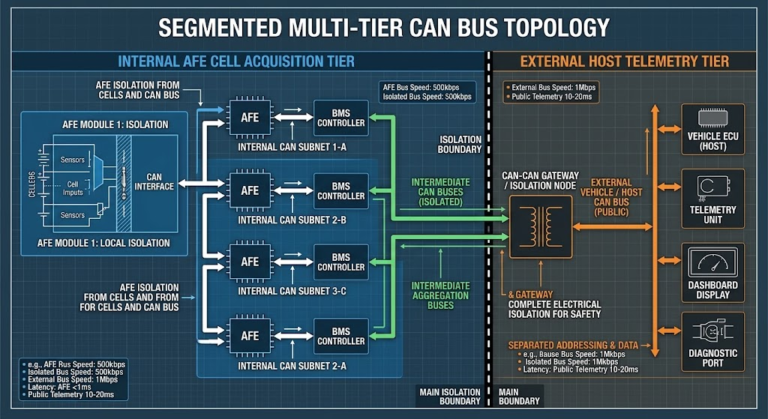
The BMS is the gatekeeper of your lithium battery. It monitors temperature, voltage, and current for every parallel group of cells. When it detects a parameter out of spec, it opens its internal solid-state switches (MOSFETs) to disconnect the battery from the load.
If your battery suddenly reads 0V, do not panic. The battery is likely not dead; the BMS has simply entered protection mode. To reset it, you must remove the load, apply a charging voltage, or use a proprietary BMS reset tool.
Wiring is another major culprit during conversions. Lead-acid systems can tolerate high voltage drops across thin, resistive wires. Lithium batteries, with their high discharge potential, demand low-resistance paths.
Upgrading to proper 2/0 AWG wiring reduces voltage drop by up to 45% compared to stock lead-acid cabling.
Thin cables create high resistance, causing severe voltage sag under load. The BMS interprets this localized voltage drop as a depleted cell and shuts down the battery. When designing high-performance setups, utilizing OEM/ODM custom lithium battery packs with pre-engineered wiring harnesses ensures your system never suffers from localized bottlenecking.
Charging and Compatibility Challenges
Can you use a standard lead-acid charger on a lithium battery? The short answer is yes, but with severe limitations and risks.
Standard lead-acid chargers fail to charge LiFePO4 batteries to their full capacity, leaving them 15-20% undercharged.
Lead-acid chargers utilize a multi-stage profile that slowly tapers current. They often feature an automatic “equalization” mode. This mode sends high-voltage pulses (sometimes exceeding 15.5V) to stir up stratified acid.
If a lithium BMS detects a voltage this high, it will immediately trigger thermal runaway protection or overvoltage protection, shutting down the entire system. Furthermore, because lead-acid chargers drop to a low float voltage too early, they never let the lithium cells reach their full State of Charge.
Charging via an engine alternator presents another challenge. Lithium batteries have incredibly low internal resistance. When connected directly to a vehicle’s alternator, they will draw maximum current indefinitely.
This massive current draw can easily overheat and burn out a standard alternator. To prevent this, always install a dedicated DC-to-DC battery charger. This device limits the current drawn from the alternator to a safe level, protecting your vehicle’s charging system while delivering a proper LiFePO4 charging profile.
For detailed parameters on charging profiles, you can consult technical resources on Battery University.
Application-Specific Fixes: Golf Carts, RVs, and Marine Systems
Different applications introduce unique electrical behaviors that can trick standard lithium setups.
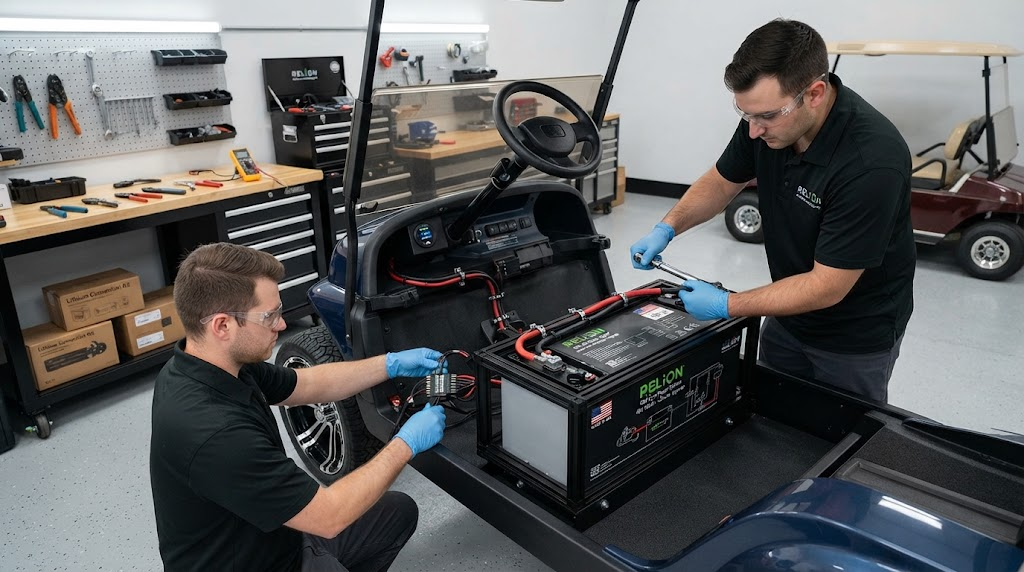
Golf Cart Conversion Errors
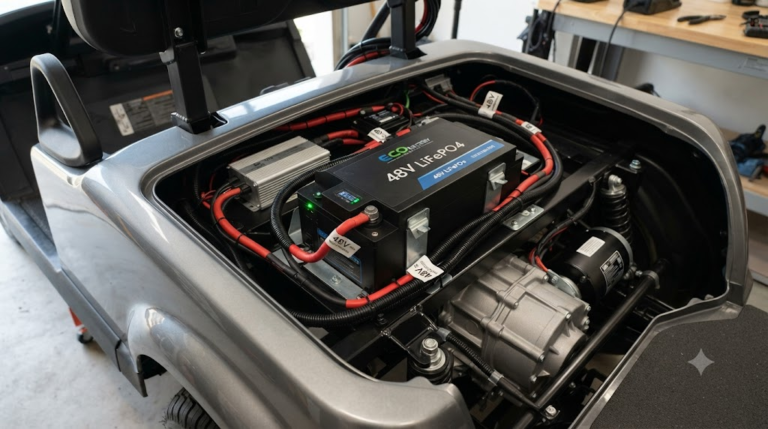
A classic issue occurs in 48V EZGO or Yamaha golf carts. When accelerating up a steep hill or starting from a complete stop with multiple passengers, the DC motor demands a massive inrush of startup current.
If your golf cart has been retrofitted with a low-grade battery, this surge will trigger the BMS overcurrent protection. The cart will suddenly die mid-climb. To solve this, you must install custom LiFePO4 golf cart batteries designed specifically with high-surge BMS limits (often 300A for 10 seconds) to handle motor startup curves.
RV Solar Lithium Integration
In RV setups, users often complain that their solar panels do not fully charge their new lithium bank. This is usually caused by incorrect charge controller settings.
Ensure your solar regulator is set to a dedicated LiFePO4 profile. If your regulator lacks a lithium preset, program custom user settings. Set the absorption voltage to 14.4V and disable temperature compensation, which is unnecessary and potentially harmful for lithium chemistry.
For advanced system schematics and integration guidelines, check out the documentation provided by Victron Energy.
Marine Dual-Battery Systems
Boats require isolated starting and house banks. If you swap your house bank to lithium but keep a lead-acid battery for starting your outboard engine, avoid using a standard Automatic Charging Relay (ACR).
The flat voltage curve of the lithium house battery will keep the ACR combined almost indefinitely, draining your starting battery or damaging the alternator. Use a smart, ignition-controlled DC-to-DC charger instead to keep the two systems electrically isolated.
If you are planning an upgrade, read more about engineered RV lithium battery integration to avoid common wiring pitfalls.
BMS Fault Codes and Charging Profiles Comparison
To help you diagnose issues quickly, refer to these reference tables compiled by our technical support team.
| BMS Fault Code | Root Cause | Immediate Troubleshooting Action |
|---|---|---|
| Overvoltage Protection (OVP) | One or more cells exceeded 3.65V during charging. | Disconnect charger. Apply a small load to drain and balance cells. Reduce absorption voltage. |
| Undervoltage Protection (UVP) | A cell dropped below 2.50V under load. | Remove all loads immediately. Apply a low-current charge to wake up the BMS. |
| Overcurrent Protection (OCP) | Load demand exceeded the continuous rating of the BMS. | Reduce load size. Upgrade to a battery pack with a higher peak discharge rating. |
| Overtemperature Protection (OTP) | Internal cell temperature exceeded 140°F (60°C). | Allow battery to cool. Check for loose, high-resistance terminal connections causing localized heat. |
Next, let us look at the key differences between the charging stages required by these two distinct battery chemistries.
| Charging Stage | Lead-Acid Profile (Flooded/AGM) | LiFePO4 Profile (Lithium) | Impact of Wrong Profile on Lithium |
|---|---|---|---|
| Bulk Stage | Constant Current to ~14.4V | Constant Current to 14.4V–14.6V | No major issue; battery charges normally. |
| Absorption Stage | Held at 14.4V for 2–4 hours | Held briefly at 14.4V until current drops | Unnecessarily long absorption degrades cells. |
| Float Stage | Maintained at 13.2V–13.8V | Maintained at 13.5V–13.6V | Low lead-acid float leaves lithium undercharged. |
| Equalization Stage | Periodic spikes to 15.5V+ | Strictly Prohibited (None) | Triggers immediate BMS high-voltage shutdown. |
About the Author & Expert Review
This guide was written by Marcus Vance, a Certified Marine & EV Electrical Technician with over 15 years of hands-on experience designing and troubleshooting mobile off-grid power systems.
“In our testing at JHY Battery, we find that over 90% of conversion issues are entirely external to the battery cells themselves. By paying close attention to wire gauge resistance and ensuring your BMS is properly matched to your motor’s real-world inrush currents, you can completely eliminate premature system shutdowns.”
— Senior Design Engineer, JHY Battery (Juheyuan Science & Technology Co., Ltd.)
With over a decade of industry-leading battery manufacturing experience, JHY Battery specializes in OEM/ODM custom battery packs. Our production facilities hold complete international quality certifications, including ISO9001, CE, UN38.3, MSDS, and UL, guaranteeing high safety standards and reliable cycle life for industrial, marine, and recreational applications worldwide.
Frequently Asked Questions About Lithium Conversions
Why does my lithium battery turn off under load?
This is almost always caused by the BMS tripping its overcurrent or undervoltage protection. High startup currents from motors or heavy inverters can exceed the battery’s maximum discharge limit. Alternatively, thin stock wiring can cause localized voltage sag, tricking the BMS into thinking the battery is empty.
Do I need a new charger if I upgrade to LiFePO4?
Yes, we highly recommend a dedicated LiFePO4 charger. While some lead-acid chargers can partially charge a lithium battery, they will leave it 15-20% undercharged and run the risk of sending high-voltage equalization pulses that can trigger BMS safety shutdowns.
Can I connect lithium batteries in series to get 48V?
Only if the specific batteries are rated for series connection. Connecting standard 12V lithium batteries in series can cause severe cell imbalance over time because individual BMS units cannot communicate with each other. For 48V systems, it is always best to buy a native 48V battery pack.
Ready to Upgrade Without the Headaches?
Avoid DIY trial-and-error. Let JHY Battery design a custom-engineered LiFePO4 pack tailored to your system’s exact electrical demands.