Selecting a Battery Supplier for FDA Medical Devices
Core Requirements for Medical Device Battery Vendors
Sourcing a battery supplier for FDA-cleared medical devices requires validating certified quality systems, cell chemistry stability, redundant BMS protections, comprehensive Design History File (DHF) documentation, and strict change freeze protocols to prevent regulatory non-compliance, unexpected recall risks, and redesign delays during 510(k) reviews.
- Verify ISO 13485 and Medical Certifications: Confirm the vendor operates certified quality management systems capable of medical-grade component traceability.
- Assess Cell Quality and BMS Design: Evaluate Tier-1 cell chemistries and multi-layer hardware protection circuits for single-fault tolerance.
- Validate Traceability & Design Freeze: Require audited cell lot tracking and binding Engineering Change Order (ECO) freeze commitments.
- Ensure Regulatory Documentation Support: Verify direct access to testing test reports, UN 38.3 dossiers, and DHF compliance data.
- Audit Production Scalability: Confirm automated cell matching, spot-welding precision, and end-of-line functional safety testing capabilities.
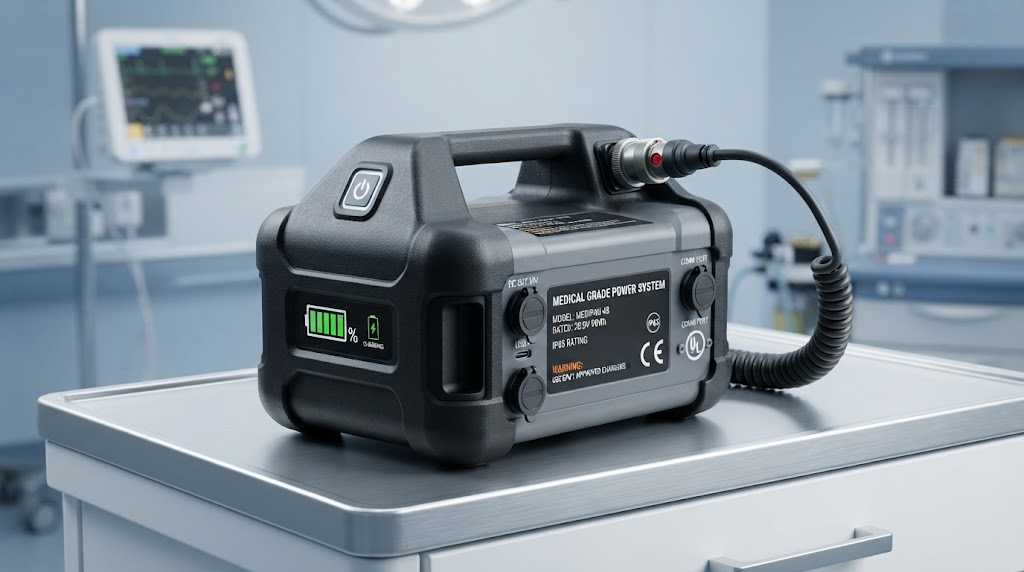
Medical device power systems operate under strict regulatory scrutiny. Unlike consumer consumer electronics, power failure in a clinical monitoring system, infusion pump, or surgical tool can directly cause patient injury.
その FDA Recognized Consensus Standards database lists specific benchmarks for electrical safety and secondary cell reliability that OEMs must fulfill before market introduction.
FDA Device Classifications and Battery Validation Testing
The regulatory pathway for your medical device directly governs the documentation, validation depth, and compliance certifications required from your battery pack manufacturer.
Deploying energy systems into healthcare equipment requires assessing device risk categories established under FDA 21 CFR Part 820.
| FDA Class | Typical Applications | Submission Route | Mandatory Battery Testing & Standards |
|---|---|---|---|
| Class I | Digital thermometers, diagnostic penlights, examination lamps | General Controls (Mostly 510(k) exempt) | UN 38.3 transport safety, basic cell safety (UL 1642), CE compliance. |
| Class II | Infusion pumps, portable ventilators, ECG monitors, surgical drills | Premarket Notification 510(k) | IEC 62133-2, UL 2054, ANSI/AAMI ES 60601-1, smart BMS communication logs, thermal shock profiles. |
| Class III | Implantable pacemakers, automated external defibrillators (AEDs), LVADs | Premarket Approval (PMA) | Complete custom cell characterization, full hardware FMEA, continuous telemetry audit, hermetic seal validation. |
For Class II products, establishing robust verification protocols prevents catastrophic launch stalls. Reviewing custom medical device battery manufacturer capabilities allows engineering teams to identify suppliers capable of providing pre-validated certification test reports upfront.
Complying with FDA-recognized consensus standards such as IEC 62133-2 and UL 2054 reduces 510(k) technical review cycle times by an estimated 30 to 45 days.
When battery sub-assemblies arrive pre-certified with complete CB Scheme reports, FDA reviewers can verify electrical subsystem integrity without issuing secondary information requests.
Medical Battery Chemistry Selection: Engineering Comparison
Selecting cell chemistry requires balancing volumetric energy density, discharge rates, thermal runaway limits, and calendar longevity.

| Chemistry | 公称電圧 | Cycle Life (80% DoD) | Thermal Runaway Threshold | Best Suited Clinical Use-Case |
|---|---|---|---|---|
| LiFePO4 (Lithium Iron Phosphate) | 3.2 V | >2,000 cycles | ~270°C (Extremely Stable) | Mobile medical carts, surgical robotics, clinical diagnostic base stations. |
| Li-ion NMC (Nickel Manganese Cobalt) | 3.6 V – 3.7 V | 500 – 1,000 cycles | ~210°C (Moderate) | Wearable patient monitors, handheld ultrasound scanners, infusion devices. |
| LiSOCl2 (Primary Thionyl Chloride) | 3.6 V | Primary (1 cycle) | >200°C (High stability) | Implanted telemetry beacons, long-term standby tracking, single-use telemetry. |
| Silver-Zinc | 1.5 V – 1.85 V | 200 – 400 cycles | Non-flammable aqueous | Hearing prosthetics, ultra-compact surgical headlamps. |
Medical-grade LiFePO4 battery pack implementations deliver over 2,000 charge cycles at 80% DOD compared to 300-500 cycles for consumer-grade lithium cobalt oxide cells.
This cycle life variance changes total cost of ownership in hospital fleet environments, where batteries undergo daily rapid charging cycles.
The 5-Pillar Medical Battery Qualification Protocol
To eliminate subjective vendor evaluation, MedTech engineering groups must apply a structured technical framework. We utilize the 5-Pillar Medical Battery Qualification Protocol to audit and score prospective energy suppliers before signing commercial supply contracts.

1. Safety Architecture & System FMEA
The vendor must provide a comprehensive Design Failure Mode and Effects Analysis (DFMEA) and Process Failure Mode and Effects Analysis (PFMEA).
Audit cell interconnect layouts, thermal isolation barriers between parallel strings, and redundant pressure-relief vent pathways.
2. Process Traceability & MES Integration
Each battery pack must feature an individual serialized barcode linked to a Manufacturing Execution System (MES).
This database must record the exact incoming lot of bare cells, weld resistance logs, BMS PCB serial numbers, and final potting compound batch numbers.
3. Consensus Standard Certifications
Ensure the facility operates under ISO 13485 Quality Management or audited ISO 9001 systems aligned with medical device manufacturing practices.
Confirm the vendor possesses active test dossiers for IEC 62133-2, UL 2054, UL 1642, and UN 38.3 transport safety compliance.
4. BMS Hardware Reliability & Telemetry Precision
Inspect the Battery Management System for active over-voltage, under-voltage, over-current, and multi-point temperature sensor integration.
Evaluate state-of-charge (SoC) algorithm drift over dynamic discharge loads to ensure medical telemetry displays reliable remaining run-times.
5. Change Control & Supply Chain Longevity
Secure contractual commitments that guarantee component availability for a minimum of 5 to 7 years.
Require written notification protocols for any bill-of-materials adjustments, microchip revisions, or assembly line relocations.
Custom Smart BMS Architecture and Safety Redundancies
The Battery Management System (BMS) serves as the primary safeguard against electrochemical failure. In medical applications, standard single-IC protection circuits are insufficient to meet risk mitigation requirements.
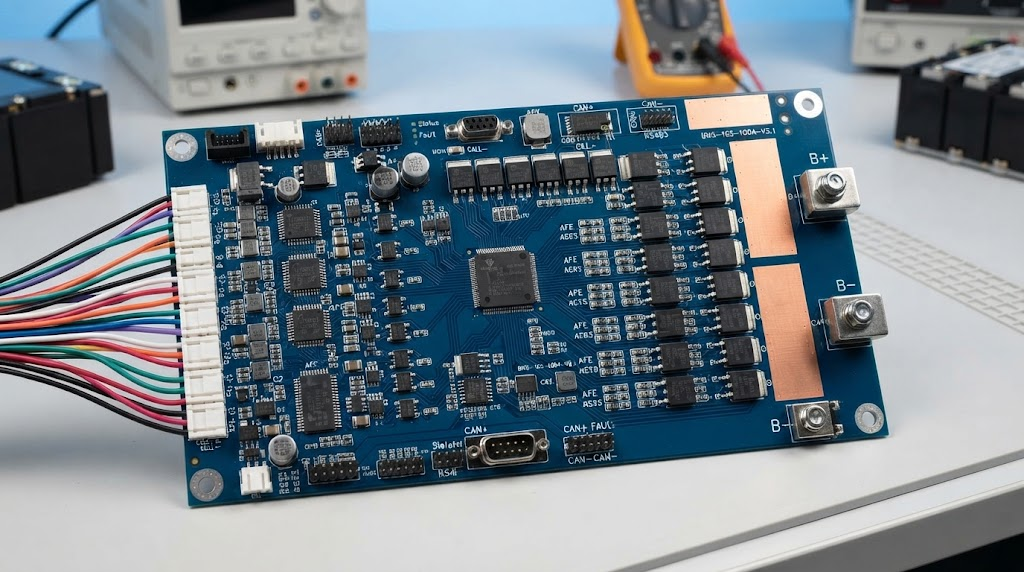
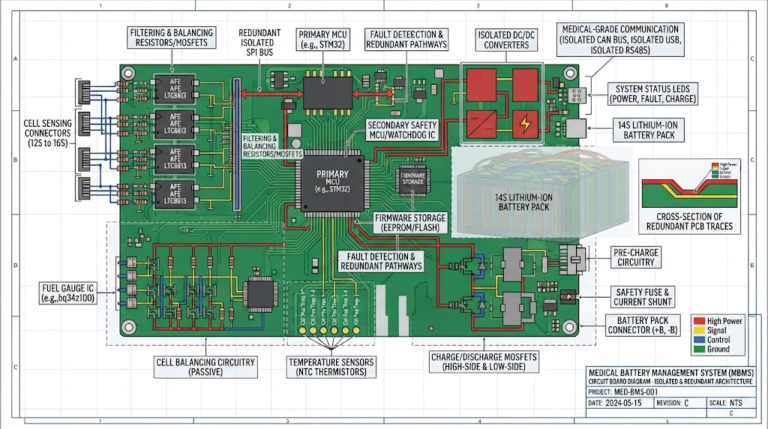
Modern clinical devices require specialized custom lithium-ion battery solutions featuring dual-fault protection architectures.
- Primary Protection IC: Regulates field-effect transistors (FETs) for overcharge, over-discharge, short-circuit, and charge/discharge temperature windows.
- Secondary Hardware Protector: An independent circuit monitor connected to an active chemical fuse. If a FET shorts during an over-voltage event, the secondary fuse trips permanently, isolating the pack.
- Medical Isolation Barrier: Galvanic isolation protecting host medical device logic from transient voltage spikes originating in the battery pack.
- Communication Buses: Low-noise SMBus, I2C, or CANbus interfaces transmitting voltage, pack impedance, cycle counts, and predictive maintenance flags directly to the host CPU.
Over 43% of FDA Class II medical device electrical subsystem recalls are associated with battery thermal degradation or power management communication errors.
Engineering robust SMBus communication protocols into the BMS eliminates communication dropouts that can cause medical hardware to trigger sudden safety shutdowns.
Supplier Quality Agreements and Design Freeze Control
A frequent mistake MedTech procurement teams make is treating battery packs as standard commodity components. In an FDA-regulated ecosystem, unannounced component substitutions can invalidate your 510(k) clearance.
A binding Supplier Quality Agreement (SQA) must be executed prior to freezing your final device design.
Essential SQA Clauses for Medical Batteries:
- Formal Design Freeze: The supplier agrees not to modify cell models, cathode chemistry formulations, BMS silicon, PCB layouts, firmware versions, or structural plastics without prior written authorization.
- Engineering Change Notification (ECN) Timeline: Mandatory 90- to 180-day advance notice before any planned component obsolescence or manufacturing line modifications.
- Certificate of Analysis (CofA): Every production batch must ship with a verified CofA detailing open-circuit voltage (OCV), internal DC resistance (DCR), and capacity validation metrics.
- Right-to-Audit Clauses: Explicit authorization for on-site quality audits of the manufacturing, cleanroom packaging, and testing facilities by your internal QA team or notified bodies.
Custom OEM/ODM Medical Battery Solutions with JHY Battery
With over a decade of industry-proven engineering experience, JHY Battery (Juheyuan Science & Technology Co., Ltd.) provides high-reliability OEM/ODM battery pack manufacturing for global medical device innovators.
JHY Battery engineers custom battery configurations tailored to strict dimensional envelopes, high discharge rates, and rigorous runtime requirements.
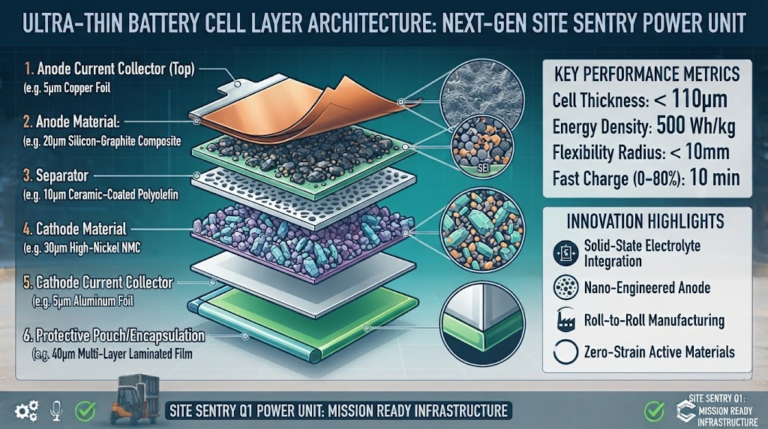
- Comprehensive Chemistry Support: High-energy-density custom lithium-ion systems alongside ultra-safe, high-cycle-life custom LiFePO4 battery packs.
- Deep BMS Customization: In-house hardware and firmware development accommodating complex communication protocols (SMBus, CAN, I2C), precise fuel-gauging, and redundant protection circuits.
- International Certification Backing: Turnkey production compliant with ISO 9001, CE, UN 38.3, MSDS, and UL safety standards.
- Full Traceability & Quality Control: Automated cell grading, computerized spot welding, 100% burn-in testing, and detailed lot-tracking records matching medical DHF expectations.
Whether you require a compact battery for a handheld diagnostic scanner or a high-capacity energy storage pack for an automated surgical cart, JHY Battery delivers scalable, fully validated power systems.
Frequently Asked Questions About Medical Battery Sourcing
What is the practical difference between UL 1642 and UL 2054?
UL 1642 applies strictly to bare, individual lithium cells subjected to mechanical, electrical, and thermal stress tests. UL 2054 applies to complete, multi-cell battery packs and includes evaluation of enclosure flame resistance, wiring, and the electronic safety circuit (BMS) under fault conditions. FDA Class II submissions generally require both bare cell (UL 1642 / IEC 62133-2) and pack-level (UL 2054) compliance.
What happens if a battery supplier discontinues a cell used in our cleared 510(k)?
If an internal cell model changes, you must perform a regulatory risk assessment. If the replacement cell possesses identical electrical characteristics, equivalent dimensions, and carries active UL/IEC certifications, documentation can often be handled via an internal Letter to File. However, if the chemistry, form factor, or safety profile alters device performance, a 510(k) supplement or new premarket submission may be required.
Is UN 38.3 testing mandatory for prototype medical device shipments?
Yes. UN 38.3 transport testing is an international hazardous materials requirement governing air, sea, and ground transport of lithium cells. Prototype battery packs shipped for clinical trials or testing must have verified UN 38.3 test summaries or follow strict carrier-approved hazardous shipping exemptions.
Why is SMBus communication standard in medical battery designs?
The System Management Bus (SMBus) standard provides robust, two-wire communication between the battery pack and the host medical hardware. It allows the device to read real-time state-of-charge, cycle history, internal cell temperatures, and error flags, enabling predictive low-battery alerts during surgical or critical monitoring procedures.
Expert Review & Medical Power Engineering Standards Team
Technical Review Sign-Off: “Evaluating medical battery suppliers requires looking beyond rated nominal capacity. Hardware engineers must verify cell lot traceability, inspect thermal isolation barriers, and confirm that the BMS architecture enforces multi-point hardware cutoffs. Selecting an engineering-focused battery partner early prevents expensive delays during premarket safety testing.” — Director of Biomedical Power Systems Engineering
This technical sourcing guide has been reviewed by power systems engineers and regulatory compliance specialists specializing in FDA Recognized Consensus Standards, ANSI/AAMI ES 60601-1 electrical safety, and UN 38.3 lithium transport protocols.
Accelerate Your Medical Battery Development
Partner with JHY Battery for certified, high-reliability OEM/ODM lithium battery pack design. Receive custom engineering drawings, BMS architecture schematics, and complete regulatory compliance documentation.