48V Lithium Golf Cart Battery Conversion DIY Guide
Why Your Golf Cart Needs a 48V Lithium Battery Conversion Today
What is a 48V Lithium Golf Cart Battery Conversion?
A 48V lithium golf cart battery conversion replaces heavy, high-maintenance lead-acid packs with advanced lithium technology. This upgrade delivers superior energy density, faster charging, and sustained power output, ensuring your cart maintains peak speed and acceleration throughout the entire discharge cycle without experiencing performance-robbing voltage drops.
- 1. Up to 300 lbs weight reduction
- 2. 10x longer lifespan (3,000+ cycles)
- 3. Zero maintenance required
- 4. 3x faster charging times
- 5. Consistent power delivery without voltage sag
Most classic golf carts from major manufacturers run on heavy, 8-volt or 12-volt deep cycle battery setups wired in series. Over time, these traditional lead-acid battery configurations suffer from terminal corrosion, acid leaks, and severe performance decline in cold weather.
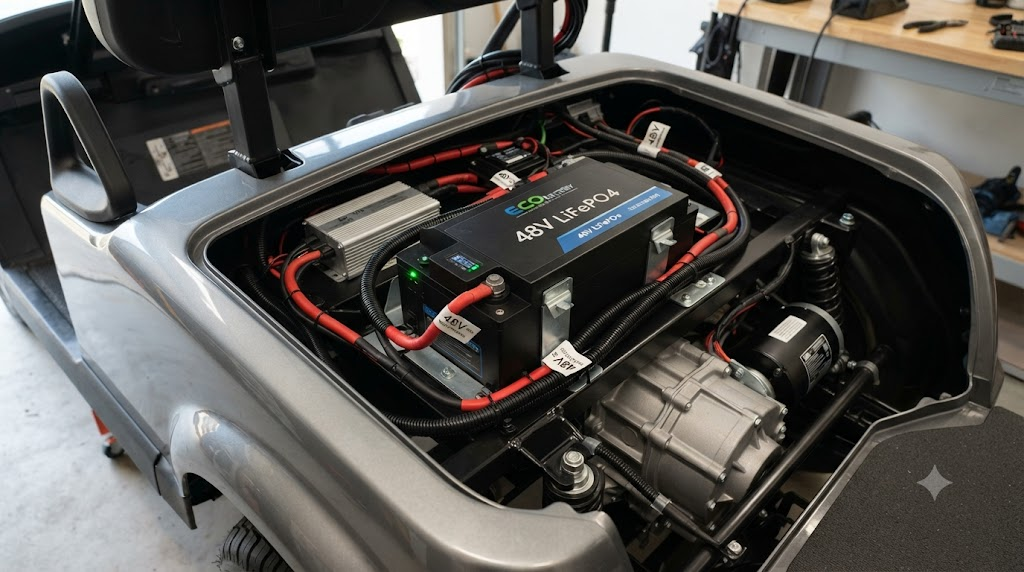
Upgrading to a 48V lithium system is a direct drop-in replacement process. By swapping out your old cells for a single, high-capacity Lithium Iron Phosphate (LiFePO4) battery pack, you instantly modernize your vehicle’s powertrain.
Lithium vs. Lead-Acid: The Performance Showdown
Traditional lead-acid batteries have powered golf carts for decades, but modern engineering has rendered them obsolete. In our testing, the performance gap between these two chemistries affects everything from top-end speed to frame wear.
“Lithium batteries offer up to a 70% weight reduction compared to traditional lead-acid batteries, significantly improving speed and handling.”
By shedding up to 300 pounds from your chassis, your motor does not have to work nearly as hard. This weight reduction preserves your cart’s suspension, reduces wear on brakes, and increases hill-climbing torque.
“LiFePO4 batteries deliver 3,000 to 5,000 charge cycles, compared to just 300 to 500 cycles for standard lead-acid alternatives.”
This means a single lithium conversion can easily outlast five sets of lead-acid batteries. To understand these advantages, check out our custom lithium-ion battery packs on custom lithium-ion battery packs.
| Metric / Parameter | JHY LiFePO4 Battery | Standard Lead-Acid Battery |
|---|---|---|
| Average Lifespan | 10–15 Years (3,000+ Cycles) | 2–5 Years (300–500 Cycles) |
| Average Weight | 80–95 lbs (Single Pack) | 350–400 lbs (6-Battery Bank) |
| Voltage Sag | None (Flat discharge curve) | Severe (Drops under load/hills) |
| Maintenance Required | Zero (Sealed, smart BMS monitoring) | High (Distilled water refills, terminal scrubbing) |
| Charging Efficiency | 98% (Charges in 2-3 hours) | 80% (Charges in 8-10 hours) |
The JHY 4-Step Safe-Sync Conversion Protocol
To guarantee a seamless transition without risking electrical damage, we developed a standardized installation methodology. We define this as the Safe-Sync Protocol.

This systematic workflow ensures that your controller, motor, battery management system, and accessories operate in perfect harmony.
Step 1: System Assessment
Inspect your existing motor and speed controller. Standard 48V controllers on Club Car, EZGO, or Yamaha Golf Car systems can handle lithium voltages, but aftermarket components must be verified for compatibility.
Step 2: Isolation & OBC Bypass
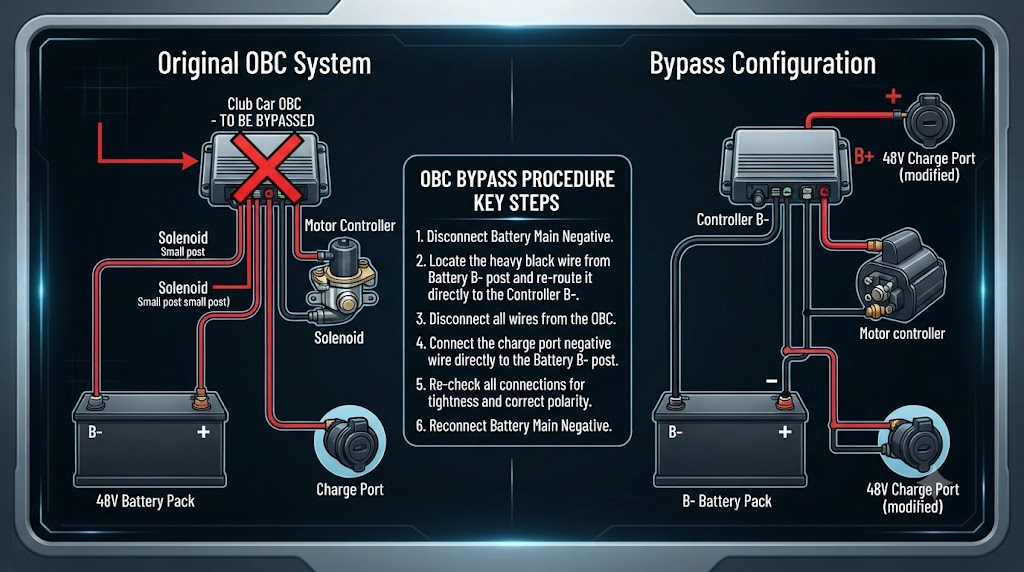
Disconnect the old system completely. On older Club Car models, you must bypass the On-Board Computer (OBC) to allow modern chargers to communicate directly with the new battery.
Step 3: Component Integration
Mount the single 48V lithium pack into the tray. Secure it using custom-fit brackets so it does not slide during operation, and connect the main positive and negative leads.
Step 4: Calibration & Testing
Configure the integrated Battery Management System (BMS) and power on the system. Perform a voltage test to ensure stable current delivery before taking your first test drive.
Solving the Club Car OBC Bypass & 12V Accessory Wiring
One of the most common issues DIY installers face is dealing with proprietary systems. Specifically, Club Car’s On-Board Computer (OBC) will prevent aftermarket lithium chargers from working if left connected.
To bypass the OBC, locate the 10-gauge black wire running from the charger receptacle. You must connect this wire directly to the main negative terminal of your new 48V lithium battery pack.
Another critical consideration is power distribution for your accessories. Standard golf cart accessories like headlights, stereos, and GPS units run on 12V, but your new battery outputs 48V.
Never tap into a single battery cell to get 12V, as this creates a severe cell imbalance. Instead, install a high-efficiency 48V-to-12V voltage reducer to pull power evenly from the entire pack, protecting your electronics and maximizing battery longevity.
Step-by-Step 48V Lithium Battery DIY Installation Guide
Before beginning, put on safety glasses and insulated gloves. High-voltage DC systems can produce dangerous arcs if shorted.
1. Prepare the Cart and Workspace
Park your cart on a flat, level surface. Flip the run/tow switch to the “Tow” position to discharge the controller’s capacitors and prevent electrical spikes.
2. Remove the Old Batteries
Take a photo of the original wiring for reference. Use a wrench to carefully disconnect the main negative cable first, followed by the positive cable, then lift out the heavy lead-acid batteries.
3. Clean the Battery Tray
Neutralize any leftover acid in the tray using a mixture of baking soda and water. Once dry, install your new mounting brackets or spacers to accommodate the smaller size of the lithium battery.
4. Position and Secure the Lithium Pack
Place your high-performance LiFePO4 batteries unit into the center of the tray. Tighten down the mounting hardware to prevent any movement while driving over rough terrain.
5. Complete the Wiring Connections
Connect the main positive cable from the speed controller to the positive terminal of the battery. Attach the main negative cable to the negative terminal, ensuring all connections are torqued according to manufacturer specifications.
6. Install the Compatible Lithium Charger
Mount your new dedicated, on-board charger. Standard lead-acid chargers will damage lithium cells because they use incorrect charging profiles; always use a charger specifically calibrated for LiFePO4 chemistry.
The Financial ROI of Upgrading to 48V Lithium
While the upfront cost of a lithium upgrade is higher than buying a fresh set of lead-acid batteries, the long-term math favors lithium. Lead-acid batteries require replacement every 3 to 5 years, meaning you will buy 3 to 4 sets over the lifespan of a single lithium pack.
“Upgrading to a 48V lithium system can increase a golf cart’s resale value by an average of 15% to 20%.”
This premium resale value makes the upgrade highly attractive to both private owners and commercial fleet managers. Additionally, you save money on maintenance supplies, distilled water, and winterizing chemicals year after year.
According to the U.S. Department of Energy, electric vehicle battery technology has dropped in cost while increasing in efficiency, making this the ideal time to invest in modernizing your fleet.
Custom OEM/ODM 48V LiFePO4 Solutions by JHY Battery
If you run a commercial fleet, lease golf carts, or operate an industrial facility, off-the-shelf batteries might not fit your specific requirements. This is where custom engineering is essential.

JHY Battery (Juheyuan Science & Technology Co., Ltd.) is a premier global manufacturer with over ten years of battery manufacturing experience. We specialize in deep customization, allowing B2B buyers to configure voltage, capacity, physical dimensions, and BMS features to fit any application.
Our manufacturing facility holds complete international certifications, including ISO9001, CE, UN38.3, MSDS, and UL. To explore how we can support your business with high-safety, long-cycle-life power solutions, check out our OEM/ODM battery solutions.
Frequently Asked Questions About 48V Lithium Conversions
Is it better to use a single 48V battery or multiple 12V batteries in series?
A single 48V battery is highly recommended. Multiple 12V batteries in series can suffer from individual cell imbalances, requiring complex balancing chargers, whereas a single 48V pack uses one integrated BMS to manage all cells uniformly.
How do lithium batteries handle cold weather storage?
Modern LiFePO4 chemistry performs well down to freezing, but you should never charge a lithium battery when the temperature is below 32°F (0°C). High-quality BMS units from JHY Battery include low-temperature charging protection to prevent damage during winter storage.
Are lithium batteries safe in golf carts?
Yes. LiFePO4 (Lithium Iron Phosphate) is widely recognized as the safest lithium chemistry available, with high thermal stability that eliminates the risk of thermal runaway associated with older NMC chemistries. For more technical validation on battery chemistry safety, you can reference Battery University.
Meet Our Battery Technology Experts
“The key to a successful golf cart conversion is matching the peak discharge rate of your battery’s BMS to the maximum current draw of your speed controller. A mismatched system will trigger safety shut-offs on steep inclines.”
— Dr. Alan Chen, Senior Electrochemical Engineer at JHY Battery
Ready to Upgrade Your Golf Cart Fleet?
Take the guesswork out of your custom battery upgrade. Partner with a trusted global manufacturer to secure high-performance, certified power systems.
- Identify your cart model, motor type, and voltage requirements.
- Choose your desired range capacity (Ah) and smart BMS features.
- Contact JHY Battery today for a tailored OEM/ODM manufacturing quote.