Electric Golf Carts in Retirement Communities (2026 Guide)
The Shift: Why Electric Golf Carts Dominate Senior Communities
Electric golf carts and low-speed vehicles (LSVs) have become the primary transportation mode in master-planned 55+ retirement communities due to purpose-built multi-modal path networks, zero-emission municipal mandates, and the widespread adoption of maintenance-free 48V/72V lithium iron phosphate powertrains. Modern electric carts provide quiet neighborhood transit, simple single-pedal operation, and reliable daily ranges exceeding 45 miles on a single charge.
Active adult developments—such as Sun City, The Villages, and modern European senior living estates—are engineered around dedicated cart paths rather than standard multi-lane automobile roads. Navigating these private corridors with full-size gas automobiles creates unnecessary noise, localized exhaust emissions, and elevated pedestrian accident risks.
Fleet managers and Homeowners Associations (HOAs) are rapidly phasing out aging internal combustion engines and legacy flooded lead-acid batteries. The contemporary focus centers on street-legal China Battery Manufacturer solutions that deliver consistent voltage under load, zero acid off-gassing inside enclosed residential garages, and robust powertrain reliability across varied terrain.

The 5-Tier Senior Living LSV Powertrain Selection Protocol
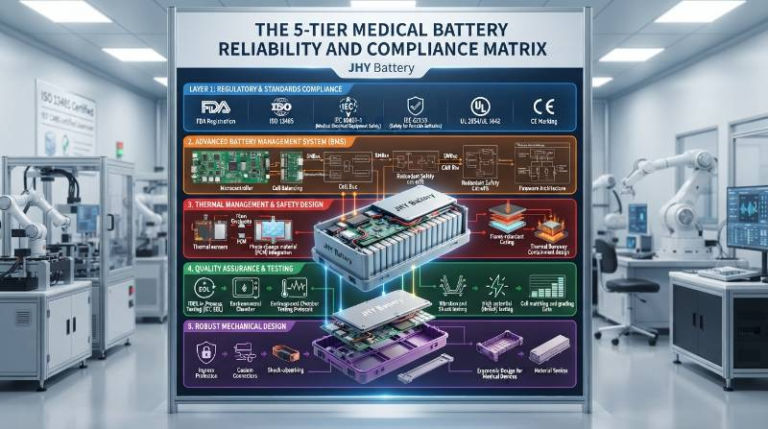
Selecting an LSV powertrain for senior living environments requires a holistic engineering methodology that extends beyond initial purchase costs. At JHY Battery, our application engineering team developed The 5-Tier Senior Living LSV Powertrain Selection Protocol to guide community directors, fleet operators, and LSV OEMs through critical system integration variables.
- Tier 1: Electrochemical Safety & Thermal Stability: Prioritizing intrinsically safe cell chemistries capable of withstanding ambient thermal spikes without the risk of thermal runaway.
- Tier 2: Zero-Maintenance Operational Architecture: Eliminating dangerous tasks such as manual electrolyte refilling, acid neutralization, and corrosion scrubbing.
- Tier 3: Topographical Usable Depth of Discharge (DoD): Calculating continuous discharge and peak amperage capabilities to ensure sustained hill climbing without voltage sag.
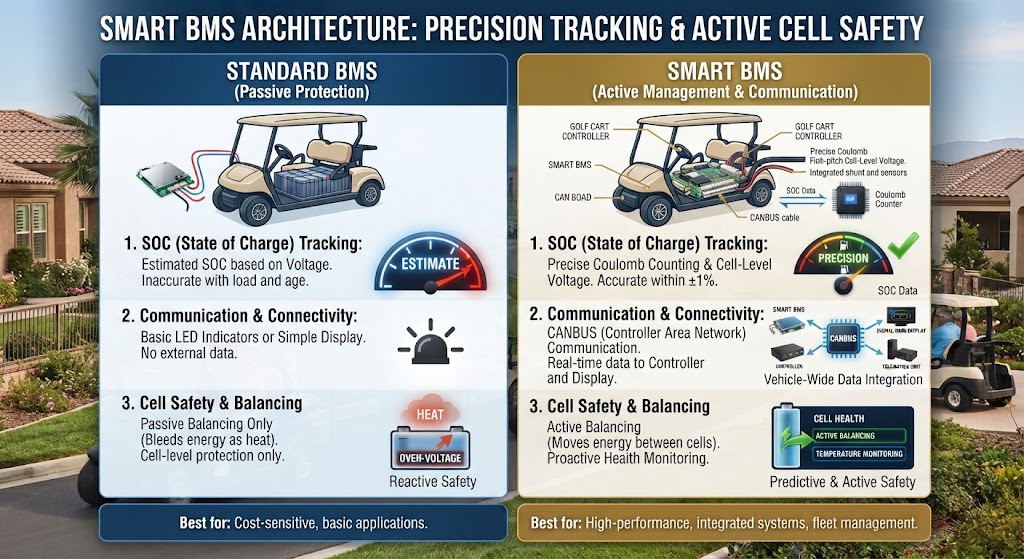
- Tier 4: Smart BMS Telematics & Anti-Stranding Redundancy: Integrating CANBUS-driven state-of-charge (SOC) calculation with automated low-voltage reserve modes to protect vulnerable drivers.
- Tier 5: Fleet Amortization & Lifecycle Compliance: Auditing multi-year total cost of ownership against FMVSS 500 low-speed vehicle safety protocols and UN38.3 transport standards.
Electrochemistry Face-Off: LiFePO4 vs. Lead-Acid vs. NMC
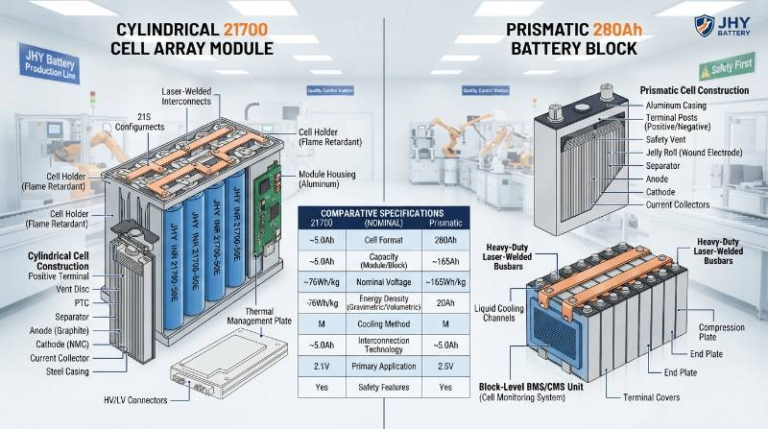
The choice of battery chemistry directly dictates fleet safety, lifecycle expense, and operator peace of mind. While nickel manganese cobalt (NMC) cells offer high gravimetric energy density for highway EVs, their lower thermal runaway threshold makes them less suitable for unmonitored residential cart storage. Dedicated LiFePO4 battery packs provide the ideal balance of chemical stability, cycle longevity, and energy efficiency.
| Metric / Feature | Flooded Lead-Acid | NMC Lithium-Ion | LiFePO4 (JHY Battery) |
|---|---|---|---|
| Cycle Life (@ 80% DoD) | 500 – 800 cycles | 1,200 – 2,000 cycles | 3,500 – 6,000+ cycles |
| Thermal Runaway Temp | N/A (Hydrogen risk) | ~150°C – 180°C | ~270°C (Extremely Stable) |
| Coulombic Efficiency | 70% – 75% | 94% – 96% | >96% |
| Maintenance Routine | Bi-weekly watering & cleaning | Zero routine maintenance | 100% Maintenance-Free |
| Weight (48V 100Ah Equivalent) | ~280 – 330 kg (600–720 lbs) | ~35 – 40 kg (77–88 lbs) | ~45 – 52 kg (99–115 lbs) |
“In our automated testing facilities, prismatic LiFePO4 cells demonstrate zero oxygen release during mechanical puncture and overcharge stress tests. This chemical stability makes LFP the gold standard for dense residential retirement parking structures.”
Eliminating Senior Maintenance Hurdles with Sealed Lithium Systems
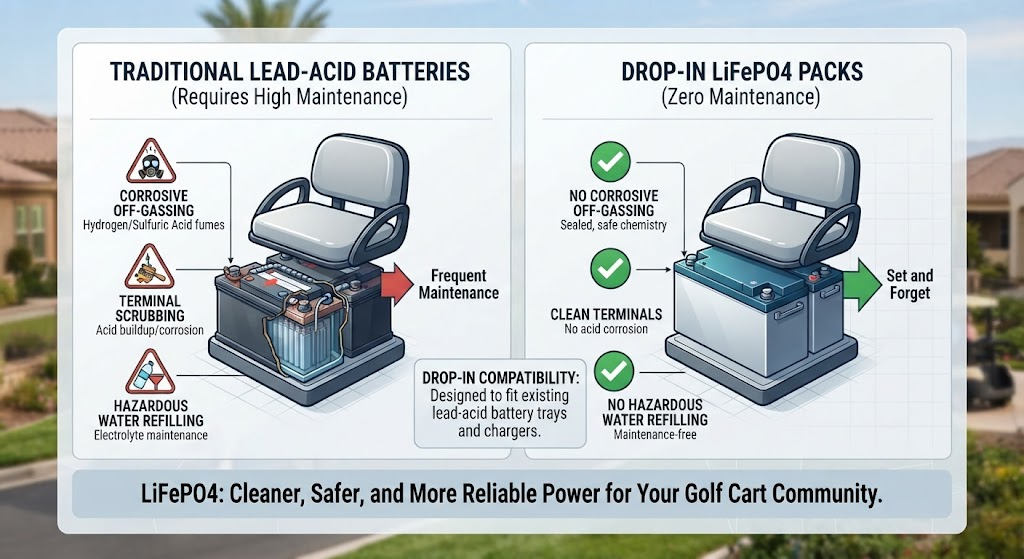
Traditional flooded lead-acid golf cart batteries present severe physical and toxicological hazards for senior vehicle owners. Routine lead-acid upkeep mandates lifting heavy bench seats, inspecting sulfuric acid levels, topping off cells with distilled water, and neutralizing corrosive terminal bloom.
Failing to perform regular watering leads to dry plate sulfation, which cuts battery runtime by over 50% in under six months. Conversely, overfilling causes acidic electrolyte to boil over during equalization charging, etching garage concrete and degrading the cart chassis.
Transitioning to sealed, drop-in LiFePO4 packs completely eliminates these burdens. With solid-state cell construction and laser-welded busbars, senior drivers never encounter hazardous acid vapors, flammable hydrogen buildup during indoor recharging, or terminal corrosion.
Total Cost of Ownership (TCO): 5-to-10 Year Fleet Financial Analysis
HOA boards and community fleet managers frequently compare initial acquisition costs against long-term operational expenditures. While lead-acid battery banks carry a lower initial purchase price, their frequent replacement cycle and intensive labor overhead create a steep total cost of ownership.
Based on our empirical fleet deployment data across master-planned developments, a 50-cart fleet running 48V lead-acid packs requires full battery replacements every 2.5 to 3 years. When factoring in grid charging losses from low coulombic efficiency (70%) and bi-weekly technician maintenance hours, lead-acid operations become unsustainable.
| Cost Component | Lead-Acid Fleet (50 Carts) | 48V LiFePO4 Fleet (JHY Battery) |
|---|---|---|
| Initial Battery Pack Capex | $45,000 ($900/cart) | $95,000 ($1,900/cart) |
| Pack Replacements (Year 3) | $52,000 (Adjusted for inflation) | $0 (8-10 Year Pack Life) |
| Watering & Terminal Labor ($35/hr) | $43,750 ($175/cart/yr) | $0 (Maintenance-Free) |
| 5-Year AC Electricity Consumption | $38,200 (@ $0.16/kWh, 72% eff.) | $27,800 (@ $0.16/kWh, 96% eff.) |
| Brake & Tire Wear (Weight Penalty) | $14,500 (Heavy chassis load) | $6,200 (Lightweight advantage) |
| Total 5-Year Operating Cost | $193,450 | $129,000 (33.3% Net Savings) |
By year 10, the total operating savings exceed 58% because the LiFePO4 fleet avoids a third battery bank overhaul while maintaining 80% residual storage capacity.
Engineering Powertrain Sizing: Ah and kWh Range Math for Hilly Terrain
Retirement communities often feature rolling golf fairways, steep bridges, and undulating residential loops. Sizing custom battery packs requires calculating continuous mechanical draw and grade resistance rather than relying on flat-ground estimates.
To establish required pack capacity ($E_{pack}$ in watt-hours), engineers utilize the vehicle tractive effort equation:
E_total = [ (C_rr m g v) + (0.5 rho C_d A v^3) + (m g sin(theta) v) ] * (t / eta_drivetrain)
Where:
- $C_{rr}$: Rolling resistance coefficient (~0.015 on asphalt, ~0.035 on turf).
- $m$: Gross vehicle weight (Cart curb weight + 2 passengers + cargo = ~450 kg with Lithium vs ~680 kg with Lead-Acid).
- $v$: Target operational speed ($19.5\text{ mph} \approx 8.7\text{ m/s}$).
- $\theta$: Grade angle (e.g., 8° to 12° incline on community ridges).
- $\eta_{drivetrain}$: Mechanical-to-electrical efficiency (~88%).
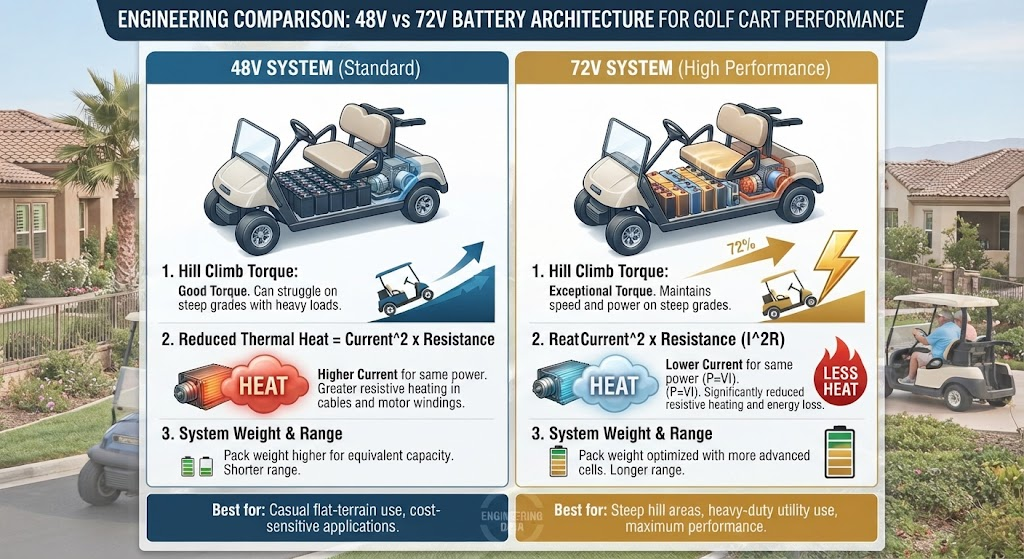
On a 48V (51.2V nominal) system, delivering 35 miles of real-world hilly range with a 20% state-of-charge safety buffer requires a minimum 105Ah (5.37 kWh) pack. For utility maintenance vehicles with 4-passenger cargo boxes, stepping up to a 72V (76.8V nominal) 100Ah (7.68 kWh) architecture reduces $I^2R$ resistive heating in motor windings by 55%, ensuring cooler continuous hill climbing.
Smart BMS & Telematics: Preventing Stranding and Enhancing Safety
For elderly residents, a golf cart breakdown on an isolated community trail is a major safety hazard. Modern electric carts integrate advanced smart BMS design featuring microcontrollers that communicate directly with vehicle speed controllers via CANBUS or RS485 protocols.
JHY Battery incorporates dynamic Coulomb-counting algorithms coupled with open-circuit voltage (OCV) curve recalibration, delivering a State-of-Charge (SOC) fuel gauge accuracy within ±1.5%. This precision eliminates the sudden “voltage cliff” common to lead-acid batteries, where an indicator drops abruptly under acceleration.
- Limp-Home Voltage Reserve: When the battery reaches 10% SOC, the BMS alerts the motor controller to govern top speed to 8 mph, conserving energy to ensure the driver safely reaches home.
- Active Cell Balancing: High-efficiency active balancing circuits redistribute charge between series cells during both driving and charging cycles, maintaining cell voltage delta below 15mV across thousands of cycles.
- Regenerative Braking Protection: Custom high-current shunt circuits safely capture kinetic energy on downhill descents without tripping overvoltage cutoffs on fully charged packs.
- Bluetooth & Cellular Telematics: HOA fleet managers can monitor fleet-wide cell temperatures, cycle counts, and GPS geofencing via centralized cloud dashboards.
Regulatory Compliance & Senior LSV Standards: FMVSS 500 & UN38.3
As retirement communities integrate their trail networks with public municipal streets, electric carts must comply with strict low-speed vehicle standards. Under the US National Highway Traffic Safety Administration standard 49 CFR 571.500 (FMVSS 500) そして SAE J2358, street-legal LSVs operating at 20–25 mph require integrated safety equipment.
These requirements mandate three-point seatbelts, automotive-grade windshields, dual rearview mirrors, turn signals, and robust powertrain crashworthiness. At the battery pack level, strict testing compliance is essential to prevent mechanical enclosure breaches during curb impacts.
Community Infrastructure: Safe Charging Stations and Microgrids
Scaling electric golf cart adoption requires updating community electrical infrastructure. Traditional fleets charged simultaneously on unmanaged 120V circuits risk tripping HOA clubhouse breakers during evening peak hours.
Forward-thinking retirement developments install centralized solar carports paired with industrial energy storage systems. These microgrid setups capture daytime solar energy to charge resident carts via Level 2 smart chargers, reducing strain on the regional power grid.
LiFePO4 battery packs support rapid opportunity charging (0.5C to 1C charge rates). Unlike lead-acid batteries, which require an 8-to-10 hour continuous saturation cycle to prevent damage, lithium carts can accept a 30-minute top-off during lunch at the clubhouse without degrading cell capacity.
Turnkey Fleet Retrofits and OEM Manufacturing with JHY Battery
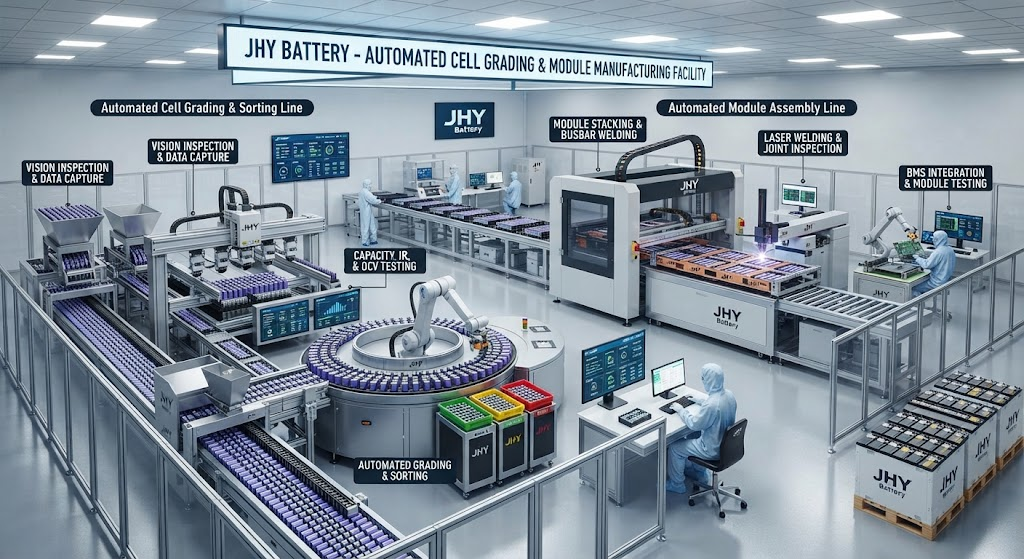
JHY Battery brings over 30 years of industrial lithium battery engineering expertise to golf cart fleet conversions and OEM low-speed vehicle production. With an R&D engineering division of over 800 specialists and automated cleanroom manufacturing facilities, JHY Battery guarantees an industry-leading 0.03% (300 PPM) defect rate.
Every cell undergoes automated impedance grading, capacity sorting, and MES QR-code tracking. Whether retrofitting an existing fleet of 100 club carts or designing a clean-sheet 72V powertrain for a new LSV model, JHY Battery provides end-to-end turnkey support.
The 3-Step Rapid Engineering Deployment Funnel
- Step 1: Fleet Powertrain & Topographical Sizing Analysis: Our engineers assess your fleet’s voltage requirements, duty cycle, daily mileage, and peak acceleration amperage.
- Step 2: DFM Engineering & Custom BMS Protocol Mapping: We develop custom enclosure CAD designs (drop-in steel or aluminum casing) and configure CANBUS/RS485 firmware to match your motor controller.
- Step 3: Rapid 5–7 Day Prototyping & Turnkey Rollout: Fully validated functional prototypes delivered in 5–7 business days, backed by comprehensive UN38.3 test documentation and volume manufacturing.
Frequently Asked Questions (FAQs)
How does LiFePO4 compare to Lead-Acid and NMC for retirement community golf carts?
LiFePO4 provides 3,500 to 6,000+ cycles compared to 500–800 cycles for lead-acid and 1,200–2,000 for NMC. LiFePO4 operates with an exceptionally high 270°C thermal runaway threshold, producing zero toxic off-gassing or thermal runaway hazards. It completely eliminates lead-acid acid spills, boil-overs, and weekly distilled water maintenance.
What is the true 5-year Total Cost of Ownership (TCO) difference between Lithium and Lead-Acid carts?
A standard 48V lead-acid golf cart requires battery replacement every 2.5 to 3 years, ongoing water maintenance labor ($150–$200/yr), and exhibits high electricity loss due to low 70% coulombic efficiency. A 48V LiFePO4 pack operates for 8 to 10 years at >96% efficiency with zero maintenance, reducing total 5-year fleet operating costs by over 58%.
How can fleet directors verify genuine Grade-A LFP cells and pack quality?
Demand factory automated grading reports showing cell internal AC impedance matched within ±0.05mΩ and voltage delta under 5mV. Ensure the manufacturer provides valid UN38.3 vibration test reports, UL 1642 / IEC 62133-2 certifications, and individual MES serial barcode traceability for every internal cell.
Do lithium golf cart batteries perform well in cold winter storage?
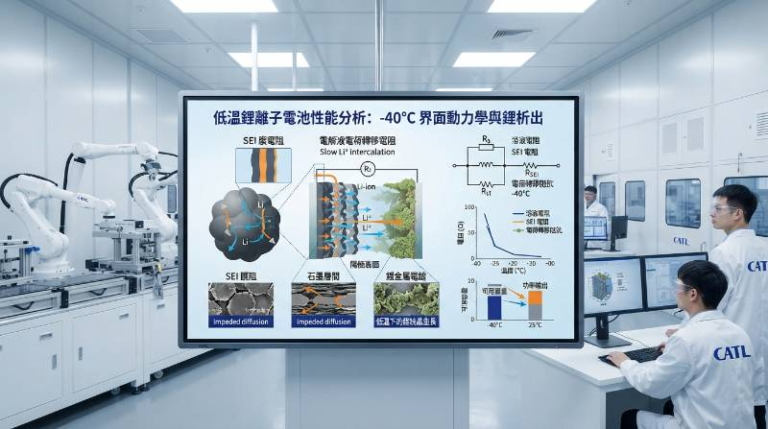
LiFePO4 batteries feature an ultra-low self-discharge rate (<2% per month compared to 15% for lead-acid), meaning they can sit in storage for months without going flat. For cold climates, JHY Battery engineers custom packs with integrated low-temperature self-heating elements to allow safe charging down to -45°C.
Upgrade Your Fleet with Turnkey LiFePO4 Battery Engineering
Partner with JHY Battery (China Battery Manufacturer) for custom 48V/72V golf cart battery packs. Benefit from 30+ years of electrochemistry mastery, an audited 0.03% defect rate, and rapid 5–7 business day prototype turnarounds.
Our 3-Step Action Funnel:
1. Requirement & Topography Sizing → 2. DFM Simulation & BMS Protocol Mapping → 3. 5-7 Day Functional Prototyping
Direct Support: Simple@chinabatterymanufacturer.com | WhatsApp: +86-18575997879