Wearable Technology Batteries: Custom B2B Solutions
Custom Wearable Technology Batteries: Engineering Next-Gen IoT
The Internet of Things (IoT) landscape is moving faster than ever. Smartwatches, fitness trackers, and smart rings require smaller, lighter, and more resilient power sources.
Hardware engineers face the daunting task of squeezing maximum energy into microscopic form factors. This is where modern wearable technology batteries step in.
We design these power sources to fit seamlessly into non-traditional form factors while maintaining high energy density. If you are developing a next-generation consumer or medical device, selecting the right energy source is critical.
Explore our dedicated Wearables Solutions to see how we resolve these complex design challenges.
The Core Challenge: Balancing Energy Density, Form Factor, and Skin Safety
Designing power solutions for body-worn electronics requires a fundamental shift in battery architecture. Standard cylindrical cells are far too bulky for modern micro-electronics.
Wearable technology batteries are highly specialized rechargeable micro-batteries—primarily using lithium-ion polymer and advanced solid-state chemistries—engineered to provide reliable energy in ultra-thin, flexible form factors while maintaining strict thermal control for constant human skin contact.
To select the ideal battery for your wearable device, engineers must prioritize four essential criteria:
- Energy Density: Maximizing capacity mAh within extremely restricted, millimetric physical volumes.
- Form Factor: Engineering thin wearable batteries that can bend, curve, or fit into ultra-compact spaces.
- Safety: Implementing multi-layered protections to guarantee zero thermal runaway during skin-contact usage.
- Cycle Life: Delivering long-term reliability through hundreds of stable charge and discharge cycles.
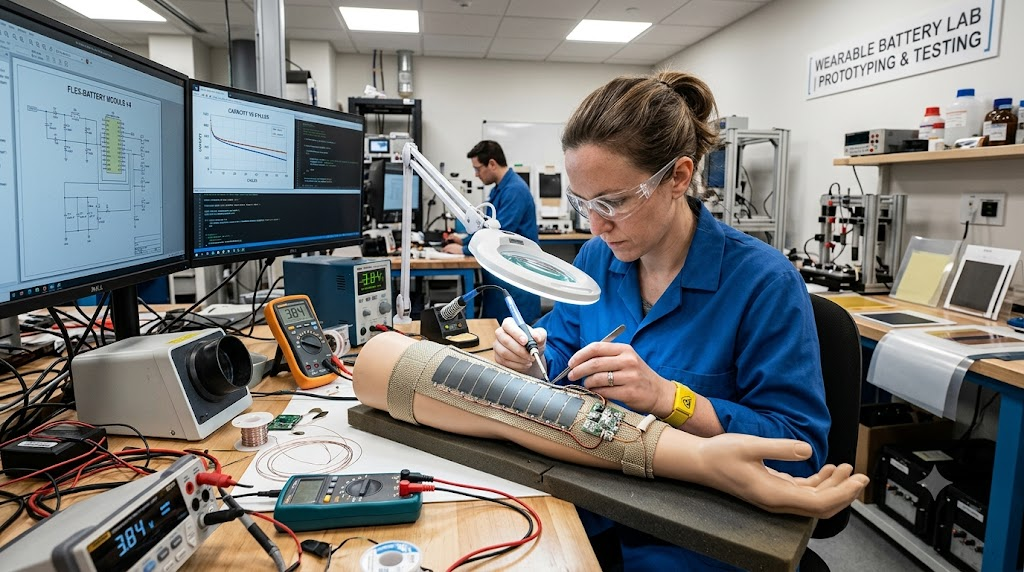
JHY’s 3-D Micro-Safety Protocol
At JHY Battery, we do not believe in standard, off-the-shelf solutions for complex wearable designs.
Based on our testing and manufacturing data, we have developed a proprietary framework: The JHY 3-D Micro-Safety Protocol.
This methodology addresses the specific geometric and thermal safety challenges of modern wearables:
- 1. Dimensional Optimization (Design): We customize the physical footprint, thickness (down to 0.4 mm), and curvature to eliminate mechanical stress on the cells.
- 2. Active Thermal Defense (Defense): Integrating ultra-thin power management IC chips and customized ceramic separators prevents internal short circuits and limits surface temperatures to under 37°C.
- 3. Structural Durability (Durability): We encapsulate our custom lithium-ion battery packs in reinforced aluminum-plastic composite films, ensuring high puncture resistance and IP-rated moisture sealing.
This systematic approach ensures that every micro-cell we manufacture complies with international safety standards. Learn more JHYバッテリーについて and our commitment to engineering excellence.
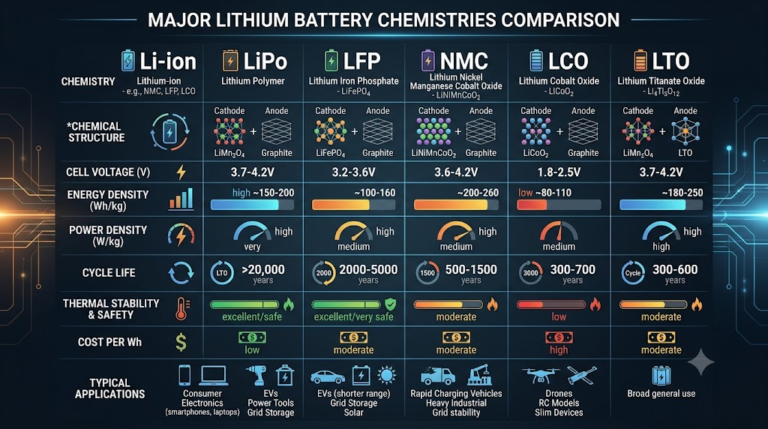
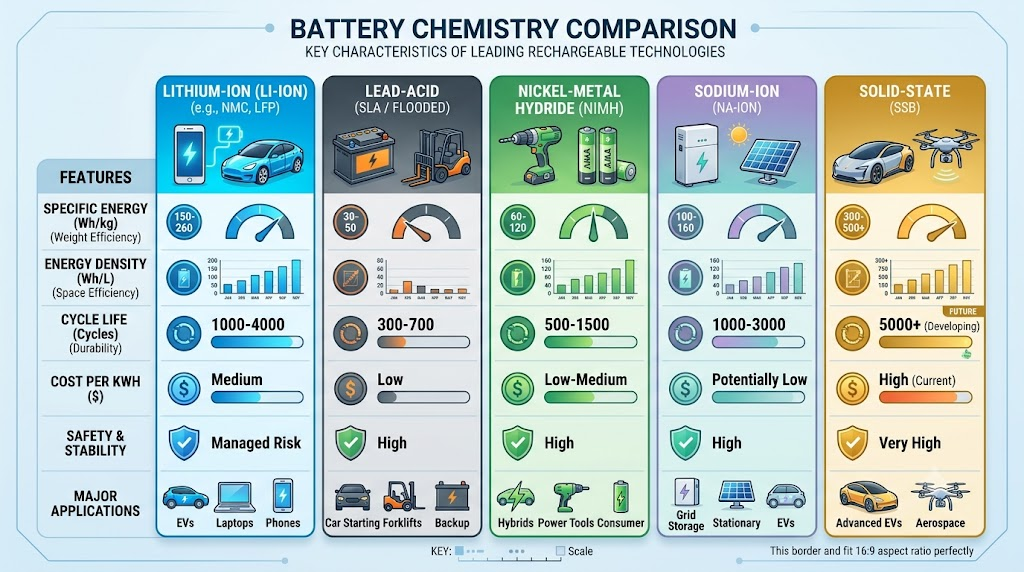
Master Battery Chemistry Comparison for Wearables
Different wearable applications require distinct chemical compositions. Choosing the wrong chemistry can lead to premature failure or safety hazards.
The table below outlines how common chemistries perform under modern wearable standards:
| Chemistry Type | エネルギー密度 | Flexibility & Thickness | Safety Profile | Cycle Life |
|---|---|---|---|---|
| Lithium Polymer (LiPo) | High (250-300 Wh/kg) | Semi-flexible, thin down to 0.4mm | Excellent with integrated BMS | 500+ cycles |
| Solid-State Battery | Very High (350+ Wh/kg) | Rigid, micro-scale footprints | Outstanding (non-flammable) | 1000+ cycles |
| Flexible / Printed | Low to Moderate | Highly flexible, rollable | Good | 200-400 cycles |
| Thin-Film Lithium | Low (due to scale) | Ultra-thin (micrometer scale) | Very High | 2000+ cycles |
For high-capacity demands, our Custom Lithium-ion Battery Packs offer the ideal balance of power and custom shape integration.
Designing for 2026 Wearable Trends: Smartwatches, Fitness Trackers, and Smart Rings
The wearable market is no longer limited to wristwear. In 2026, we are seeing a massive surge in smart rings, smart eyewear, and patch-based medical sensors.
Each of these form factors introduces unique engineering constraints:
- Smartwatch Batteries: Require high capacity mAh to support continuous GPS, cellular LTE, and OLED screens.
- Fitness Tracker Batteries: Depend on long, narrow, and ultra-thin profiles to fit sleek wristbands.
- Smart Rings: Require specialized curved micro-batteries with a thickness under 1.5mm and precise radius mapping.
According to a recent study published in Nature Electronics, optimizing micro-battery surface area is key to sustaining multi-day operations in smart rings.
Our engineering team specializes in modeling these complex geometric structures. To find the perfect layout for your device, explore our extensive catalog of Custom Battery Solutions.
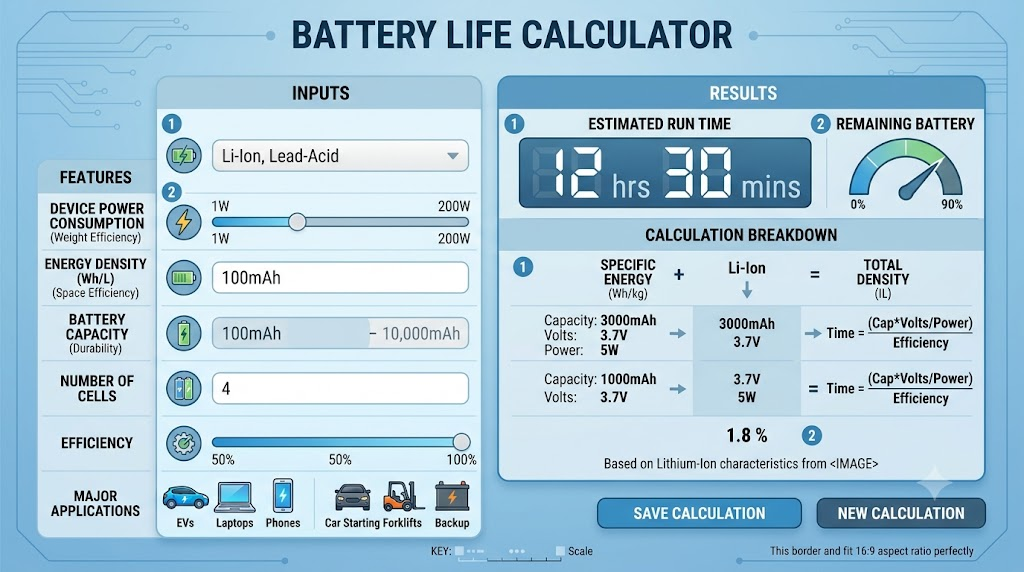
Interactive Wearable Battery Life Calculator
Estimating actual operational life is critical before locking in a battery design.
We use a standardized formula to calculate theoretical runtime while accounting for real-world environmental degradation:
Runtime (Hours) = [Battery Capacity (mAh) × Efficiency Factor (0.85)] ÷ Average Current Draw (mA)
To use this formula effectively, engineers must break down the power draw profile of their device:
- Active Mode: High current draw during sensor readings, display activation, or wireless transmission.
- Sleep Mode: Micro-ampere draw supported by ultra-low power microcontrollers.
- Energy Harvesting Offset: Deducting any supplementary energy gathered from solar or kinetic sources.
By calculating these values early, you can easily determine whether you need thin wearable batteries or a larger capacity pack.
Power Optimization & Charging Solutions for Wearable IoT
Maximizing battery life is not just about increasing capacity mAh. It requires a holistic approach to system-level power optimization.
By integrating a highly efficient power management IC (PMIC), hardware designers can regulate voltage rails and minimize parasitic draw.
According to research published on IEEE Xplore, ultra-low power microcontrollers coupled with modern power management ICs can reduce standby energy consumption by up to 40%.
Furthermore, modern wearables leverage diverse charging methodologies:
- Wireless Charging: Utilizing compact receiver coils to allow fully sealed, waterproof enclosures.
- Energy Harvesting: Supplementing power using body heat (thermoelectric) or movement (piezoelectric) to extend standby times.
- Fast Charging: Implementing safe, high-current charging profiles that do not compromise the cycle life of thin cells.
Why Partner with JHY Battery for Custom Wearable Solutions?
Choosing a reliable battery manufacturer is crucial to the success of your wearable project.
JHY Battery (Juheyuan Science & Technology Co., Ltd.) brings over a decade of specialized experience to the global B2B market.
Our state-of-the-art facilities offer complete OEM/ODM battery solutions. We support deep customization across voltage, capacity, dimensions, and BMS integration.
Every custom lithium-ion battery pack we produce undergoes rigorous testing. We hold complete international certifications including ISO9001, CE, UN38.3, MSDS, and UL1642.
To get started on your custom project, follow our simple 3-step action path:
- 手順 1: Define your target physical dimensions, required capacity, and voltage guidelines.
- ステップ 2: Consult our engineering team to design a customized 3D cell layout.
- ステップ3: Receive a rapid, fully certified prototype within 10 working days.
Explore our complete range of products and technical resources via our JHY Battery Sitemap.
Frequently Asked Questions (FAQ)
Q: Are lithium-ion polymer batteries safe for direct skin contact?
A: Yes, when designed with integrated safety circuitry. JHY Battery uses advanced thermal management and protective ICs to ensure our wearable batteries never exceed safe skin temperatures.
Q: What is the typical lifespan of a smartwatch battery?
A: Most high-quality smartwatch batteries are engineered to last 500 to 800 full charge-discharge cycles before dropping below 80% of their original capacity.
Q: Can you manufacture curved or custom-shaped batteries for smart rings?
A: Absolutely. Our OEM/ODM capabilities allow us to produce specialized curved micro-batteries engineered to fit the precise inner radius of smart rings and curved wristbands.
Meet Our Expert Engineering Team
Our technical documentation is authored and reviewed by our senior power design engineering team.
“We continuously push the boundaries of energy density and physical thinness. Our goal is to provide hardware teams with the exact geometric battery configurations they need without compromising on safety.” — Senior Battery Design Engineer, JHY Battery.
With extensive experience in micro-battery architectures, our engineering department ensures that every design meets both performance and safety standards.