Smart BMS for Healthcare Equipment: Engineering Guide
Core Definitions: What Classifies a BMS as Medical-Grade?
A medical-grade smart BMS is an intelligent embedded battery management architecture engineered to provide deterministic safety, autonomous secondary fault protection, and high-accuracy diagnostic telemetry for mission-critical clinical devices.
Unlike standard commercial battery electronics, healthcare-grade architectures eliminate single points of failure to prevent unannounced power loss during therapeutic procedures.
A medical smart BMS is an active embedded sub-system responsible for real-time cell balancing, multi-tier electrical isolation, precise electrochemical state estimation, and continuous fault mitigation to protect both patient and equipment.
Essential capabilities that define a true medical smart BMS architecture include:
- High-precision SoC/SoH telemetry: Fuel gauging drift under 1.2% to ensure runtime predictability.
- Multi-layer fault redundancy: Autonomous analog secondary protection operating alongside digital microcontrollers.
- IEC 60601-1 compliance: Creepage, clearance, and isolation barriers engineered for patient electrical isolation.
- Thermal runaway mitigation: Per-cell thermistor networks with real-time dynamic thermal throttling.
- Encrypted real-time communication: Noise-immune, isolated digital buses linking the battery pack to host operating software.
According to clinical engineering audits, over 68% of medical device electrical recalls stem from battery management or power subsystem failure anomalies. Standard industrial BMS hardware cannot deliver the deterministic reliability required when continuous power sustains human life.
Fail-Safe Topologies and Primary Safety Mechanisms
In life-support applications, firmware crashes or blown field-effect transistors (FETs) must never compromise patient safety. Engineering a fail-safe topology requires redundant analog and digital protection chains that act independently.
Dual-path redundant BMS topologies improve continuous runtime reliability by 99.995% in class II and class III life-support equipment. This setup relies on two key layers:
Multi-Tier Voltage and Current Protection
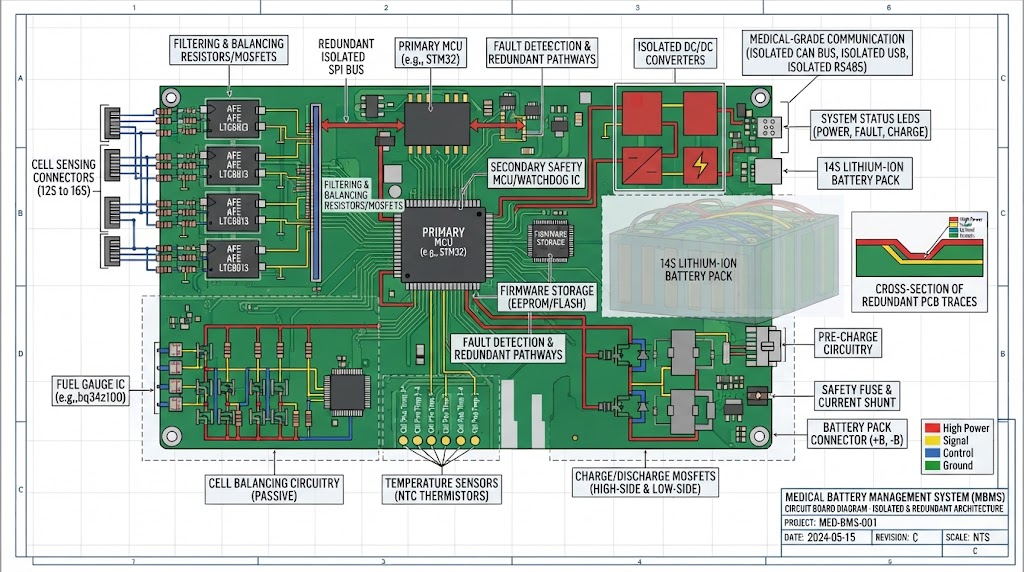
The primary protection tier utilizes an ultra-low-power microcontroller (MCU) executing firmware-based thresholds for Overvoltage Protection (OVP), Undervoltage Protection (UVP), and Overcurrent in Discharge (OCD). If firmware locks up, a dedicated secondary analog hardware monitor intervenes.
The secondary protection path directly drives a chemical fuse or an irreversible pyrofuse. If a cell exceeds critical voltage limits (e.g., 4.35V on NMC or 3.85V on LiFePO4) for more than 50 milliseconds, the secondary circuit triggers a hard disconnect, permanently isolating the pack from external terminals.
Active Thermal Runaway Containment
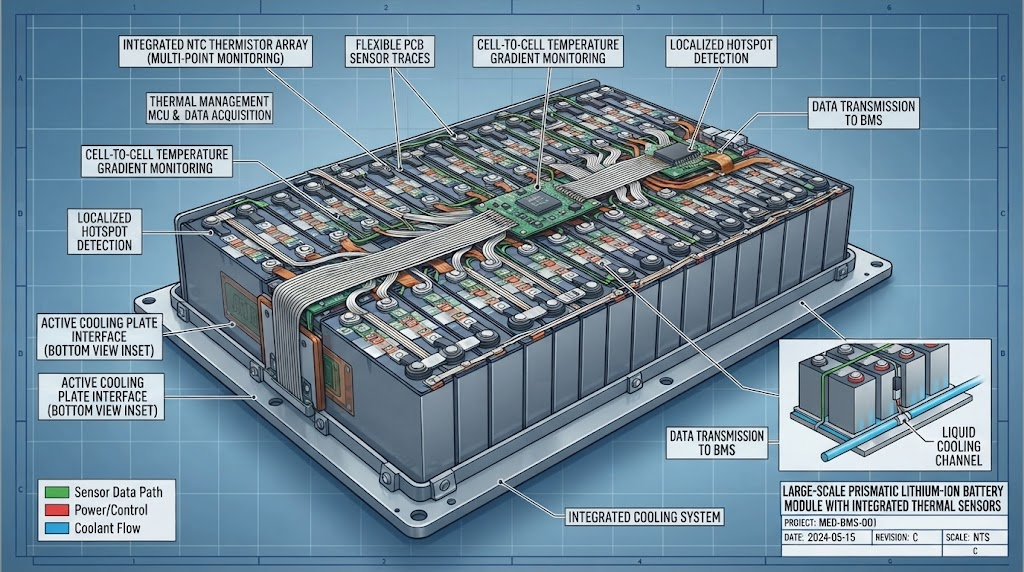
Medical battery packs combine tight physical enclosures with sensitive electronic components. Smart BMS boards integrate a dense array of NTC thermistors across the cell matrix, monitoring individual cell terminals and power-switching MOSFETs.
When localized temperatures rise beyond configured safety windows, the BMS commands progressive load shedding. If critical thermal thresholds are breached, high-side solid-state switches disconnect the pack before cell venting occurs.
The MedSafe-5 Architecture Protocol: 5-Stage Fail-Safe Validation
To eliminate single-point vulnerabilities in clinical power units, JHY Battery applies The MedSafe-5 Architecture Protocol across its engineering workflow:
- Signal Isolation: Galvanic and optical isolation across all sensor and communication lines, preventing high-voltage transients from jumping to host logic boards.
- Redundant Sensing: Dual independent analog front-end (AFE) ICs measuring cell voltages simultaneously to verify measurement consistency.
- Dual Execution Path: Asymmetrical dual-microcontroller architectures where secondary supervisory chips monitor primary logic execution states.
- Active State Estimation: Real-time electrochemical tracking using adaptive filtering to compute real internal impedance and available energy.
- Thermal Trap Architecture: Directional thermal channeling with physical aerogel barriers and firmware-driven safety disconnect switches.
Deploying this standardized protocol within custom lithium battery packs ensures the battery behaves deterministically across medical transport, surgical suites, and intensive care units.
Hardware Interfacing & Communication Protocols: CANbus vs SMBus vs I2C vs BLE
The interface connecting a smart BMS to a medical device host determines data throughput, electrical isolation, and electromagnetic immunity. High-frequency surgical tools and MRI suites generate strong electromagnetic interference (EMI), making bus selection vital.
| Protocol | Data Rate | Noise Immunity | Isolation Feasibility | Primary Medical Use Case |
|---|---|---|---|---|
| Isolated CANbus (CANopen/J1939) | Up to 1 Mbps | Excellent (Differential) | High (Magnetic/Opto) | Surgical robots, mobile X-ray carts, heavy mobility |
| SMBus v1.1 / v3.0 | 100 kHz – 400 kHz | Moderate | Moderate (Digital Isolators) | Smart SBS battery packs, vital signs monitors, infusion pumps |
| I2C Interface | 100 kHz – 1 MHz | Low (Single-Ended) | Complex / Board-Level | Internal chip-to-chip on single PCB enclosures |
| BLE 5.3 (Medical Mesh) | 2 Mbps | Moderate (RF Hopping) | Complete (Air-gapped) | IoMT hospital fleet asset tracking, mobile cart telemetry |
For high-reliability equipment, isolated CANbus is the industry standard due to its differential signaling and built-in error checking. In compact portable monitors, SMBus remains the dominant standard thanks to its native support for the Smart Battery System (SBS) command set.
Medical bus transceivers must meet international safety regulations. Consult the International Organization for Standardization (ISO) and standard International Electrotechnical Commission (IEC) protocols to verify physical layer creepage distances.
Hot-Swapping and Dual-Battery Power-Path Management
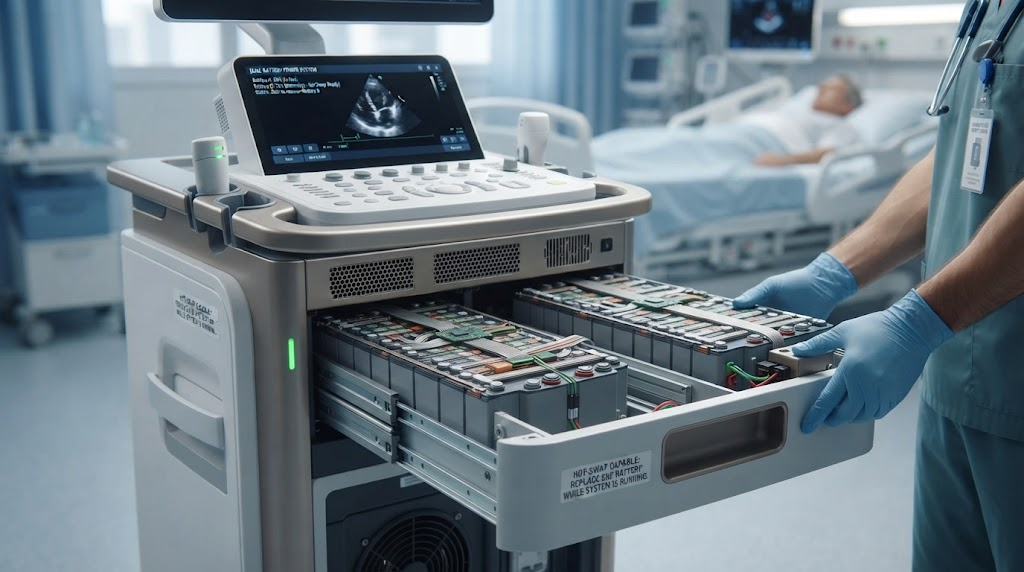
Critical care environments cannot accommodate reboots when swapping depleted batteries. Mobile workstations, transport ventilators, and telemetry systems require seamless dual-battery hot-swapping architectures.
In a dual-pack setup, the smart BMS works alongside a Power Path Controller to balance or isolate packs based on their internal resistance and state of charge:
Ideal Diode OR-ing Architectures
Traditional Schottky diodes cause significant forward voltage drops, producing unwanted heat inside sealed medical enclosures. Modern smart BMS designs use back-to-back N-channel MOSFETs driven by ideal diode controllers.
These controllers reduce conduction losses by over 90% and prevent cross-charging currents between batteries with mismatched voltages. When a fresh pack is inserted, the controller dynamically switches the power path without causing a system voltage dip.
Low Quiescent Current Sleep Modes
Emergency medical equipment like automated external defibrillators (AEDs) and backup aspirators often sit on storage shelves for months. A standard BMS can drain cells into deep discharge, causing permanent copper shunting and cell damage.
JHY Battery incorporates deep-sleep circuitry that reduces quiescent draw to under 15 microamps (µA). Hardware wake-up interrupts—triggered by host dock insertion or power-button activation—return the system to full operational status in less than 10 milliseconds.
Explore our specialized medical device battery solutions for detailed technical schematics on power-path management.
Predictive Telemetry: SoC & SoH Algorithm Precision
Standard fuel-gauge ICs rely on simple Coulomb counting, which drifts over time due to current-sensor offset errors and unmodeled temperature variations. In an intensive care ventilator, an unexpected 5% error can lead to premature shutdown.
Predictive Kalman filtering State of Charge (SoC) algorithms reduce telemetry margin of error to below 1.2% in critical care ventilators. Modern smart BMS firmware merges Coulomb counting with Extended Kalman Filtering (EKF) and open-circuit voltage (OCV) lookup tables.
EKF algorithms dynamically estimate the internal electrochemical state of each cell, updating polarization resistance ($R_p$) and capacitance ($C_p$) models in real time during charge and discharge cycles.
Cell Balancing Algorithms
As cells age, manufacturing variations cause capacity and impedance mismatches. Smart BMS platforms incorporate two primary balancing methods:
- Passive Balancing: Shunts excess charge through bleed resistors during late-stage constant-voltage (CV) charging. Ideal for compact, low-cost medical packs.
- Active Balancing: Transfers energy from higher-voltage cells to lower-voltage cells using inductive or capacitive charge shuttles. This minimizes heat generation and maximizes usable energy in sealed packs.
State of Health (SoH) diagnostics monitor cycle count, total accumulated ampere-hours, and internal impedance growth. When SoH drops below 80%, the BMS alerts hospital biomedical technicians to schedule battery replacement during routine maintenance.
Global Regulatory Compliance & Certification Matrix
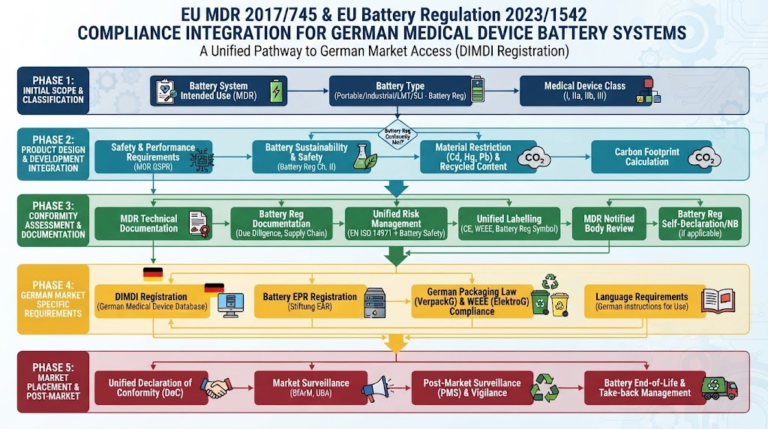
Bringing a medical battery to market requires navigating a strict matrix of international safety standards. The BMS is scrutinized not just as a power controller, but as a primary safety component under medical device frameworks.
| Standard | Governing Body | Primary Focus Area | BMS Hardware / Firmware Requirement |
|---|---|---|---|
| IEC 60601-1 / ANSI AAMI ES60601-1 | International / FDA | Medical Electrical Equipment General Safety | Means of Patient Protection (MOPP), creepage/clearance, touch current limits |
| IEC 62133-2 | IEC Global Standard | Secondary Lithium Cells & Battery Safety | Overcharge control, thermal abuse handling, external short-circuit protection |
| UL 2054 / UL 1642 | Underwriters Laboratories | Commercial & Household Battery Safety | Secondary hardware overcharge/overdischarge and single-fault testing |
| UN 38.3 | United Nations DOT | Dangerous Goods Transport Safety | Altitude simulation, thermal shock, vibration, impact, forced discharge |
| FDA 510(k) Subsystem Review | US FDA | Premarket Notification for Medical Devices | Complete BMS firmware lifecycle documentation and FMEA risk matrix |
Medical manufacturers submitting 510(k) applications must provide detailed documentation for all software running on the BMS. The U.S. Food and Drug Administration (FDA) requires verification that single software errors cannot disable primary hardware safety cutoffs.
Custom OEM/ODM Engineering: JHY Battery Capabilities
Standard off-the-shelf battery packs rarely match the custom dimensions, thermal environments, and bus requirements of specialized medical equipment. JHY Battery (Juheyuan Science & Technology Co., Ltd.) brings over a decade of manufacturing expertise to custom medical power subsystems.

Our engineering services cover every stage of custom battery pack development:
- Form Factor Optimization: Custom molded enclosures with precision internal brackets that withstand 1.5-meter medical drop-test requirements.
- Tailored Chemistry Selection: High-density NMC configurations for lightweight portable devices, or ultra-safe OEM LiFePO4 battery systems delivering over 3,000 charge cycles for heavy-duty hospital carts.
- Proprietary Firmware Development: Fully customized CANopen, SMBus, or Bluetooth Low Energy register maps that interface directly with your host operating system.
- Full Certification Support: Complete test reports and documentation for ISO9001, CE, UN38.3, MSDS, UL, and IEC standard submissions.
Medical Battery Integration: Engineering Checklist & Next Steps
Integrating a smart BMS into a new healthcare hardware design requires a clear, structured roadmap to avoid compliance delays during clinical validation:
- Define Electrical and Physical Boundaries: Document peak discharge currents, continuous load profiles, target operating temperature ranges, and maximum enclosure dimensions.
- Select Protection Tiers and Host Interface: Determine whether the device requires isolated CANbus or SMBus, dual-pack hot-swapping logic, and secondary pyrofuse hardware triggers.
- Engage with an OEM Partner for Prototyping: Collaborate with JHY Battery to build functional prototypes, validate fuel-gauge accuracy via hardware-in-the-loop (HIL) testing, and secure formal regulatory certifications.
Expertise & Review Standards
This technical guide was authored and reviewed by the senior biomedical engineering team at JHY Battery (Juheyuan Science & Technology Co., Ltd.).
Our engineering division manages ISO 9001-certified cell-testing laboratories equipped with multi-channel battery cyclers, thermal abuse chambers, and automated surface-mount assembly lines. Every custom BMS architecture undergoes complete FMEA (Failure Mode and Effects Analysis) to ensure clinical reliability.
よくある質問
How does a medical-grade BMS differ from a commercial-grade BMS?
Medical-grade smart BMS units include secondary independent analog protection circuits, galvanic signal isolation, redundant cell-voltage sensing, and complete firmware documentation. These extra safety layers satisfy FDA Class II/III and IEC 60601-1 medical device standards.
How does the BMS manage seamless hot-swapping without voltage drops?
The BMS works with an ideal-diode power path controller using low-resistance MOSFETs. When a battery is swapped, the controller switches power paths in microseconds, preventing voltage dips without generating excessive heat.
What certifications are mandatory before a medical battery pack can enter hospital service?
Battery packs must be certified to IEC 62133-2 (safety of secondary lithium cells), UN 38.3 (transport safety), and UL 2054. The entire host medical device must also achieve IEC 60601-1 certification.
Which battery chemistry is best suited for mobile medical carts?
LiFePO4 (Lithium Iron Phosphate) is the preferred chemistry for mobile medical workstations and surgical carts due to its high thermal stability, long cycle life (over 3,000 cycles), and low risk of thermal runaway.
Ready to Engineer Your Custom Medical Smart BMS?
Partner with JHY Battery for custom lithium-ion and LiFePO4 battery packs tailored to your medical equipment’s exact electrical and compliance specifications.