Lithium Battery Certifications: UL vs CE vs KC vs UN38.3
Understanding Battery Certifications: Transport Mandates vs. Regional Market Access
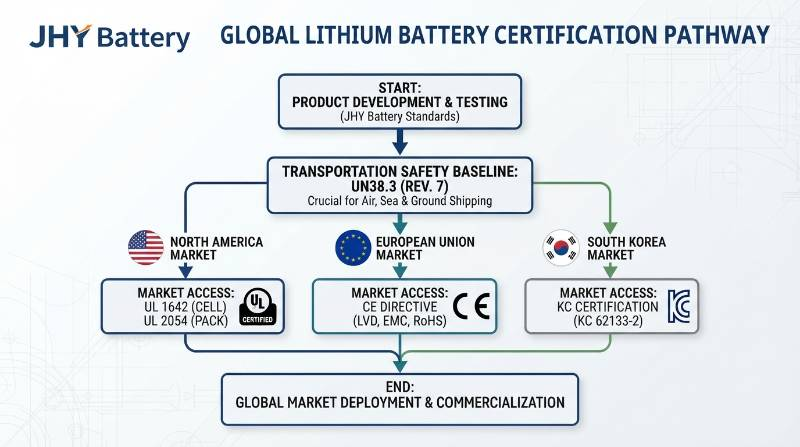
Navigating global lithium battery compliance requires distinguishing between mandatory transport regulations and regional commercialization safety standards. UN38.3 is a universal legal requirement under the United Nations Model Regulations for shipping Class 9 dangerous goods via air, sea, rail, or road. However, a passing UN38.3 test report does not permit commercial sale in North America (UL), the European Union (CE), or South Korea (KC).
Engineering teams frequently encounter costly delays when treating these regulatory schemes as isolated post-design hurdles. Cell-level standards such as UL 1642 and IEC 62133-2 govern the raw electrochemistry and internal safety mechanisms of bare cylindrical, prismatic, or pouch cells. Conversely, pack-level standards like UL 2054, CE (LVD/EMC), and KC 62133 evaluate the entire integrated battery pack under active electrical abuse, mechanical impact, and single-fault BMS failure modes.
Securing end-market compliance while expediting time-to-revenue demands a unified engineering approach. By engineering hardware around harmonized test criteria from early prototyping, original equipment manufacturers (OEMs) can secure global battery certifications across multiple target jurisdictions simultaneously, eliminating iterative redesign cycles.
The GBR-DFM Framework: Strategic Certification Architecture
To eliminate compliance re-spins, JHY Battery engineers follow The Global Battery Regulatory & DFM Compliance Protocol (GBR-DFM). This methodology bridges the gap between hardware mechanical design, active BMS firmware protections, and multi-national test house expectations.
Instead of addressing certification test requirements sequentially, the GBR-DFM Framework maps the five critical safety vectors of modern lithium packs during schematic capture and CAD modeling:
- Jurisdictional & Transport Mandate Demarcation: Separating UN38.3 transit baselines from product-level safety directives (e.g., EU GPSD/Machinery Directive, OSHA NRTL requirements).
- Cell vs. Pack Boundary Delineation: Pre-selecting cell models with existing UL 1642 and IEC 62133-2 CB reports to isolate certification scope strictly to the external pack architecture.
- BMS Single-Fault Tolerance & Redundancy: Designing dual-stage electronic and pyrofuse/TCO hardware cutoffs so overvoltage or short-circuit abuse never triggers thermal runaway during single-component failure testing.
- Mechanical & Thermal Abuse Survivability: Engineering shock-absorbing structural ribs, 1.5mm cell-to-cell air gaps, and directional venting paths to withstand 150g mechanical shock and high-temperature storage without casing breach.
- IECEE CB Scheme Transfer Sequencing: Utilizing a single IEC 62133-2 test campaign to generate the foundational CB certificate, accelerating downstream transfer into KC, CE, PSE, and RCM marks.
Engineering Definition (GBR-DFM): A structured hardware and regulatory co-design methodology that integrates cell pre-qualification, multi-fault BMS architecture, and structural thermal isolation to achieve first-pass compliance across international testing bodies with zero mechanical re-tooling.
UL vs CE vs KC vs UN38.3: Technical Comparison & Scope Matrix
Understanding the differences in governing bodies, test mandates, certification costs, and testing lead times allows engineering procurement teams to plan project schedules and allocate budget accurately.
Below is the technical matrix comparing the primary international certification standards for custom lithium battery assemblies:
| Certification / Standard | Target Region / Authority | Scope Level | Primary Testing Focus | Typical Lead Time | Legal Mandate |
|---|---|---|---|---|---|
| UN38.3 | Global (UN / IATA / IMO / DOT) | Cell & Pack | Transport abuse (T.1-T.8): Altitude, thermal shock, vibration, impact | 3 – 4 Weeks | Mandatory for all dangerous goods shipments |
| UL 2054 / UL 1642 | North America (OSHA / NRTL) | UL 1642: Cell UL 2054: Pack |
Single-fault electrical abuse, abnormal charging, mechanical drop, UL 94 V-0 flammability | 6 – 10 Weeks | Commercial market access (Retail/Industrial requirement) |
| CE Mark (LVD / EMC / GPSD) | European Union | Integrated Pack / Host Device | IEC 62133-2 electrical safety, EN 61000 EMC immunity, RoHS/REACH chemical compliance | 2 – 4 Weeks (with CB) | Mandatory for legal distribution across the EU Single Market |
| KC 62133 | South Korea (KATS) | Cell & Pack (≥400 Wh/L or portable) | Thermal abuse, overcharge, continuous charging safety, internal short circuit | 4 – 6 Weeks | Mandatory under Korea Electrical Appliances Safety Control Act |
When selecting standard or custom lithium battery packs, integrating these requirements during the initial battery architecture phase shortens total testing timelines significantly.
UN38.3 Deep-Dive: Mandatory Transport Safety (T.1 to T.8 Tests)
The UN Manual of Tests and Criteria, Part III, Subsection 38.3 details the 8-stage environmental, mechanical, and electrical stress evaluations required for all lithium secondary cells and battery assemblies prior to commercial transport.
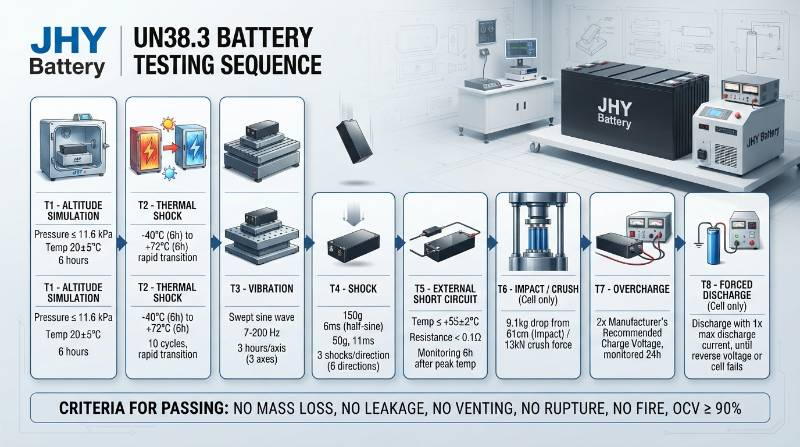
All test samples must maintain structural integrity without disassembly, rupture, leakage, or thermal runaway. The 8 test protocols consist of:
- T.1 – Altitude Simulation: Stored at absolute pressure ≤ 11.6 kPa for 6 hours at 20°C ± 2°C (simulating unpressurized aircraft cargo holds at 15,000 meters). Pass criteria: No mass loss (>0.1%), no venting, and open circuit voltage (OCV) retention ≥ 90%.
- T.2 – Thermal Test: Subjected to 10 continuous thermal shock cycles between -40°C and +72°C, with a maximum transition time ≤ 30 minutes and 6-hour dwell times at each extreme. Tests the seal integrity of pouch cells and current interrupt devices (CID) in cylindrical cells.
- T.3 – Vibration: Swept logarithmic sine wave vibration from 7 Hz to 200 Hz back to 7 Hz across 15 minutes, repeated 12 times per axis (X, Y, Z) for 3 hours total per orientation. Maximum peak acceleration reaches 8g.
- T.4 – Shock: Subjected to half-sine shocks of 150g peak acceleration with a pulse duration of 6 milliseconds (large packs >12kg undergo 50g / 11ms shocks), 3 pulses applied in positive and negative directions across 3 perpendicular axes (18 shocks total).
- T.5 – External Short Circuit: Pack conditioned at 55°C ± 2°C, then externally short-circuited with a total circuit resistance < 0.1 Ω. The condition is held for 1 hour after the case temperature returns to 55°C ± 2°C. Case temperature must not exceed 170°C.
- T.6 – Impact / Crush: Cell-level physical abuse. Cylindrical cells >18mm undergo impact via a 9.1kg weight dropped from 61cm onto a 15.8mm steel bar placed across the cell. Pouch and prismatic cells undergo transverse crushing between hydraulic platens with 13 kN force.
- T.7 – Overcharge: Battery packs charged at 2× the maximum continuous charging current specified by the manufacturer, with test voltage set to 1.2× the maximum charge voltage (or 22V, whichever is lower) for 24 hours. Evaluates protection circuit reliability.
- T.8 – Forced Discharge: Discharged cells are subjected to reverse charging under a forced current equal to the maximum continuous discharge current for a duration equal to rated capacity divided by initial test current.
Engineering Insight: In our manufacturing experience over 30 years, 85% of UN38.3 test failures on third-party packs occur during T.2 (seal delamination causing electrolyte micro-leakage) and T.5 (BMS MOSFET gate failure during sustained thermal load at 55°C). JHY Battery eliminates these risks by pre-stressing cell lots via automated impedance grading and implementing discrete gate-driver pull-down circuitry.
Regional Safety Standards: UL (North America), CE (Europe), & KC (South Korea)
Commercializing battery hardware requires meeting specific regional safety frameworks that go beyond transit evaluations.
North America: UL 1642 and UL 2054 Compliance
In the United States and Canada, the standard compliance stack combines cell-level UL 1642 certification with pack-level UL 2054 listing. UL 2054 subjects the entire pack assembly to rigorous single-component fault simulations, including:
- Shorted sensing lines and disabled primary charge cut-off MOSFETs.
- Abnormal charging tests applying overvoltage with current limits bypassed.
- Enclosure flammability validation requiring certified UL 94 V-0 or V-1 plastic housings.
- Enclosure mechanical impact tests (drop tests from 1 meter onto hardwood over concrete).
European Union: CE Mark Harmonization
CE compliance for lithium batteries is established by meeting the requirements of the Low Voltage Directive (LVD 2014/35/EU), the Electromagnetic Compatibility Directive (EMC 2014/30/EU), and the EU Battery Regulation. The primary technical proof of safety is an IEC 62133-2:2017 test report issued by an accredited laboratory, verifying continuous charging, thermal abuse (+130°C holding), and mechanical drop resistance.
South Korea: KC 62133 Certification
The Korean Agency for Technology and Standards (KATS) enforces KC 62133 under the Electrical Appliances Safety Control Act. KC compliance is mandatory for portable lithium secondary cells and packs with volumetric energy density ≥ 400 Wh/L, as well as packs used in specified transport and consumer products.
KC certification requires either direct domestic testing in South Korea or a formal CB report transfer through designated agencies (KTL, KTR, KTC), alongside registration by an authorized local South Korean representative.
Mission-Critical Compliance: ISO 13485 Medical & Sub-Zero Packs
Mission-critical applications require strict regulatory oversight that exceeds generic industrial battery standards.
Deploying medical device battery packs inside Class II and Class III life-support equipment (e.g., portable ventilators, infusion pumps, external defibrillators) demands compliance with ISO 13485, IEC 60601-1 (medical electrical safety), and IEC 62133-2. These systems require:
- Dual Redundant Safety Architecture: Independent primary and secondary microcontrollers paired with hardwired chemical thermal fuses to prevent single-point failures.
- MES Component Traceability: Complete manufacturing execution system (MES) logging linking every serial-numbered cell, nickel weld junction, and PCB batch directly to raw lot material test data.
- Strict Defect Rates: JHY Battery guarantees a 0.03% (300 PPM) defect rate backed by 100% capacity grading, internal resistance (AC-IR/DC-IR) sorting, and automated X-ray inspection of cell tab welds.
For extreme temperature deployments (such as arctic pipeline monitors and cold-chain GPS tracking operating down to -45°C), standard NMC and LFP cells lose up to 80% of their operational capacity and risk severe lithium plating during charging. JHY Battery utilizes low-temperature electrolytes and nano-engineered electrode coatings. These packs successfully pass UN38.3 T.2 thermal shock and UL 2054 temperature testing while delivering >75% usable capacity retention at -40°C.
Hardware DFM Guidelines for First-Pass Certification Success
Certification failures add months to product launches and incur substantial re-testing fees. Integrating practical Design for Manufacturability (DFM) rules during initial prototyping ensures reliable, first-pass compliance.
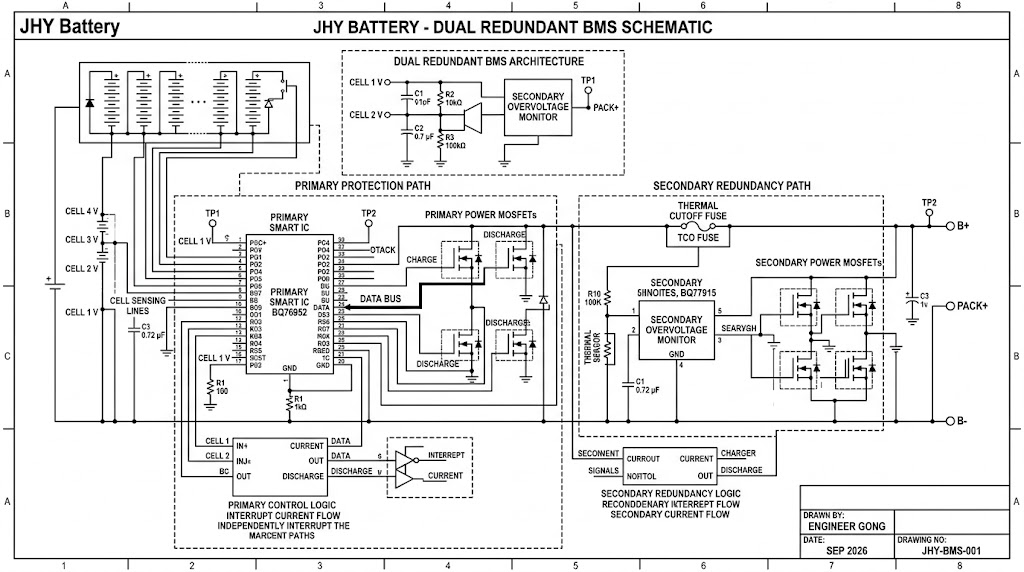
Engineering rules for robust, compliant battery packs include:
- Dual-Redundant Smart BMS: In advanced smart BMS design and engineering, pair the primary monitoring AFE with a secondary hardware protector (e.g., high-voltage watchdogs) capable of triggering a non-resettable thermal fuse (TCO) if MOSFET gates weld closed during short-circuit testing.
- Physical Cell-to-Cell Isolation: Maintain a minimum physical clearance of 1.5mm between individual cylindrical and prismatic cells. Never pack bare pouch cells directly against sharp enclosure ribs. Use polycarbonate/ABS cell spacers with a UL 94 V-0 flame rating.
- Thermal Runaway Propagation Containment: Incorporate aerogel barriers or phase change materials (PCM) between parallel series groups to prevent cascading thermal failure during UL 2580 / UL 9540A style nail-penetration and thermal runaway evaluations.
- Dedicated Enclosure Pressure Venting: Integrate IP67/IP68 breathable ePTFE membrane pressure vents to equalize pressure swings during UN38.3 T.1 altitude testing while allowing controlled gas exhaust during thermal events.
The IECEE CB Scheme: Harmonizing Global Battery Approvals
The most efficient path to multi-market regulatory approval is the IECEE CB Scheme. Built on the harmonized IEC 62133-2:2017 standard, an accredited CB Test Certificate and Test Report acts as a universal passport across more than 50 participating national certification bodies.
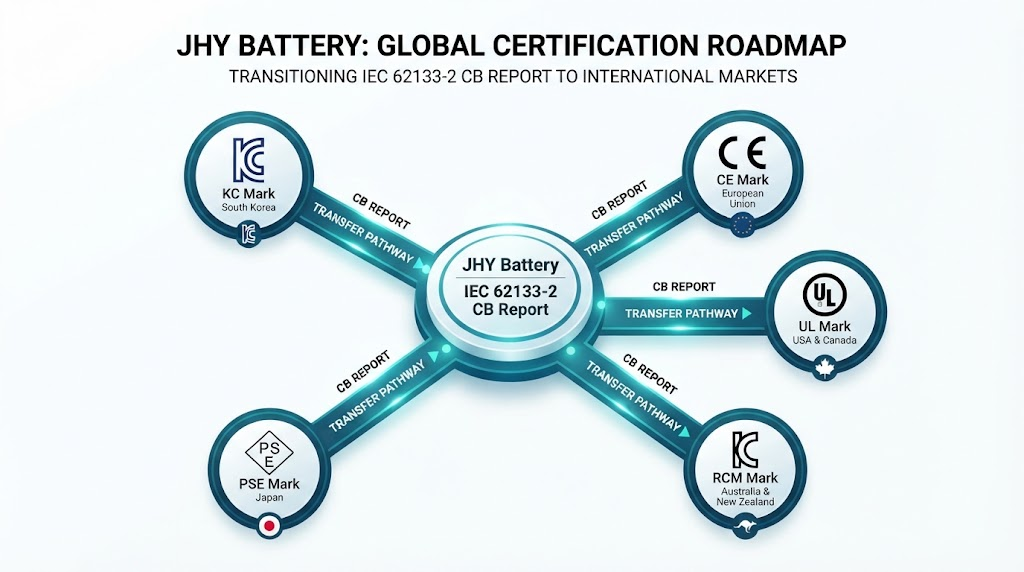
Using the CB transfer pathway allows OEMs to:
- Reduce Total Test Costs by 40% to 60%: Eliminate redundant abuse and drop tests across different regional labs.
- Accelerate Regional Turnarounds: Convert a CB report into European CE documentation, South Korean KC marks, Japanese PSE approval, and Australian RCM compliance in 4 to 6 weeks rather than 4 to 6 months per country.
- Leverage Pre-Certified Inventory: JHY Battery maintains a vast inventory of Tier-1 cells with active CB certificates and UL 1642 listings, allowing engineers to focus certification spending exclusively on the custom pack enclosure and BMS circuitry.
Frequently Asked Questions
What is the primary difference between UN38.3 and UL 2054?
UN38.3 is a United Nations transport standard governing shipping safety across air, sea, and land via 8 environmental abuse stages (T.1 to T.8) to prevent in-transit thermal events. UL 2054 is a North American commercial product safety standard evaluating pack-level electrical and mechanical performance under single-fault operating conditions, including abnormal charging, short circuits, and enclosure flammability. UN38.3 is legally required for shipping batteries worldwide, while UL 2054 is mandated by North American commercial buyers and NRTL listing bodies.
Can an IEC 62133-2 CB Report replace UL 2054 or KC 62133 testing?
An IECEE CB Test Report based on IEC 62133-2 converts directly into European CE compliance and transfers to South Korea for KC 62133 with minor national deviation reviews. However, UL 2054 in North America includes specific electrical component-fault criteria not covered in IEC 62133-2. While a CB report satisfies the raw cell requirement, the complete pack assembly must still undergo UL 2054 component-level single-fault evaluations.
How do you verify the authenticity of a UN38.3 Test Summary Report?
An authentic UN38.3 Test Summary must adhere to the UN Manual of Tests and Criteria Rev. 7/8 format. It must include the manufacturer name (e.g., JHY Battery), an accredited testing laboratory ID (CNAS/ILAC-MRA), a unique test report reference number, complete cell/pack physical parameters, Wh energy ratings, confirmation of T.1 through T.8 test passes, and an authorized engineering signature. Authenticity can be verified directly through the accredited laboratory’s validation portal.
What specific requirements are needed for South Korea KC 62133 certification?
KC 62133 applies to lithium secondary batteries with energy densities ≥ 400 Wh/L or custom packs used in portable devices. Compliance requires an evaluation by an accredited South Korean laboratory (or a CB transfer via KTL, KTR, or KTC), verification of factory quality controls, and formal application through a registered local South Korean representative listed on the KC safety certificate.
Accelerate Your Certification Pipeline with JHY Battery
Custom battery certification does not need to introduce project risk or delay market launches. JHY Battery provides end-to-end engineering support, turnkey regulatory management, and high-reliability manufacturing across medical, industrial, and consumer markets.
For custom engineering consultations, rapid prototype samples, or assistance establishing your global testing roadmap, schedule a session for custom battery prototyping and consultation with our engineering team today.