Medical Device Batteries: Regulatory & Design Guide
Regulatory Compliance: ISO 13485, IEC 62133, and FDA 510(k) Guidelines
Medical device battery requirements mandate strict adherence to ISO 13485 quality systems, IEC 62133 safety standards, and ISO 10993 biocompatibility protocols. These regulations ensure that medical-grade batteries deliver reliable power, resist thermal runaway, and use non-toxic materials safe for active patient contact.
- Establish a certified ISO 13485 quality management system.
- Conduct rigorous IEC 62133 safety and electrical abuse testing.
- Verify material safety using ISO 10993 biocompatibility testing.
- Implement redundant battery management system (BMS) protections.
- Document risk management files according to EN ISO 14971 standards.
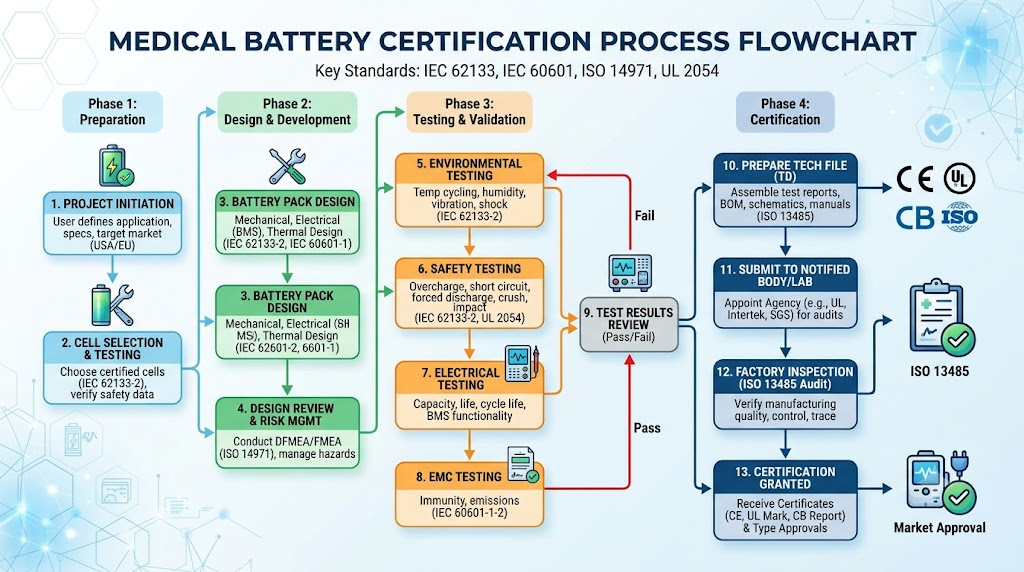
Designing power sources for medical hardware requires navigating a dense matrix of safety certifications. Standard consumer electronics batteries do not meet the strict safety protocols demanded by hospital and clinical environments.
To secure market clearance, manufacturers must align their quality processes with the ISO 13485 certification standard. This quality management system (QMS) ensures every battery cell and pack is fully traceable from raw material to finished assembly.
Electrical safety is governed by IEC 62133. This standard tests cells under extreme conditions, including continuous low-rate charging, vibration, mechanical shock, and external short circuits.
For systems integrated into medical electrical equipment, compliance with IEC 60601-1 is also required. This standard focuses on patient and operator safety, ensuring that battery failures do not result in hazardous electrical shocks or excessive surface temperatures.
When preparing a submission for the Food and Drug Administration (FDA), design engineers must provide comprehensive data showing compliance with these guidelines. This includes risk management EN ISO 14971 documentation, which details potential failure modes and their mitigation strategies.
Under the European Medical Device Regulation (MDR), battery traceablity and safety documentation are audited even more closely. Any failure in compliance can delay product launches by months or years.
At JHY Battery, we specialize in developing certified medical device batteries. Our facilities operate under strict quality controls to guarantee that every unit complies with global regulatory demands.
Biocompatibility and Material Safety: ISO 10993 Standards
When engineering batteries for wearable sensors, diagnostic devices, or active implantable medical devices, material safety becomes a primary design constraint.
Biocompatible batteries are power sources designed with non-toxic, hermetically sealed materials that do not induce a harmful biological response, such as cytotoxicity, irritation, or systemic toxicity, when placed in direct or indirect contact with human tissue under ISO 10993 guidelines.
Biocompatibility testing under the ISO 10993 framework ensures that the battery enclosure and exposed components are safe for human contact. This is especially critical for wearable patches that remain on a patient’s skin for extended periods.

In our testing laboratories, we focus heavily on cytotoxicity, sensitization, and irritation assessments. Cytotoxicity testing determines if any leachable chemicals from the battery housing can cause cell death or damage.
To mitigate these risks, medical-grade batteries often utilize advanced medical-grade plastics or stainless steel enclosures. These materials must be hermetically sealed to prevent any internal electrolyte leakage from escaping the battery pack.
Leachable and extractable testing is performed under worst-case temperature and chemical exposure scenarios. This guarantees that even if a wearable device is exposed to sweat, body oils, or cleaning alcohol, the battery enclosure remains chemically inert and safe.
The JHY Triple-Shield™ Protocol for Medical Battery Safety
To address the critical safety demands of the medical industry, JHY Battery developed a proprietary engineering framework: The JHY Triple-Shield™ Protocol.
This systematic design process ensures that every lithium-ion battery pack we produce operates safely under both normal and abnormal conditions.
1. Redundant BMS Safety Circuits
The first shield is our custom-engineered battery management system (BMS). Unlike standard consumer electronics, our medical BMS designs feature dual-channel, independent protection integrated circuits.
These circuits monitor individual cell voltages, pack temperatures, and current flow in real time. If the primary controller fails, a secondary hardware-level cutoff circuit steps in to isolate the battery, preventing overcharge, over-discharge, or short-circuit hazards.
2. Thermal Runaway Prevention
Our second shield focuses on physical thermal management. We utilize advanced phase-change materials (PCM) and aerogel insulation barriers between cells.
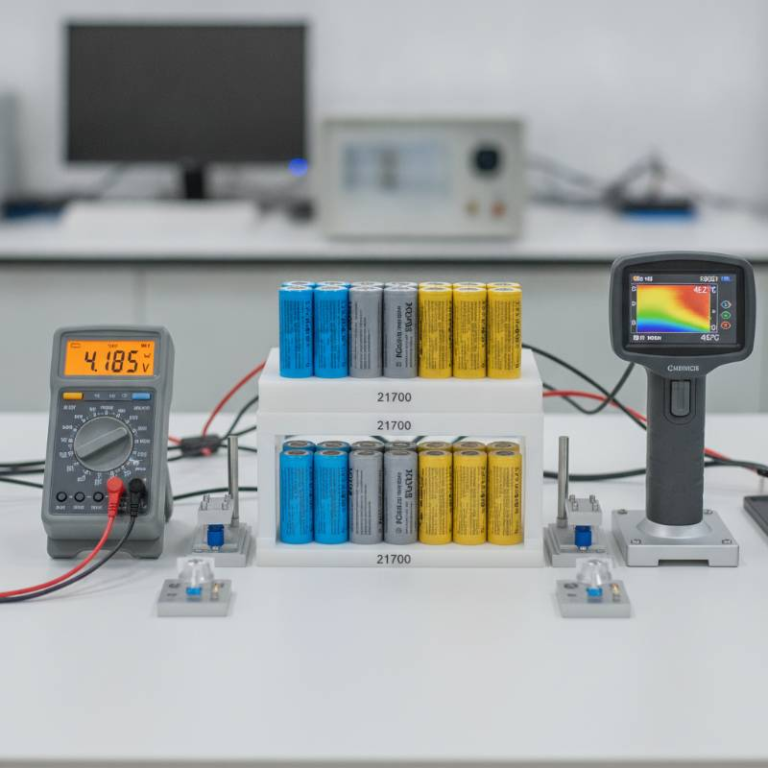
Based on our proprietary thermal runaway testing data, we simulate internal short circuits to verify that if a single cell fails, the thermal energy is contained. This prevents a cascading thermal event, keeping the external enclosure temperature well below the limits defined by IEC 60601-1.
3. Hermetic Sealing & Mechanical Isolation
The third shield is mechanical isolation. We use ultra-sonic welding and custom-molded silicone gaskets to achieve IP67 or IP68 water and dust resistance.
This hermetic seal prevents ingress of bodily fluids, cleaning agents, or sterilizing chemicals. It also ensures that internal gassing or electrolyte release is completely contained within the battery pack shell.
Comparing Battery Chemistries for Medical Use Cases
Choosing the correct battery chemistry is a balancing act between energy density, lifecycle, weight, and safety. Different medical applications require tailored power solutions.
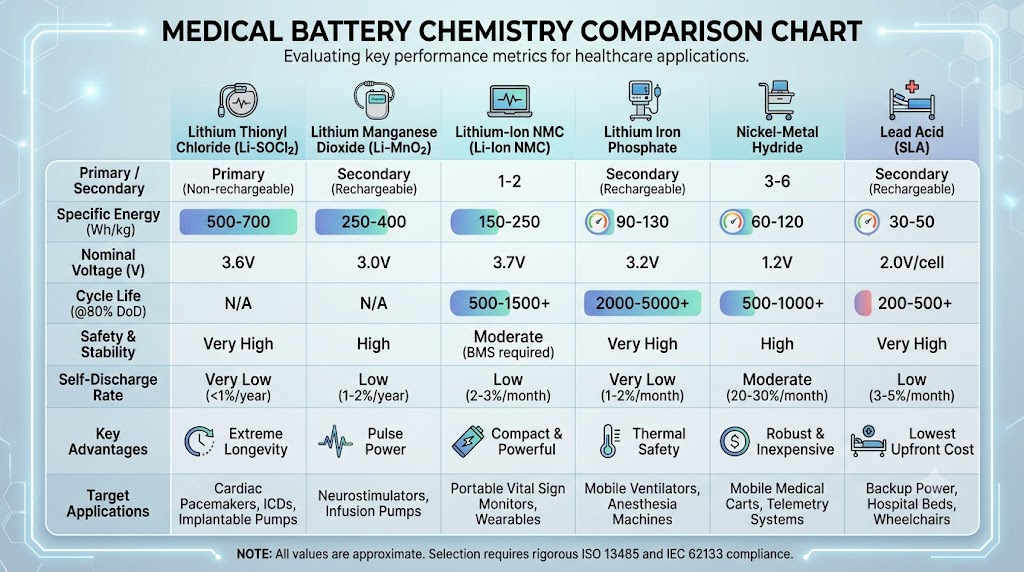
| Chemistry | Energy Density | Cycle Life | Safety Profile | Ideal Medical Application |
|---|---|---|---|---|
| Lithium-ion (NMC) | Very High | 500 – 1,000 cycles | Moderate (Requires active BMS) | Wearables, portable monitors, surgical tools |
| LiFePO4 | Moderate | 2,000 – 5,000+ cycles | Excellent (Highly stable) | Ventilators, hospital carts, backup power |
| NiMH | Low | 500 – 800 cycles | High | Legacy infusion pumps, low-drain monitors |
For portable devices where lightweight design is critical, custom lithium-ion battery packs offer the highest energy density. They allow devices to run longer on a single charge without adding unnecessary weight for the patient or clinician.
In contrast, backup power systems and clinical cart equipment benefit greatly from LiFePO4 batteries. Their exceptional thermal stability and long cycle life make them highly reliable for stationary or semi-portable clinical hardware.
Custom Medical Battery Packs: OEM/ODM Solutions by JHY Battery
JHY Battery (Juheyuan Science & Technology Co., Ltd.) is a leading global battery manufacturer with over a decade of rich industry experience. We specialize in providing comprehensive OEM/ODM one-stop battery solutions, supporting deep customization of voltage, capacity, dimensions, and BMS configurations.
We understand that off-the-shelf batteries rarely meet the precise space and safety constraints of advanced medical devices. That is why our engineering team works directly with your product developers to design custom battery packs from the ground up.
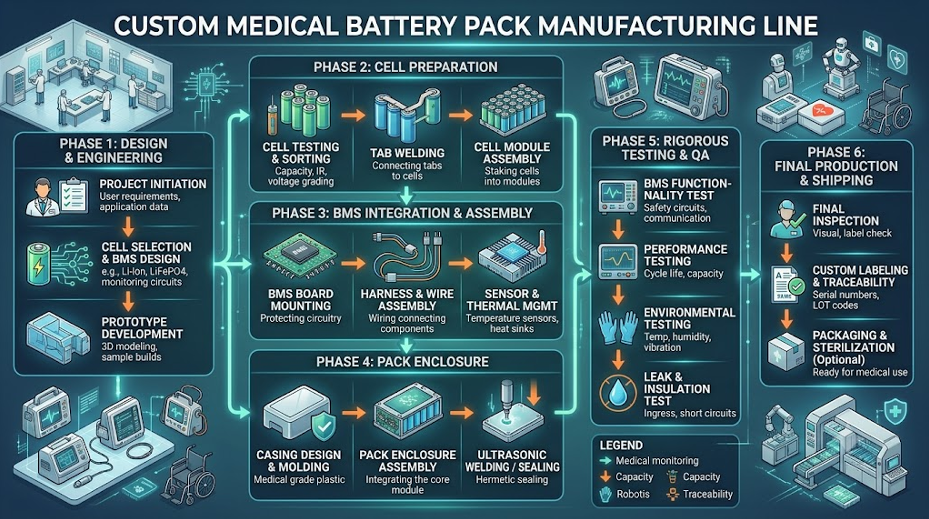
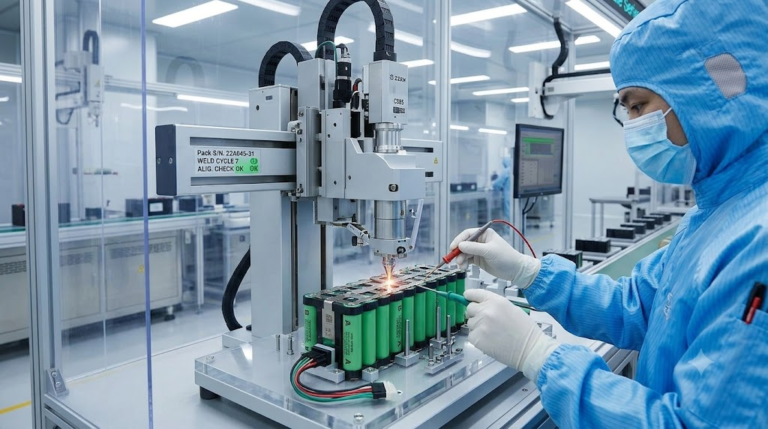
Our custom assemblies feature high-grade materials, precision-welded nickel strips, and custom plastic enclosures. We handle everything from initial 3D CAD modeling to final compliance testing.
JHY Battery holds a complete suite of international certifications, including ISO9001, CE, UN38.3, MSDS, and UL. This ensures that your custom battery packs are fully certified for global distribution and transport.
Whether you require a low-profile custom lithium-ion battery packs for a new wearable device, or a robust power pack for critical life-support systems, JHY Battery delivers the safety, performance, and reliability your application demands.
Step-by-Step FDA 510(k) Battery Compliance Checklist
Filing a premarket notification with the Food and Drug Administration (FDA) requires meticulous documentation. Use this reference checklist to ensure your battery documentation meets the necessary regulatory standards.
- Cell Specification Sheet: Provide detailed datasheets showing chemistry, voltage, capacity, and manufacturer details.
- UN38.3 Test Report: Include the lithium battery transport testing summary to prove transportation safety compliance.
- IEC 62133 Certification: Attach certified test reports proving compliance with electrical, mechanical, and thermal safety tests.
- BMS Schematic and Logic: Provide schematics showing redundant overvoltage, undervoltage, and overcurrent protections.
- ISO 10993 Biocompatibility Data: Supply material safety data sheets (MSDS) and cytotoxicity test results for all external materials.
- Thermal Runaway Mitigation Plan: Document design features (such as spacing or thermal barriers) that prevent propagation.
- Traceability Records: Provide evidence of manufacturer ISO 13485 compliance to guarantee component traceability.
Frequently Asked Questions About Medical Device Batteries
What is the main difference between consumer and medical-grade batteries?
Medical-grade batteries require strict traceability (ISO 13485), redundant hardware-level safety protections (BMS), and biocompatible materials (ISO 10993). They also must undergo comprehensive safety testing under IEC 62133 to ensure they do not fail under extreme clinical conditions.
Why is ISO 13485 certification important for battery manufacturers?
ISO 13485 is a quality management system standard specific to medical devices. It ensures that the manufacturer maintains strict process controls, product traceability, and risk management procedures throughout the entire production lifecycle, minimizing the risk of manufacturing defects.
Is UN38.3 certification mandatory for medical batteries?
Yes. UN38.3 is a mandatory global safety standard for the transport of lithium-ion batteries. All medical batteries must pass these strict environmental, mechanical, and electrical tests before they can be legally shipped by air, sea, or land.
Expert Engineering Insights & Custom Battery Consultation
“In our testing, we have found that early-stage thermal modeling saves up to 40% in development time. Designing the physical enclosure and the BMS safety parameters simultaneously is the absolute key to meeting FDA and MDR guidelines on your very first submission.”
— Senior Medical Battery Design Engineer, JHY Battery
Navigating medical device battery requirements does not have to delay your project. JHY Battery provides a streamlined, 3-step action path to take your medical device from concept to global market clearance:
- Submit Your Specs: Contact our team with your power requirements, envelope dimensions, and target certifications.
- Receive 3D CAD & Review: Our engineering team will deliver a custom 3D CAD design and engineering review within 48 hours.
- Get Certified Prototypes: We manufacture and test prototypes in our ISO 13485-aligned facility, ensuring they are ready for regulatory audits.
Ready to Power Your Next Medical Innovation?
Partner with JHY Battery for certified, high-safety custom medical battery packs designed to pass ISO 13485, IEC 62133, and ISO 10993 standards.