Sourcing Lithium Batteries: Factory Direct vs Distributor
The Strategic Hardware Dilemma: Factory Direct vs. Distributor
Sourcing lithium batteries requires balancing immediate inventory availability against long-term landed unit economics, mechanical integration, and firmware ownership. Selecting between a regional component distributor and an Original Equipment Manufacturer (OEM) directly dictates your product’s safety margins, operational lifespan, and supply chain scalability.
For early-stage proof-of-concept testing under 500 units, catalog distributors offer convenient standard configurations. However, scaling production exposes severe distributor constraints: inflexible protection circuits, unoptimized energy densities, lack of cell-level data logging, and compounding broker margins of 25% to 45%.
Direct engagement with an established cell integrator like China Battery Manufacturer (JUHEYUAN SCIENCE & TECHNOLOGY CO., LTD. / JHY Battery, backed by the industrial manufacturing infrastructure of Sichuan Changhong Group) bridges the gap between raw electrochemical design and precision hardware production. Engineering teams gain complete access to Design for Manufacturability (DFM) support, register-level BMS tuning, and traceable cell sorting.
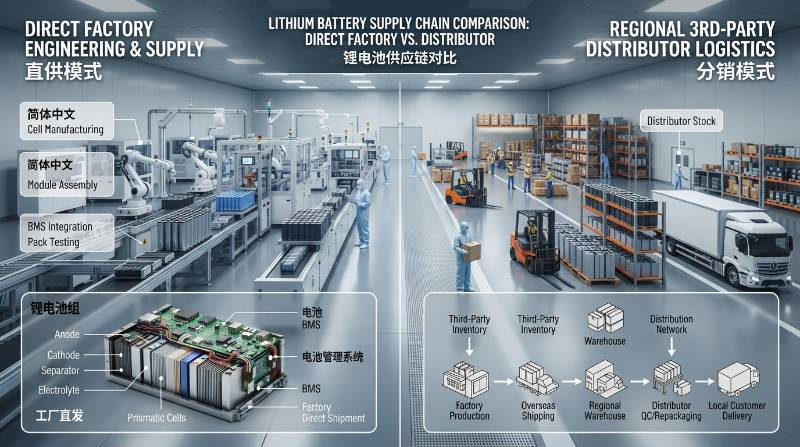
The 5-Tier Industrial Sourcing & Lifecycle TCO Protocol
To systematically evaluate procurement channels, our engineering team developed The 5-Tier Industrial Sourcing & Lifecycle TCO Protocol. This framework moves beyond initial purchase price, auditing the full architectural and financial impact across the battery system’s operating lifecycle.
| Evaluation Dimension | Authorized Catalog Distributor | Direct Factory Partner (Changhong / JHY) |
|---|---|---|
| 1. Electrochemical & Mechanical DFM | Fixed off-the-shelf plastic enclosures; standardized cell configurations (e.g., rigid 1S2P, 4S1P). | Custom 3D CAD modeling, IP67/IP68 enclosures, precision nickel busbars, ultra-thin/shaped pouch options. |
| 2. BMS & Firmware Control | Hardcoded generic Protection Circuit Modules (PCM); no external bus communication or register access. | Custom hardware/firmware with CANbus 2.0B, SMBus, RS485, UART, configurable safety thresholds, and active balancing. |
| 3. Quality & Lot Traceability | Batch-level testing only; potential mixed cell bins, aging stock, and third-party relabeling risks. | 100% automated capacity and internal resistance sorting (Delta-IR < 1.5mΩ), full MES barcode tracking, <300 PPM defect rate. |
| 4. Unit Economics & Landed TCO | Lower upfront NRE; high per-unit markups (25-45%); unamortized costs penalize high-volume runs. | Direct bill of materials (BOM) transparency; 18-35% unit cost reduction at scale; amortized tooling across volume. |
| 5. Compliance Ownership | Shared, non-exclusive certificates; modifications require costly recertification loops. | OEM-owned UL 2054, IEC 62133-2, CE, CB, and UN38.3 certifications registered directly under your brand name. |
Engineering complex industrial or consumer devices requires configuring every millimeter of internal envelope volume. Explore our engineering approaches for custom battery packs to resolve strict physical envelope constraints.
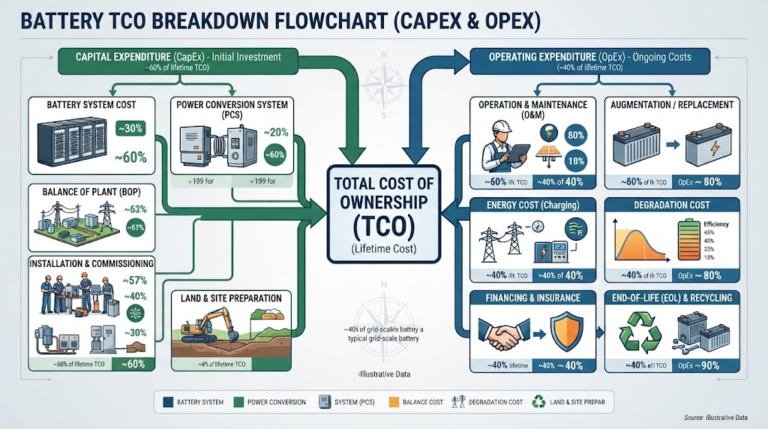
Total Cost of Ownership & Landed Cost Mechanics: The Crossover Point
Hardware procurement calculations often fail by comparing baseline Ex-Works (EXW) cell quotes against domestic distributor prices without accounting for comprehensive landed logistics and quality assurance overhead.
The total landed cost per operational cycle for industrial lithium packs is governed by the following engineering formula:
TCO = [ ( C_unit + (NRE / V) + C_hazmat + C_tariff ) / ( N_cycles × DoD ) ] + ( C_failure × P_defect )
Where:
- C_unit: Raw factory unit cost including cell, BMS, wiring harness, and housing.
- NRE / V: Non-Recurring Engineering and tooling expenses amortized over total production volume ($V$).
- C_hazmat: Class 9 Dangerous Goods freight packaging, UN-rated carton testing, and ocean/air logistics.
- C_tariff: Import duties, customs brokerage, and harbor maintenance fees.
- N_cycles × DoD: Useful lifecycle delivery (Cycle count multiplied by Depth of Discharge).
- C_failure × P_defect: Field failure warranty liability multiplied by the manufacturing defect rate.
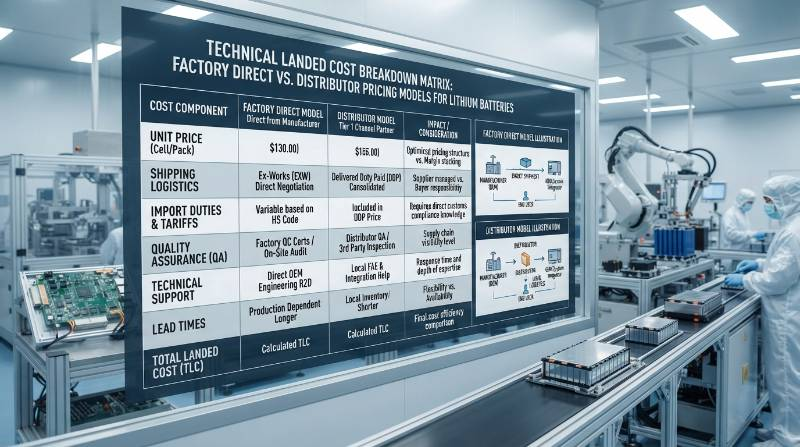
Engineering Customization & DFM Integration
Distributors sell fixed catalog geometry. When your mechanical envelope features tight radius corners, structural ribbing, or strict thermal venting pathways, modifying your chassis around an off-the-shelf pack introduces structural compromises and parasitic mass.
Direct collaboration with an engineering-led factory unlocks ground-up Design for Manufacturability (DFM):
- Interconnect Optimization: Pure nickel busbars designed with finite element analysis (FEA) to minimize I2R resistive heating under 3C to 10C pulse loads.
- Thermal Management: Phase-change materials (PCM), aerogel barriers, and aluminum heat-sink integration to prevent localized cell heating.
- Enclosure Protection: Custom injection-molded UL 94-V0 flame-retardant enclosures sealed to IP67 or IP68 waterproof standards.
- Structural Isolation: Silicon vibration damping mounts engineered to pass strict shock requirements under ASTM D4169 and UN38.3 standards.
To reduce your time-to-market, discover our rapid 5-7 business day functional prototyping via OEM/ODM turnkey battery services.
BMS Architecture & Register-Level Firmware Control
Standard distributor battery packs usually integrate rudimentary hardware protection circuit modules (PCMs). These analog boards trigger hard cutoffs during over-voltage or over-current events without alerting the host microcontroller, causing abrupt system shutdowns.
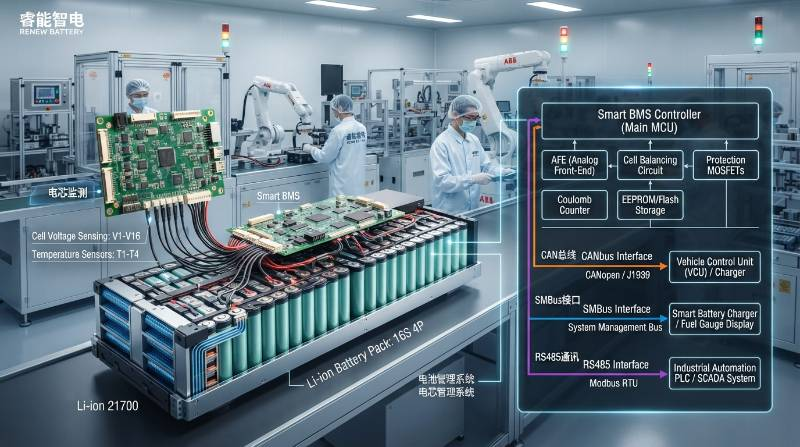
Factory-direct integration allows custom engineering of intelligent Battery Management Systems that communicate seamlessly with your host processor:
- Digital Communication Busses: Native support for CANbus 2.0B, SMBus v1.1, RS485, UART, and Bluetooth Low Energy (BLE).
- Dynamic Fuel Gauging: High-precision Texas Instruments or Analog Devices front-end ICs utilizing Coulomb-counting algorithms to ensure State-of-Charge (SOC) tracking precision within ±1.0%.
- Multi-Tier Safety Thresholds: Programmable secondary protection cutoffs for over-temperature, under-temperature charge prevention, and short-circuit response times under 200 microseconds.
- Ultra-Low Quiescent Current: Deep-sleep hardware configurations drawing under 10µA to preserve cell health during extended shelf storage.
Review our specialized hardware topologies and register configurations for BMS design and engineering.
Quality Assurance, Cell Grading, and MES Traceability
One of the primary risks in distributor supply chains is cell aging and unregulated bin variance. Lithium-ion cells that sit on distributor shelves for 9 to 18 months suffer from SEI layer growth, capacity degradation, and severe open-circuit voltage (OCV) dispersion.
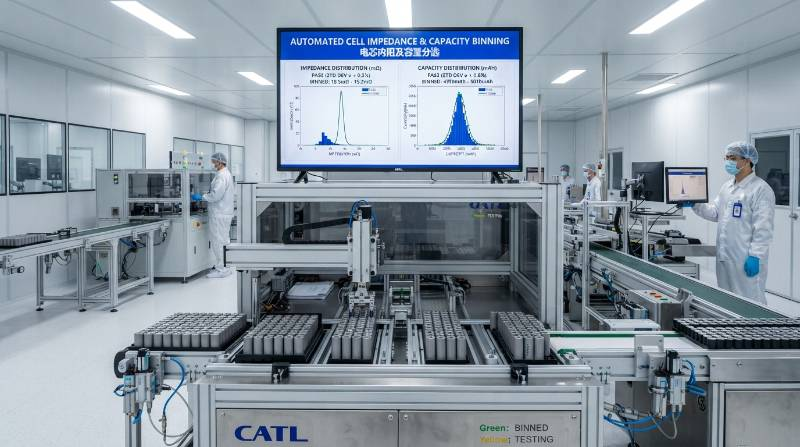
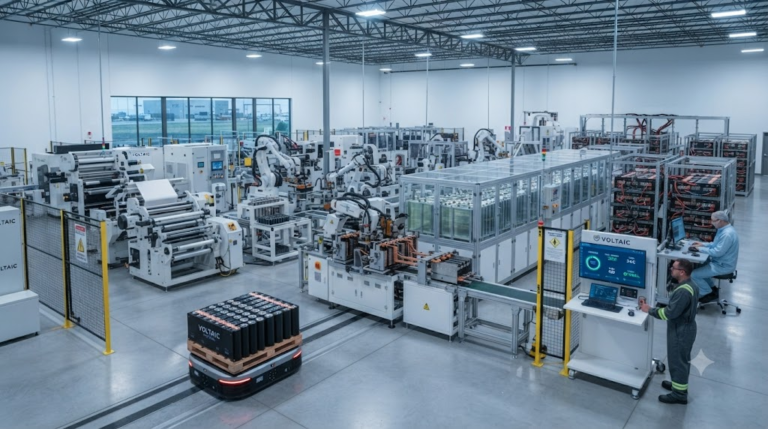
At our automated production centers, backed by over 30 years of manufacturing discipline under Sichuan Changhong Group, quality control is executed at the individual cell level before pack assembly begins:
“A battery pack’s operational lifespan is dictated entirely by its weakest cell. In our automated production lines, 100% of cells undergo five-step grading: OCV, AC Internal Resistance (AC-IR), DC-IR, dynamic capacity grading, and high-temperature aging. We maintain strict binning tolerances: Delta-IR < 1.5mΩ and Delta-Capacity < 1.0% across all parallel groups.”
Every manufactured pack is tied to our integrated Manufacturing Execution System (MES). Scanning a pack’s 2D Data Matrix code retrieves the exact initial impedance, weld resistance profiles, AOI optical inspection captures, and industrial X-ray weld penetration images for every internal junction.
Mission-Critical Medical, Robotics, and Harsh Environments
Generic distributor catalog batteries are engineered for nominal ambient conditions (0°C to 45°C) and commercial-grade duty cycles. They fail when exposed to the thermal, mechanical, and safety demands of specialized industrial sectors.
1. ISO 13485 Certified Medical Devices
Class II and Class III medical hardware—including portable ventilators, infusion pumps, and surgical power tools—demand zero-failure redundancy. We implement dual-redundant MOSFET cutoffs, secondary hardware thermal fuses, and rigorous audit trails compliant with ISO 13485 and IEC 62133-2.
Explore our engineering processes for high-reliability medical device batteries.
2. Robotics, AGVs, and Heavy Cycling Energy Storage
Autonomous Mobile Robots (AMR) and industrial automated guided vehicles demand rapid high-rate charging (1C to 3C) and extensive lifespan. Standard NMC chemistries degrade rapidly under continuous multi-shift operations. We engineer custom modular LiFePO4 battery pack systems delivering 3,000 to 6,000+ deep discharge cycles at 80% Depth of Discharge.
3. Extreme Low and High Temperature Operations (-45°C to +80°C)
Cold-chain telematics, outdoor telecom base stations, and arctic sensor nodes face immediate lithium plating and capacity drop-offs when charged below freezing. By using custom low-temperature electrolytes, nano-composite cathode coatings, and integrated internal PTC heating elements, our direct factory packs retain over 80% rated capacity at -40°C.
Regulatory Compliance & Hazmat Transport Logistics
Importing lithium batteries directly requires strict adherence to international Dangerous Goods shipping regulations. Distributors often rely on generic, shared test reports that may not match recent product revisions, leaving your company exposed to regulatory penalties.
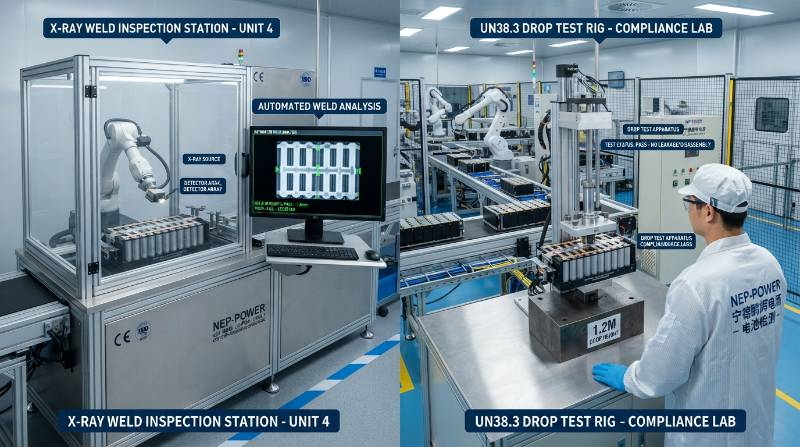
Direct factory partners provide comprehensive, audit-ready regulatory documentation for every production lot:
- UN38.3 Test Summary Reports: Validated compliance across 8 distinct tests: altitude simulation, thermal shock, vibration, mechanical shock, external short circuit, impact/crush, overcharge, and forced discharge.
- Drop Test Validation: Verified 1.2-meter packaged drop test reports in accordance with ICAO/IATA Dangerous Goods Regulations.
- Global Product Certifications: UL 2054, UL 1642, IEC 62133-2, CE, CB, KC, and FCC file registrations issued directly to your corporate entity.
- Comprehensive Customs Paperwork: Safety Data Sheets (SDS) fully compliant with current GHS revisions, Class 9 Hazmat shipping declarations, and specialized UN-approved packaging.
Supply Chain Resilience & Hybrid Buffering Models
The most resilient hardware OEMs combine direct factory pricing and engineering customization with regional inventory staging. This hybrid procurement model eliminates stockout vulnerabilities while maintaining low landed costs.
We work with enterprise clients to implement reliable supply chain frameworks:
- Rolling Blanket Purchase Orders (PO): Lock in cell pricing and raw material bills of materials 12 months in advance, mitigating raw commodity price spikes.
- Safety Stock Buffering: We maintain reserved, temperature-controlled buffer inventory of critical cells, BMS PCBA components, and custom tooling in our bonded facilities.
- Scheduled Delivery Releases: Batched sea freight shipments timed to arrive at your regional 3PL facilities or manufacturing hubs just-in-time (JIT), minimizing domestic holding costs.
Frequently Asked Questions: Sourcing Lithium Batteries
What is the true cost crossover point between sourcing through a battery distributor versus direct factory manufacturing?
The economic crossover point typically occurs between 1,000 and 2,500 packs annually. For volumes under 1,000 units, distributors absorb Class 9 Hazmat shipping, UN38.3 certification, and tooling NRE costs. Above 2,500 units, factory-direct sourcing eliminates distributor margins (25-45%), cuts landed per-unit costs by 18-35%, and fully amortizes custom tooling ($3,000-$8,000) within the first production batch.
How do BMS customization capabilities differ between distributors and direct battery manufacturers?
Distributors supply standardized off-the-shelf protection circuit modules (PCMs) with fixed over-voltage/under-voltage cutoffs and hardcoded basic fuel gauges. Direct factory manufacturers engineer custom BMS hardware and firmware from the ground up, providing configurable Coulomb-counting algorithms, multi-bus communication (CANbus 2.0B, RS485, SMBus v1.1, Bluetooth LE), active balancing, and tailored sleep modes (<10µA) for specialized system architectures.
How can hardware procurement teams verify genuine Grade-A cell integration and prevent sub-tier cell substitution?
Request raw MES grading logs and lot-specific OCV/AC-IR test data for 100% of cells before pack welding. Genuine Grade-A batches exhibit capacity variance <1.0% and AC-IR variance <1.5mΩ. Direct factory partners provide raw traceability data sheets, original manufacturer QR code scans, and material composition certs that unauthorized brokers and distributors cannot supply.
What regulatory documentation is required to ensure legal compliance when importing lithium batteries factory-direct?
Factory-direct imports require an authentic UN38.3 Test Summary Report, a verified 1.2m drop test report, Safety Data Sheets (SDS) in accordance with GHS revisions, and Class 9 Dangerous Goods declaration packaging. For medical or consumer hardware, direct access to the factory’s CB test reports (IEC 62133-2) and UL 2054 file numbers is essential to prevent customs seizures and certification delays.
Execute Your Custom Battery Strategy: 3-Step Direct Engineering Action Path
Partner directly with China Battery Manufacturer (JUHEYUAN SCIENCE & TECHNOLOGY CO., LTD. / JHY Battery), backed by the comprehensive engineering and industrial resources of Sichuan Changhong Group. Leverage our 1,200+ team members, 800+ R&D engineers, and certified ISO 13485 / ISO 9001 cleanroom facilities to take your hardware from initial concept to certified mass production.
Step 1: Submit Application Specs
Share your voltage, continuous/peak discharge current, dimensional envelope, operating temperature range, and target communication protocol.
Step 2: Receive Engineering DFM & BMS Architecture Analysis
Our engineering team delivers a complete 3D CAD envelope, thermal dissipation simulation, BOM cost model, and cell matching protocol within 24 to 48 hours.
Step 3: Rapid 5-7 Day Prototyping & Pilot Batch Validation
Receive fully functional custom battery pack prototypes supported by complete electrical test reports, UN38.3 compliance files, and MES cell sorting logs.
Email: Simple@chinabatterymanufacturer.com | joeshen@chinabatterymanufacturer.com
Technical Consultation & WhatsApp: +86-18575997879
JUHEYUAN SCIENCE & TECHNOLOGY CO., LTD. / Sichuan Changhong Group