How to Build a 72V E-Bike Battery: Engineering Guide
Engineering Overview: The 72V High-Voltage Paradigm
Building a high-performance 72V light electric vehicle (LEV) battery requires configuring 20 series groups of lithium-ion cells (or 24 series of LiFePO4) with robust interconnects, active thermal management, and a high-rate Battery Management System (BMS) capable of handling up to 84.0V peak charging and 150A discharge loads. Precise cell binning, busbar ampacity matching, and multi-layer dielectric insulation are mandatory to prevent voltage sag, cell imbalance, and thermal runaway.
Operating in the nominal 72V range (spanning 60.0V fully discharged to 84.0V fully charged for NMC chemistries) transitions your powertrain into high-power dynamics. At these potentials, a 10 kW burst draws over 135A from the pack. Standard hobbyist assembly techniques—such as uncalculated nickel plating, passive-only balancing, and rudimentary hand soldering—are primary failure points under these electrical and mechanical stresses.
Whether you are prototyping custom battery packs for high-performance electric dirt bikes (such as Sur-Ron or Talaria platforms) or engineering light industrial utility platforms, this guide breaks down the electrochemistry, mathematical sizing, spot welding mechanics, and smart BMS integration required for reliable high-voltage pack design.
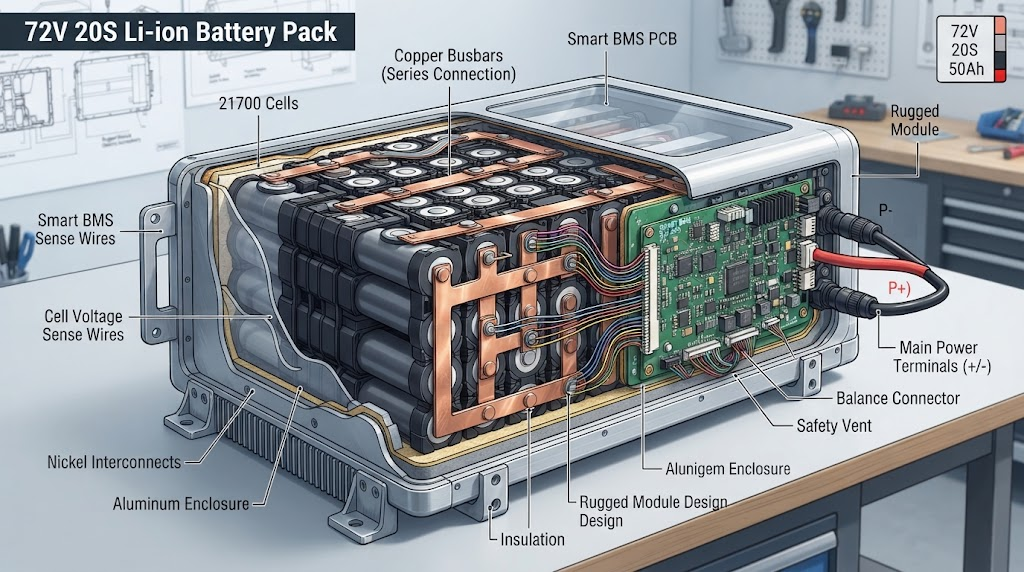
The 5-Tier High-Voltage LEV Battery Engineering Framework
Designing high-voltage packs for dynamic LEVs requires moving beyond basic series-parallel math. In our manufacturing facilities at Changhong JHY, every high-voltage architecture is evaluated against The 5-Tier High-Voltage LEV Battery Engineering Framework.
| Engineering Dimension | Standard DIY / Hobbyist Baseline | Tier-1 Industrial Standard (Changhong JHY) |
|---|---|---|
| 1. Electrochemical Matching | Basic OCV multimeter check; mixed cell batches | Automated 4-parameter binning (Capacity ≤0.5%, OCV ≤2mV, AC-IR ≤0.5mΩ, DC-IR) |
| 2. Interconnect Ampacity | 0.15mm pure nickel strip; spot welded with uneven pressure | Laser-welded C1100 copper busbars or Cu-Ni sandwich composite (<0.2mΩ resistance) |
| 3. BMS Architecture | Generic hardware BMS, single NTC, passive bleeding (<50mA) | Microcontroller Smart BMS, CANBUS/RS485, multi-NTC arrays, active balancing (≥1A) |
| 4. Structural Isolation | Hot glue, shrink wrap, single-layer electrical tape | FR4 epoxy inter-group walls, barley paper, polycarbonate cell matrices, IP67 potting |
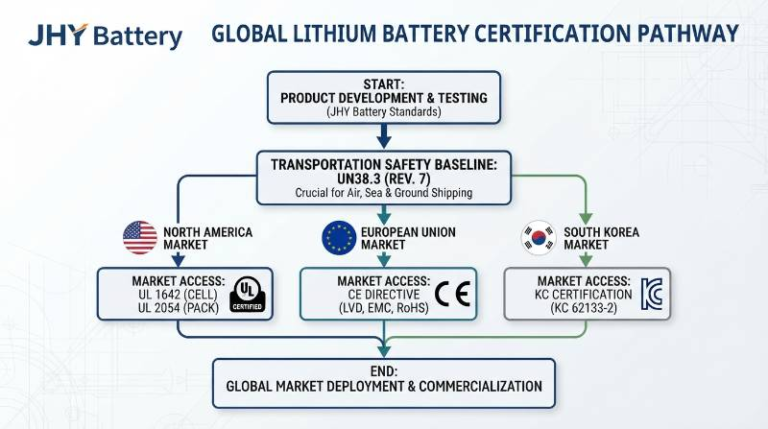
| 5. Safety & Traceability | Uncertified, no destructive shock/vibration testing | UL 2271, UN38.3, IEC 62133-2 certified with complete MES barcode traceability |
Electrochemical Architecture: 20S Li-ion (NMC) vs. 24S LiFePO4
Selecting the electrochemical foundation dictates your pack’s physical volume, weight, thermal profile, and voltage curve. For a nominal 72V system, two primary chemistries dominate the LEV sector: Lithium Nickel Manganese Cobalt Oxide (NMC/Li-ion) and Lithium Iron Phosphate (LiFePO4).
Nominal System Voltage Formula:
Vnominal = S × Vcell_nominal
Where S is the number of series cells and Vcell_nominal is the cell’s standard operating potential (3.6V for NMC, 3.2V for LiFePO4).
| Parameter | 20S NMC / Li-ion (e.g., 21700-50S) | 24S LiFePO4 (e.g., Prismatic/Cylindrical LFP) |
|---|---|---|
| Series Count (S) | 20 Series | 24 Series |
| Nominal Voltage | 72.0 V (3.60 V/cell) | 76.8 V (3.20 V/cell) |
| Peak Voltage (Cut-off) | 84.0 V (4.20 V/cell) | 87.6 V (3.65 V/cell) |
| Discharge Cut-off | 60.0 V (3.00 V/cell) | 60.0 V (2.50 V/cell) |
| Gravimetric Density | 220 – 260 Wh/kg | 130 – 165 Wh/kg |
| Cycle Life (80% DoD) | 800 – 1,200 cycles | 3,500 – 6,000 cycles |
| Thermal Runaway Temp | ~210°C | ~270°C |
For compact, high-speed motorcycle conversions where space inside the chassis triangle is limited, 20S NMC is typically selected for its gravimetric efficiency. However, for commercial delivery fleets and utility platforms requiring daily fast-charging and heavy cycling, LiFePO4 battery packs provide extended operational lifespans and chemical stability.
Selecting Cylindrical Cells: 18650 vs. 21700 & Grade-A Binning
High-voltage packs place extreme stress on individual cells when discharging at multi-kilowatt rates. 21700 form-factor cells have largely replaced 18650s in modern 72V builds due to their superior volumetric efficiency, lower internal resistance (IR), and higher continuous current handling.
- Molicel INR-21700-P45B (4500mAh, 45A CDR): The industry benchmark for high-drain 10 kW+ systems. Ultra-low AC IR (~9mΩ) prevents thermal build-up under 30A+ per cell discharge rates.
- Samsung INR21700-50S (5000mAh, 25A CDR): Excellent balance for 5 kW–8 kW builds requiring maximum volumetric energy density.
- Samsung INR18650-30Q (3000mAh, 15A CDR): Suitable strictly for legacy tight-clearance frames where 21mm cell holders cannot physically clear frame spars.
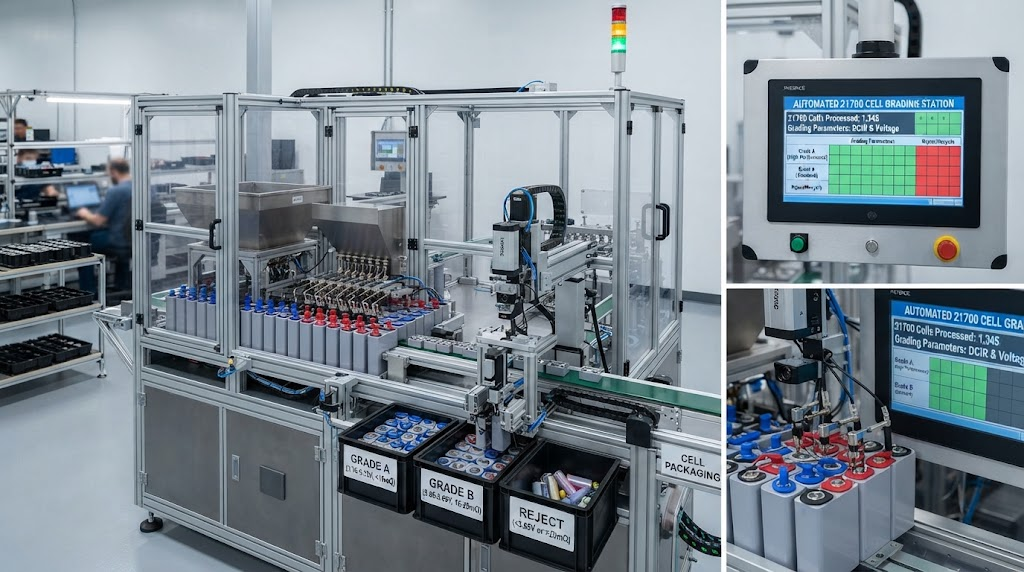
Empirical Cell Impedance (IR) Matching Data
In a 20S pack, the entire string’s discharge cut-off is dictated by the weakest parallel group. If group #7 has an average internal resistance 2mΩ higher than group #8, it experiences higher I²R voltage drop under a 100A load (Vdrop = I × R = 100A × 0.002Ω = 0.2V delta). This triggers early low-voltage BMS cut-off, stranding usable capacity.
Grade-A 4-Parameter Binning Protocol:
- 1. Open-Circuit Voltage (OCV): Measured to ±1mV precision after a mandatory 14-day resting quarantine. Maximum delta across 20S: ≤ 2mV.
- 2. AC Internal Impedance (1 kHz ESR): Measured via dedicated AC milli-ohmmeter. Maximum cell variance: ≤ 0.5mΩ.
- 3. Dynamic DC Internal Resistance (DC-IR): Measured via dual-pulse current step testing (1C to 3C).
- 4. 0.5C Actual Discharge Capacity: Matched within ≤ 0.5% tolerance across all parallel groups.
Current-Carrying Busbars & Thermal Math for 5 kW–15 kW Systems
A common error in high-power DIY builds is utilizing standard 0.15mm × 8mm pure nickel strip for main current collection on a 10 kW (135A peak) build. Pure nickel has a high electrical resistivity (ρ ≈ 9.6 × 10⁻⁸ Ω·m), roughly 5.5 times higher than pure copper (ρ ≈ 1.7 × 10⁻⁸ Ω·m).
Joule Heating (I²R Loss) Formula:
Ploss = I2 × R
Where I is continuous current in Amperes, and R is total busbar interconnect resistance in Ohms.
At 100A continuous current through a nickel interconnect segment with 5mΩ resistance, the dissipated heat power is: P = 1002 × 0.005 = 50 Watts of pure heat concentrated directly on cell positive terminals. This thermal load rapidly degrades the cell PTC, melts insulation rings, and risks thermal runaway.
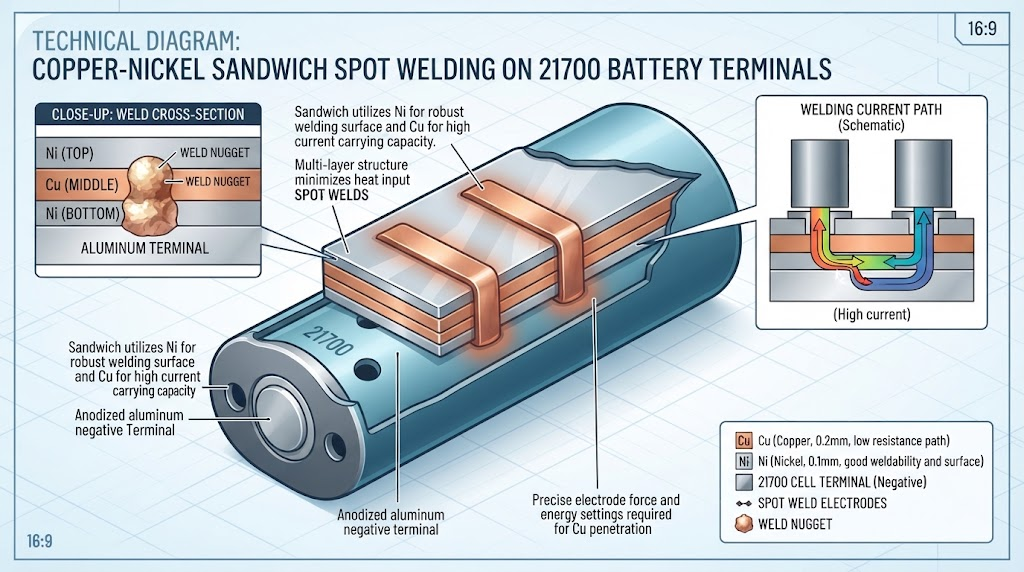
The Copper-Nickel Sandwich Welding Technique
Because pure copper cannot be easily joined using capacitive-discharge hobby spot welders (copper conducts weld energy away instantly), engineers utilize the Copper-Nickel Sandwich Method:
- Bottom Layer: 0.1mm to 0.2mm C1100 pure copper sheet laid directly across the cell terminals for high-conductivity current carrying.
- Top Layer: 0.15mm pure nickel strip with laser-cut expansion slots placed over the copper.
- Welding Mechanism: The high resistance of the top nickel layer forces weld current downward through the copper into the nickel-plated steel cell terminal, generating a localized bond without thermal penetration into the cell can.
- Alternative: Professional manufacturing lines utilize high-frequency fiber laser welders or ultrasonic wire bonders to join 1.5mm thick pure copper busbars directly.
Smart BMS Integration, Wiring Architecture & Telemetry
A 72V system requires an industrial-grade Battery Management System. Generic hardware boards with fixed analog balance circuits lack the telemetry and safety controls required for high-draw LEV powertrains. Professional LEV builds integrate custom smart BMS design featuring microcontrollers, active balancing, and bus communication.
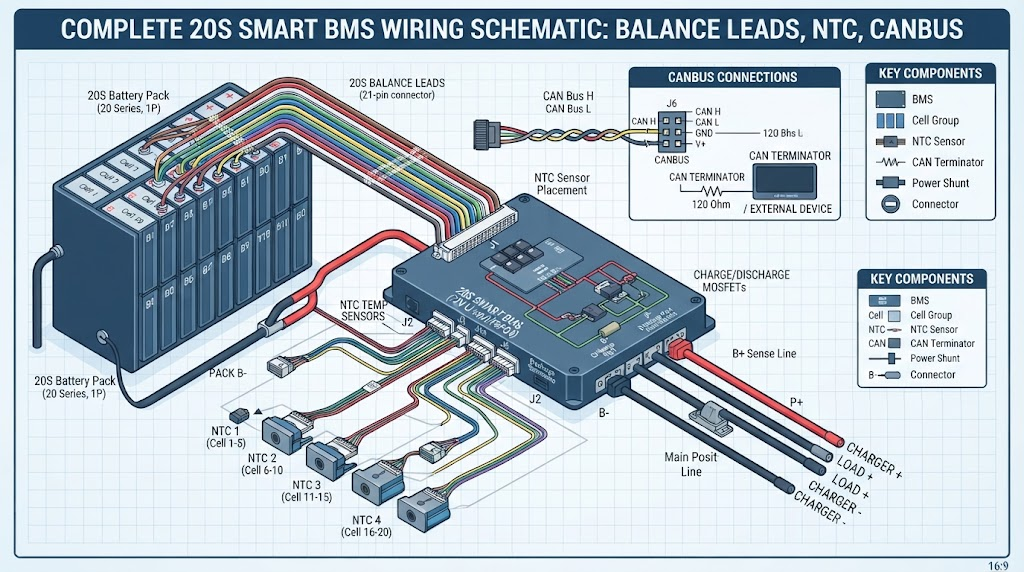
Wiring Architecture & Balance Lead Sequence
Balance leads must be wired strictly in sequential order to prevent destroying the BMS differential measurement input stages:
- Step 1: Connect Main B- minus heavy-gauge lead directly to the pack’s overall negative terminal.
- Step 2: Wire the multi-pin balance harness starting from B0 (Pack Negative), followed sequentially by B1 (Group 1 positive), B2 (Group 2 positive), up to B20 (Pack Main Positive).
- Step 3: Mandatory Verification: Before plugging the balance connector into the BMS, test each adjacent pin with a digital multimeter. The voltage MUST increase steadily by ~3.6V (or 3.2V LFP) at each step. If any pin shows 0V, reversed polarity, or a 7.2V jump, halt immediately and rectify.
- Step 4: Plug the tested balance connector into the BMS only after B- main power is established.
NTC Thermistor Sensor Strategic Placement
Standard packs place a single thermal probe on the BMS heat sink. In professional 72V architectures, a minimum of 4 NTC probes are distributed throughout the pack:
- Probes 1 & 2: Buried in the geometric center of the cell matrix (the thermal core where heat dissipation is lowest).
- Probe 3: Affixed directly onto the high-current series bridge interconnect (monitoring busbar I²R rise).
- Probe 4: Bonded directly to the BMS power MOSFET bank.
High-voltage LEV platforms should link BMS telemetry to the motor controller via CANBUS 2.0B or RS485. This allows dynamic real-time current throttling: if central pack temperature exceeds 55°C, the controller automatically reduces phase current rather than triggering a hard BMS cut-off mid-ride.
Mechanical Design, Insulation Barriers & Assembly Step-by-Step
Mechanical failure from road vibration is the leading cause of internal short circuits in high-voltage batteries. Follow this step-by-step assembly protocol to ensure structural integrity and safety.
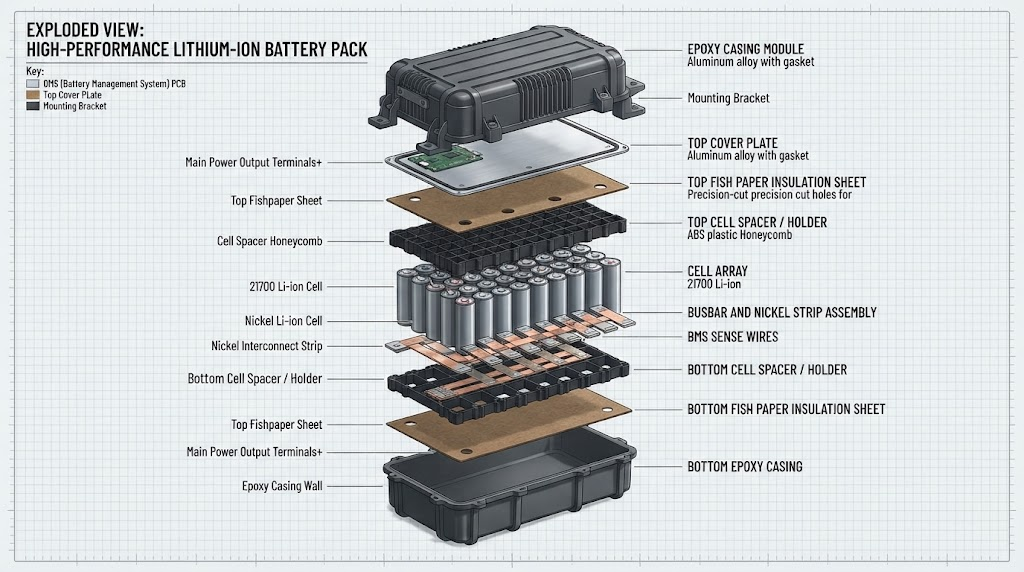
Step 1: Cell Collar Dielectric Insulation
The positive shoulder of an 18650/21700 cell is vulnerable: the steel casing (connected to the negative terminal) is separated from the positive cap by only a fraction of a millimeter beneath the thin PVC wrap. Apply adhesive high-dielectric barley paper (fishpaper) rings to every positive cell collar before pack assembly.
Step 2: Structural Cell Matrix Bracketing
Never glue cells directly together in a solid brick without spacing. Use flame-retardant (UL94-V0 rated) interlocking polycarbonate cell spacers. This maintains a uniform 1.0mm–1.5mm air gap between cell cans for thermal isolation and prevents abrasive wear through cell wrappers caused by road vibration.
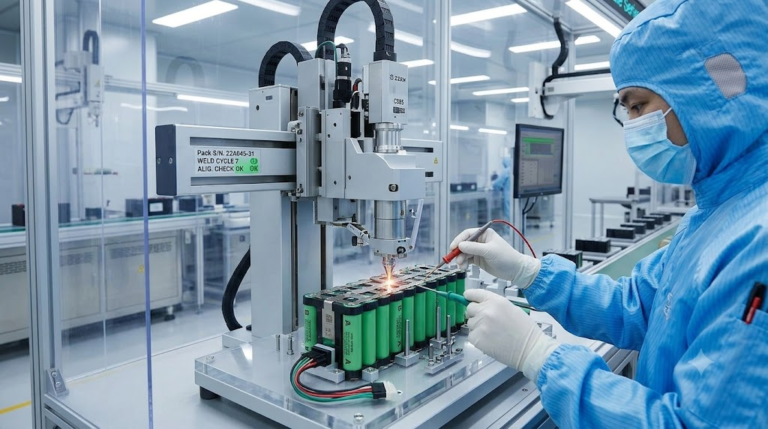
Step 3: Spot Welding Interconnects
Utilize a precision, dual-pulse capacitive-discharge or inverter DC resistance spot welder. Set pulse timing to ensure solid metal nugget penetration without blowing through the 0.3mm negative cell cap. Perform destructive peel tests on scrap nickel before welding active cells.
Step 4: Inter-Group Phase Insulation
Between adjacent series groups with large potential differences (for instance, Group 1 at 3.6V situated physically adjacent to Group 20 at 72V in a folded pack layout), install 1.0mm flame-retardant FR4 epoxy glass-cloth sheets. Wrap all balance harnesses in high-temperature Kapton tape.
Step 5: High-Current Discharge Termination
Terminate the main B+ and P- connections using ultra-flexible, high-strand silicone wire (8 AWG for up to 100A continuous, 6 AWG for up to 150A continuous). Terminate with an authentic Amass XT90-S (Anti-Spark) or Amphenol Radsok connector to eliminate high-voltage inrush arcing when connecting to motor controller input capacitors.
Quality Assurance, Load Bank Testing & Thermal Imaging Validation
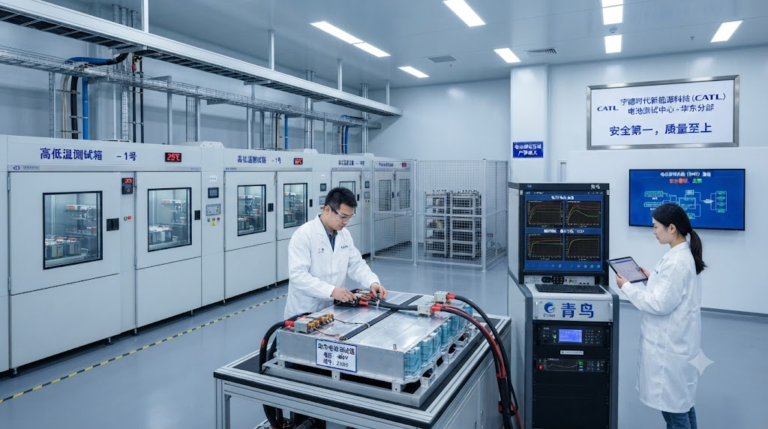
Assembly is complete only when the pack passes a structured qualification protocol. In industrial manufacturing, every pack undergoes extensive end-of-line (EOL) testing before deployment.
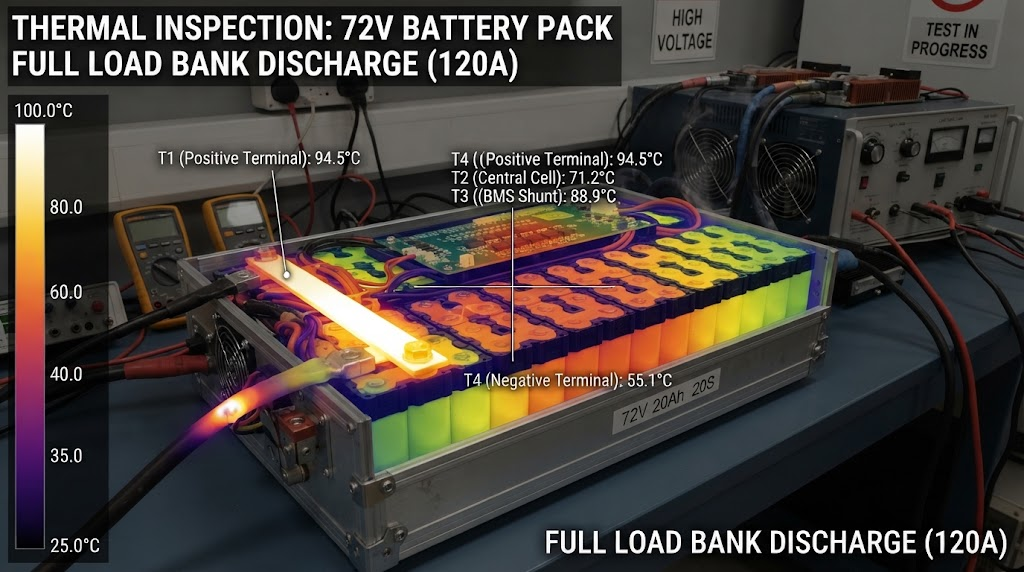
- 1. High-Potential (Hi-Pot) Insulation Test: Apply 500V DC between the active electrical circuit and the outer enclosure/heatsink. Resistance must exceed 100 MΩ with zero breakdown.
- 2. 1.0C Full Continuous Load Bank Discharge: Connect the 72V pack to a programmable DC electronic load bank. Discharge at the design continuous rate (e.g., 50A–100A) down to the BMS low-voltage cut-off.
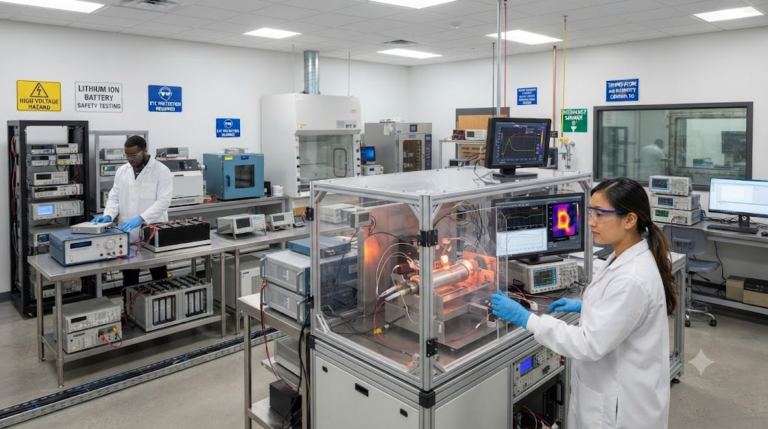
- 3. Real-Time Radiometric Thermal Inspection: Continuously monitor the pack with a calibrated FLIR thermal imager during discharge. Interconnect temperature delta (ΔT) across all 20 series groups must not exceed 8°C. Any localized hot spot (>60°C) indicates a defective weld nugget or unmatched cell impedance.
- 4. Short-Circuit Protection Verification: Test BMS short-circuit trip timing using a calibrated pulse load to ensure sub-200 microsecond isolation.
DIY Limitations vs. Certified OEM Turnkey Manufacturing
While custom one-off battery builds provide a valuable learning experience for individual prototypes, scaling high-voltage packs for commercial LEV products, fleet operations, or production vehicles introduces legal, liability, and regulatory hurdles.
Global transport regulations mandated by the United Nations (UN 38.3) make shipping uncertified custom lithium packs over 300 Wh illegal via commercial air or sea freight without specialized hazardous material certifications. Furthermore, municipal fire codes and insurance mandates increasingly require light electric vehicle powertrains to hold formal UL 2271 (Standard for Batteries for Use in Light Electric Vehicle Applications) and IEC 62133-2 battery certifications.
| Evaluation Vector | In-House DIY Prototyping | Changhong JHY OEM/ODM Production |
|---|---|---|
| Defect Rate & Binning | ~1-3% random cell variance | Guaranteed 0.03% (300 PPM) defect rate; 100% automated sorting |
| Interconnect Reliability | Manual resistance spot welds | Automated CNC fiber laser-welded C1100 copper busbars |
| Compliance Standards | None / Non-compliant for resale | ISO 9001, ISO 13485, UL 2271, UL 2054, CE, UN38.3, IEC 62133 |
| Enclosure & Ingress | PVC heat shrink / 3D-printed PLA | Extruded aluminum / injection-molded IP67/IP68 waterproof cases |
| Traceability | None | Full MES barcode traceability from cell lot to finished pack |
For engineering teams and LEV brands seeking to transition from prototype CAD drawings to high-volume production, partnering with an established Tier-1 industrial manufacturer eliminates capital tooling expenditure while guaranteeing regulatory compliance. Explore our OEM/ODM battery manufacturing services to scale your powertrain designs safely.
Frequently Asked Questions (FAQ)
Why choose 20S NMC over 24S LiFePO4 for a 72V e-bike pack?
A 20S NMC pack operates at 72.0V nominal (84.0V peak, 60.0V cutoff) with a high volumetric energy density of 220–260 Wh/kg, making it ideal for compact, high-speed, lightweight e-bikes. Conversely, a 24S LiFePO4 pack operates at 76.8V nominal (87.6V peak, 60.0V cutoff) with lower energy density (130–160 Wh/kg) but delivers 3,000–5,000 cycles and superior thermal safety, making it optimal for commercial fleets and utility LEVs.
Can standard pure nickel strip handle 100A continuous discharge in a 72V pack?
No. A single 0.15mm × 8mm pure nickel strip has a safe ampacity of only 5A–7A. Carrying 100A through standard nickel causes severe I²R heating exceeding 90°C, degrading cell wrappers and triggering BMS thermal cutoffs. High-drain packs require copper-nickel sandwich welding (0.1mm–0.2mm C1100 copper with slotted nickel cap) or 1.5mm+ laser-welded copper busbars to keep interconnect resistance below 0.2mΩ.
How do engineers verify genuine Grade-A cell matching prior to 72V pack assembly?
Cells must undergo automated grading across four strict gates: 1) Capacity tolerance ≤ 0.5% at 0.5C discharge, 2) Open-Circuit Voltage (OCV) delta ≤ 2mV after 14 days aging, 3) 1 kHz AC internal resistance ESR delta ≤ 0.5mΩ, and 4) Optical visual inspection for flawless cathode/anode seal integrity. Packaged cells must include manufacturer QR code batch traceability.
What charging voltage is required for a 72V lithium battery?
For a 20S NMC/Li-ion battery, use a dedicated Constant Current / Constant Voltage (CC/CV) lithium charger with an 84.0V DC cut-off profile. For a 24S LiFePO4 battery, the charger must be configured for an 87.6V DC cut-off. Never charge a high-voltage lithium pack with an uncalibrated power supply lacking CC/CV stage transitioning.
What gauge wire is required for a 72V 100A continuous battery system?
Use high-temperature (200°C rated) multi-strand flexible silicone wire. A continuous 100A current requires a minimum of 8 AWG wire for short runs (<50cm) or 6 AWG for longer chassis routing to keep resistive voltage drop under 1% and prevent wire jacket heating.
3-Step Engineering Path: Accelerate Your 72V Custom Pack to Production
Request Industrial 72V Battery Consultation & Rapid Prototyping
Backed by the industrial heritage of Sichuan Changhong Group and over 30 years of advanced battery pack manufacturing, China Battery Manufacturer (JHY Battery) provides turnkey OEM/ODM solutions for LEV powertrains, utility platforms, and commercial electric vehicles.
Our Streamlined 3-Step Turnkey Engineering Path:
- Step 1: Define Pack Specifications — Submit your nominal voltage, continuous/peak current profile, physical CAD envelope, and BMS communication requirements (CANBUS/RS485/UART).
- Step 2: Engineering DFM & Thermal Simulation — Our team of 800+ R&D engineers conducts complete Design-for-Manufacturability (DFM) reviews, cell thermal modelling, and busbar FEA analysis within 24–48 hours.
- Step 3: Rapid Prototyping & Certified Scale — Receive fully functional, automated laser-welded 72V prototypes within 5–7 business days, backed by our guaranteed 0.03% (300 PPM) defect rate and international certification support (UL 2271, UN38.3, IEC 62133).
Direct Engineering Inquiries: Simple@chinabatterymanufacturer.com | joeshen@chinabatterymanufacturer.com
WhatsApp / Direct Phone: +86-18575997879 | Sichuan Changhong Group / JUHEYUAN SCIENCE & TECHNOLOGY CO., LTD.