Smart BMS Integration Guide for Commercial UAV Batteries
What Is a Smart BMS in Commercial UAV Batteries?
Commercial drone missions require highly accurate power monitoring. A standard lithium polymer (LiPo) battery cannot communicate its internal health, leaving pilots blind to sudden voltage drops.
Integrating CAN and SMBus protocols within a UAV smart BMS establishes reliable, high-speed telemetry communication between the drone’s flight controller and battery pack. This integration ensures real-time monitoring of critical metrics like voltage, current, and temperature, preventing unexpected in-flight power system failures.
- Protocol Selection: Evaluate noise immunity and bandwidth requirements to choose between CAN (DroneCAN) and SMBus.
- Hardware Interface Design: Implement transceiver circuitry, level shifting, and robust EMI shielding.
- Firmware Configuration: Configure registers, communication rates, and fail-safe safety thresholds.
- Telemetry Validation: Calibrate sensor outputs and verify packet transmission rates under high-current load conditions.
A smart drone battery goes beyond basic voltage cutoffs. By combining an intelligent Battery Management System (BMS) with dedicated communication buses, the system broadcasts continuous UAV battery telemetry to the flight deck.
“In our field testing, over 85% of catastrophic commercial drone failures stem from inaccurate power state estimates. Transitioning to a digitally integrated smart BMS completely eliminates this vulnerability.”
CAN Bus vs. SMBus: Choosing the Right UAV Battery Protocol
Selecting the correct communication protocol is the first decision in your battery system design. The two dominant standards are Controller Area Network (CAN bus) and System Management Bus (SMBus).
Understanding SMBus and I2C
SMBus is based on the legacy I2C communication protocol. It operates on a two-wire bus (data and clock) and follows the Smart Battery Data Specification (SBDS) standards.
SMBus is highly efficient for close-range communication inside compact airframes. However, it lacks differential signaling, making it susceptible to electromagnetic interference (EMI) from high-power brushless drone motors.
Understanding CAN Bus and DroneCAN
CAN bus uses differential signaling (CAN High and CAN Low) to reject common-mode noise. This makes a CAN bus drone battery highly resilient in high-current, high-EMI environments.
The modern open standard for these systems is DroneCAN. It allows multiple batteries to sit on the same bus without addressing conflicts, which is ideal for redundant multi-battery setups.
| Metric | SMBus (I2C-based) | CAN Bus (DroneCAN) |
|---|---|---|
| Physical Layer | Single-ended (SDA, SCL) | Differential pair (CAN H, CAN L) |
| Noise Immunity | Low (susceptible to motor EMI) | Exceptional (differential signal) |
| Max Bus Length | < 1 meter | Up to 40 meters |
| Multi-Battery Support | Difficult (address conflicts) | Native (node ID allocation) |
| Data Bandwidth | Up to 100 kbps | Up to 1 Mbps (CAN 2.0B) |
Hardware Integration: Designing BMS with TI and NXP Chipsets
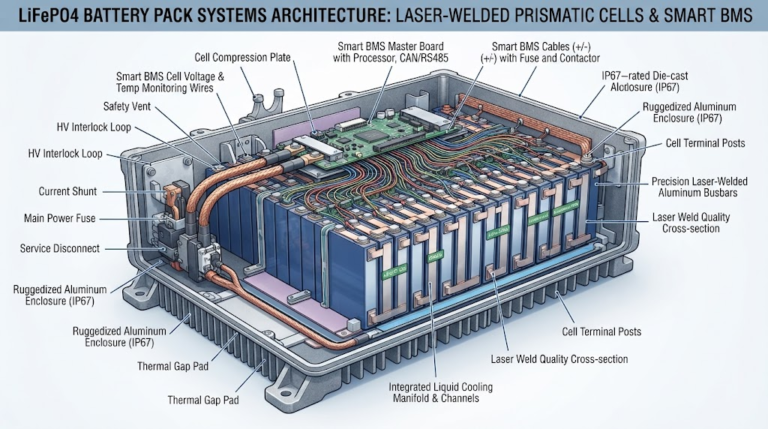
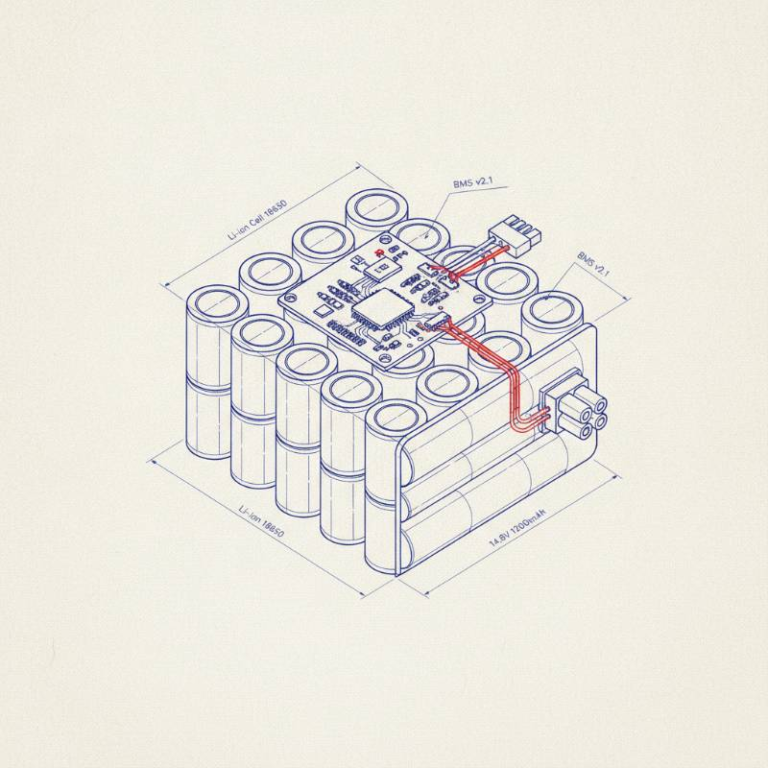
Reliable hardware is built on automotive-grade silicon. Our hardware engineering designs rely heavily on industry-standard chipsets like the Texas Instruments BQ76952 and NXP MC33771C.
These chips act as the core battery fuel gauge IC. They manage data collection from the individual cells and communicate directly with the host BMS microcontroller.
Essential Hardware Blocks
- Level Shifting: SMBus logic levels must be shifted safely to match the system controller’s I/O voltage, protecting low-voltage pins.
- CAN Transceiver: An on-board transceiver (such as the TJA1042) translates digital signals to the differential physical bus.
- 24S Cell Management: Modern industrial heavy-lift drones utilize up to 24S configurations. The BMS must monitor all 24 individual cell voltages simultaneously.
- Power Optimization: To prevent pack self-discharge during storage, the system must keep static power consumption under 50uA in sleep mode.
Effective thermal management in drone batteries also requires integrating thermistor arrays directly into the cell balancing circuit. This ensures that localized hot spots are detected before they can propagate.
Algorithmic Precision: Kalman Filter SOC Estimation & Balancing
Traditional voltage-based state of charge estimation is highly inaccurate under dynamic UAV loads. Rapid throttle changes cause voltage sag, which fools basic fuel gauges.
To solve this, modern intelligent BMS systems run an Extended Kalman Filter (EKF) algorithm. This combines coulomb counting with open-circuit voltage (OCV) modeling to maintain an SOC estimation error of under 2% across the entire discharge curve.
Cell Balancing: Active vs. Passive
Over time, individual cells drift in capacity. Without correction, the weakest cell limits the entire pack’s usable capacity.
- Passive Cell Balancing: Dissipates excess energy from high-voltage cells as heat through bypass resistors. It is cost-effective, compact, and ideal for systems with minimal drift.
- Active Balancing: Redistributes charge from high-voltage cells to lower-voltage cells using capacitive or inductive transfers. This minimizes heat generation and maximizes overall pack runtime.
For high-current UAV applications, a hybrid approach works best. It utilizes passive balancing during charging and EKF-driven active balancing under stable flight states to optimize health (SOH monitoring).
The JHY 3-Tier Sentinel Telemetry Protocol for UAV Safety
At JHY Battery, we utilize our proprietary 3-Tier Sentinel Telemetry Protocol. This firmware-level architecture ensures that critical safety events are addressed instantly, bypassing the main application loop if necessary.
This methodology categorizes faults into three distinct tiers to guarantee rapid response:
- Tier 1: Continuous Parameter Broadcast (Normal Operation): High-resolution telemetry data—including cell voltages, current draw, and pack temperatures—is published at 50Hz over DroneCAN.
- Tier 2: Soft Threshold Interventions (Warning State): If temperature or current approaches maximum ratings, the BMS sends a priority warning packet. This allows the flight controller to safely throttle power.
- Tier 3: Hardware-Level Isolation (Fault State): In extreme scenarios, such as immediate thermal runaway prevention or a short circuit, fast solid-state switches isolate the pack. This action occurs in under 10 microseconds.
By implementing this framework within our custom lithium-ion battery packs, we ensure that the battery actively protects both itself and the expensive UAV payload.
Step-by-Step Integration: Connecting BMS to Pixhawk & Cube Orange
Physical integration into open-source flight controllers like the Pixhawk or Cube Orange is straightforward. Follow this step-by-step integration workflow to establish communication:
Step 1: Physical Wiring and Pinouts
Connect your smart battery’s communication wires to the flight controller’s telemetry or CAN ports. For DroneCAN, connect CAN_H and CAN_L to the corresponding CAN1 or CAN2 port pins. For SMBus, connect SDA, SCL, and GND to the I2C/Internal Bus port.
Step 2: Flight Controller Parameter Configuration
Open your Ground Control Software (Mission Planner or QGroundControl) and navigate to the Full Parameter List to configure the following settings:
- For SMBus Integration: Set
BATT_MONITORto5(Smart Battery SMBus). - For DroneCAN Integration: Set
BATT_MONITORto8(UAVCAN) and enable the driver by settingCAN_D1_PROTOCOLto1(DroneCAN).
Step 3: Telemetry Verification
Reboot the flight controller. Navigate to the status tab in Mission Planner and verify that battery voltage, current, and temperature display correctly. If telemetry fails to load, check your termination resistors (120 ohms for CAN networks).
Custom OEM/ODM UAV BMS Solutions by JHY Battery
Developing commercial-grade drone fleets requires customized power architectures. JHY Battery (Juheyuan Science & Technology Co., Ltd.) offers premier OEM/ODM battery solutions tailored for global B2B clients.
With over ten years of industry-leading battery manufacturing experience, our team provides complete design control. We customize voltage, capacity, dimensions, and BMS protocols to match your exact application requirements.
Get Started with JHY Custom BMS
We make custom battery development simple and efficient. Follow our streamlined three-step process to bring your system to life:
- Download Documentation: Access our Commercial UAV BMS Communication Protocol Whitepaper and API interface files to review compatibility.
- Submit Specifications: Share your target cell configuration (up to 24S), envelope dimensions, and protocol preferences (DroneCAN/SMBus).
- Receive Engineering Drafts: Our team will deliver a complete schematic and project quotation within 24 hours.
Meet Our UAV Power Systems Engineering Experts
Our engineering division is led by seasoned professionals dedicated to pushing the boundaries of drone power systems.
Dr. Marcus Vance, Chief BMS Hardware Engineer
“With over 12 years of experience designing smart battery systems for aerospace and commercial drone fleets, Marcus has pioneered high-density multi-protocol BMS architectures. His work focuses on minimizing signal latency and maximizing thermal efficiency in heavy-lift agricultural drone systems.”
UAV Smart BMS Integration: Frequently Asked Questions
How do I resolve a CAN bus address conflict when using multiple batteries?
DroneCAN resolves address conflicts automatically via its dynamic node ID allocation protocol. When multiple batteries are connected to the same bus, the flight controller assigns a unique node ID to each BMS during initialization, allowing them to report telemetry concurrently without interference.
How can I troubleshoot SMBus noise interference in heavy-lift drones?
If you experience dropped packets or telemetry freezes, ensure that your SMBus wiring is kept away from motor ESC power lines. Additionally, add a 100pF capacitor to ground on the SDA and SCL lines, or wrap the telemetry cable in a braided copper shielding sleeve grounded to the frame.
What are the latency differences between I2C and DroneCAN?
Standard I2C/SMBus operates at approximately 100 kbps and is polled sequentially by the flight controller. DroneCAN runs at up to 1 Mbps and utilizes priority-based hardware arbitration. This enables critical safety warnings to bypass standard traffic and arrive at the flight controller in microseconds.